

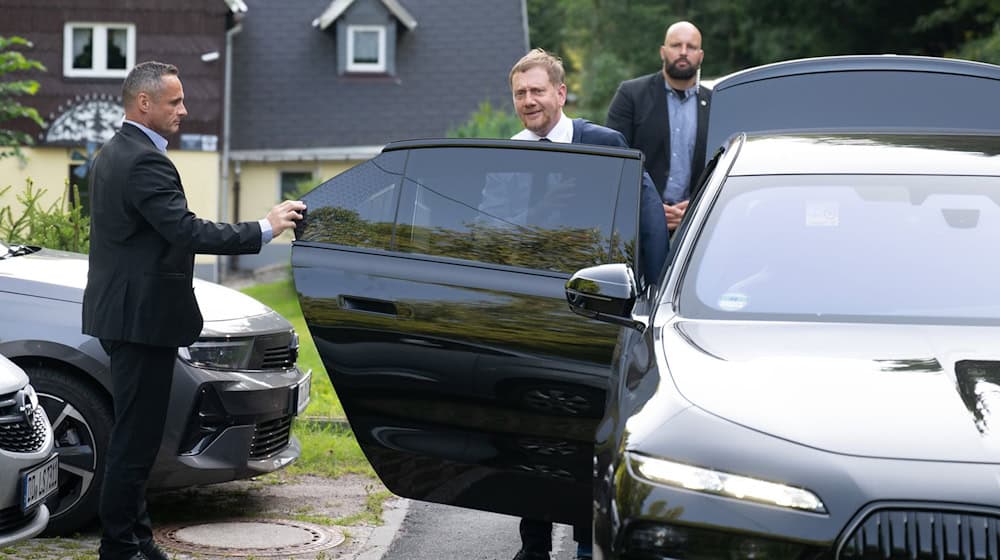
Die Deutsche Umwelthilfe (DUH) has given the Saxon state government a red card for using too many climate-damaging company cars. The cabinet has real average CO2 emissions of 165 grams per kilometer, according to the report published by Deutsche Umwelthilfe (DUH). The Free State of Bavaria came in ninth place in the state ranking. The Berlin Senate has the best record with 102 grams of CO2 per kilometer, while Mecklenburg-Western Pomerania brings up the rear with 190 grams. According to the data, Justice Minister Constanze Geiert (CDU) has the lowest real emissions with 62 grams of CO2 per kilometer and Environment Minister Georg-Ludwig von Breitenbuch (CDU) with 65. They drive electric cars. Six ministers and Head of Government Michael Kretschmer (CDU) rely on diesel. Interior Minister Armin Schuster (CDU), Social Affairs Minister Petra Köpping and Economics Minister Dirk Panter (both SPD) use hybrid vehicles. The cars of Finance Minister Christian Piwarz and State Chancellor Andreas Handschuh (both CDU) have the highest emissions per kilometer with 198 grams of CO2 each. In a comparison of the heads of the federal states, Kretschmer's diesel came in fifth place with emissions of 167 grams of CO2, behind Thuringia's Minister President Mario Voigt (CDU), Bremen's Mayor Andreas Bovenschulte, Hamburg's Mayor Peter Tschentscher (both SPD) and Baden-Württemberg's Minister President Winfried Kretschmann (Greens). According to Umwelthilfe, the latter's electric car emits just 70 grams of CO2. According to the report, Bavaria's Minister President Markus Söder (CSU) is the most polluting on business trips - his petrol car emits a whopping 292 grams. The figures from Umwelthilfe are only comparable with other statistics to a limited extent. For example, the DUH assumes for its ranking that plug-in hybrids are only used in combustion mode. According to studies, this is often the case - but it remains to be seen whether top politicians and their fleet management actually do this. In addition, only one vehicle is listed for each top politician in Germany, but many have several cars at their disposal. Copyright 2025, dpa (www.dpa.de). All rights reservedBig differences in the cabinet - from electric to diesel
Prime Ministers compared: who drives the cleanest?
Different statistics


