

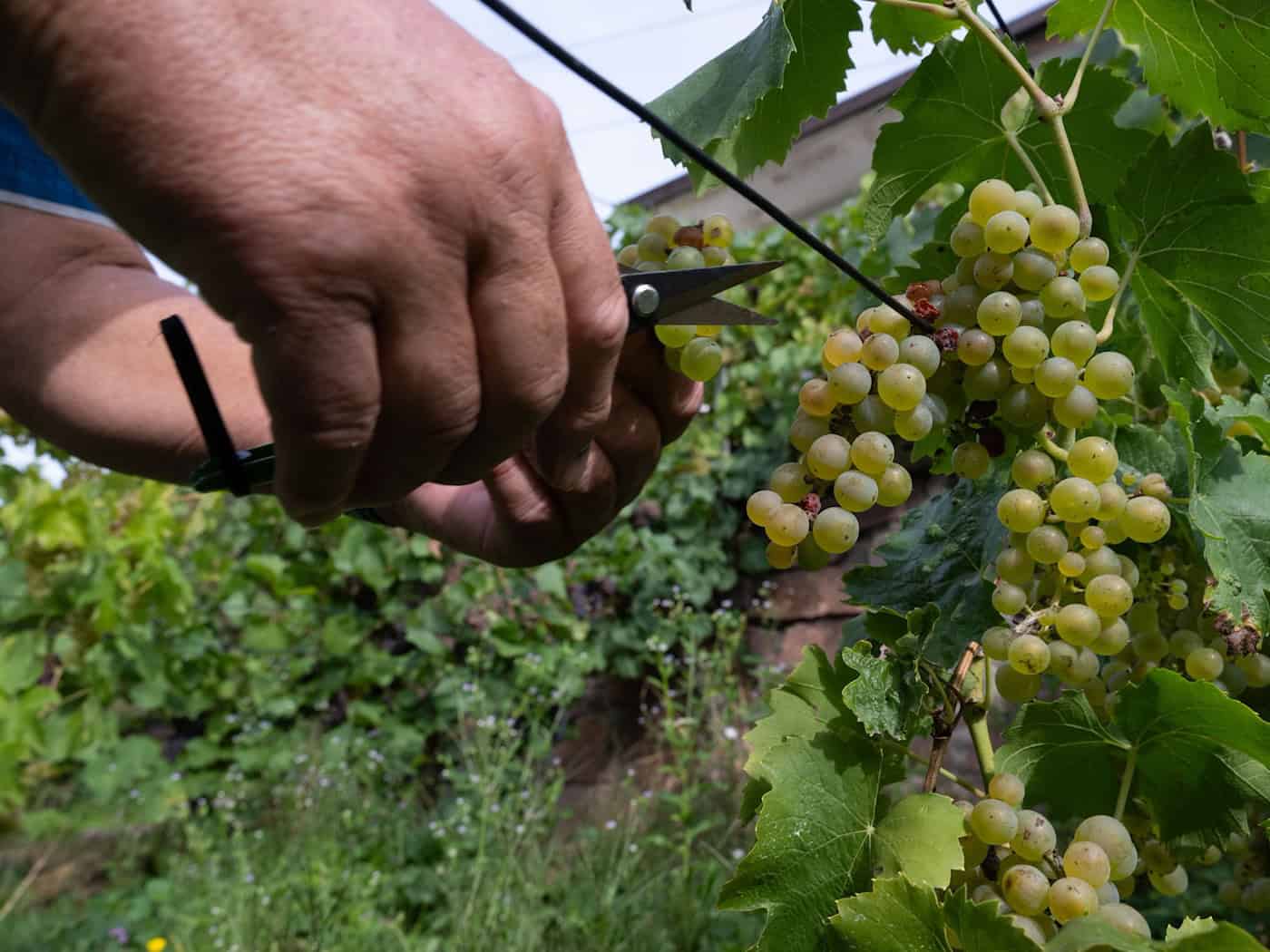
The grape harvest in Saxony is slowly coming to an end. At the Schloss Wackerbarth State Winery in Radebeul, the main harvest is expected to be completed by the end of the week—two weeks earlier than last year. “We’re currently still selectively harvesting the grapes by hand,” says spokesperson Martin Junge—for example, for the Pinot Noir and Blaufränkisch vines, as well as the last of the Riesling grapes. The Winegrowers’ Association classifies this year’s harvest as the earliest on record. “Most wineries had finished harvesting by the end of September,” said Chairman Felix Hößelbarth. Based on his observations, the growing season is shifting earlier and earlier. When he started working in viticulture in Saxony 18 years ago, the harvest had ended by the end of October: “In less than 20 years, it has shifted forward by four weeks.” White and red grapes have been harvested on the vineyards of Schloss Wackerbarth since August 20. The winery expressed satisfaction with both the quality and the yield. The yield is reportedly at a level similar to the long-term average. The wine-growing year was marked by a summer of prolonged drought and heat. Experience from previous dry years helped with vineyard management, according to Junge. For example, young vines were irrigated selectively, and the soil was tilled accordingly. The weather cooperated during the harvest, according to Junge of Schloss Wackerbarth. The winery is pleased with healthy grapes and good must weights, he said. “Thanks to warm days and cool nights, the acidity in our grapes was well preserved.” Winemaker Karl Friedrich Aust from the winery of the same name in Radebeul also speaks of a “fantastic fall.” About ten percent more grapes than last year were harvested from his vineyards. This is also due to the fact that some young vines yielded fruit for the first time. The quality is outstanding; now the focus is on carefully aging the wines in the cellar. The 2026 vintage is top-notch in terms of quality, confirmed Hößelbarth from the Winegrowers’ Association. “Healthy, ripe, aromatic grapes” were harvested by the winemakers from the vineyards. In terms of quantity, however, it is more of an average harvest by Saxon standards, said the association’s head. Accordingly, the winemakers will produce approximately 2.3 million to 2.5 million liters of wine. That is about 20 percent less than in the very good year of 2025, which yielded around 2.9 million liters. “Small quantity, but good quality,” Hößelbarth concluded. For the wine-growing region of Saxony, climate change could be beneficial for the production of first-class wines and for expanding the growing region, said winemaker Aust. On the one hand, new grape varieties can be cultivated; on the other hand, there are now red wines of a quality that would have been unthinkable in the past. About 30 percent of his wines are now reds. Many winemakers also serve as hosts, Aust emphasized. A visit to the numerous wine taverns and wineries is therefore especially worthwhile during “golden autumn.” Aust pointed to rising visitor numbers, including guests from Australia, Canada, and the United States. The wine industry in Saxony, as well as nationwide, is experiencing a reluctance among consumers to make purchases. “There is a general decline in wine consumption,” reported association head Hößelbarth. In addition, people are tending to choose less expensive options. Events, however, are an exception. “At all the wine festivals and events—people still don’t watch their money there; they just consume,” said Hößelbarth. For Saxon winemakers, this means that direct sales should be expanded as much as possible. This year, there might be ice wine again: At Schloss Wackerbarth, the grapes have not yet been harvested from an area of about 2,000 square meters planted with roughly 1,000 Traminer vines. “Now we’re hoping that the weather gods will be on our side in the coming weeks so that we can harvest these grapes as ice wine,” says Junge. Ice wine is considered a rarity among wine connoisseurs. Temperatures of at least minus seven degrees are required for its production. The frozen grapes are harvested and pressed immediately. The result is a high-quality, noble sweet wine. Of the 13 German wine regions, Saxony’s wine-growing region is one of the smallest. The wine region stretches along the Elbe River from Pirna through Dresden, Radebeul, and Meissen to Diesbar-Seußlitz, northwest of Meissen. In Saxony, wine is grown on about 500 hectares—mainly white wine. Just under 20 percent of the area is reserved for red wines. The main grape varieties are Müller-Thurgau, Riesling, Pinot Blanc, Pinot Gris, Traminer, Pinot Noir, and Dornfelder. Copyright 2026, dpa (www.dpa.de). All rights reservedWinegrowers’ Association: Grape Harvest Coming Earlier and Earlier
The weather cooperated during the harvest
Lower yields across Saxony compared to last year
Climate change as an opportunity?
Wine Consumption Is Declining
Will ice wine make a comeback?
Wine grown on approximately 500 hectares


