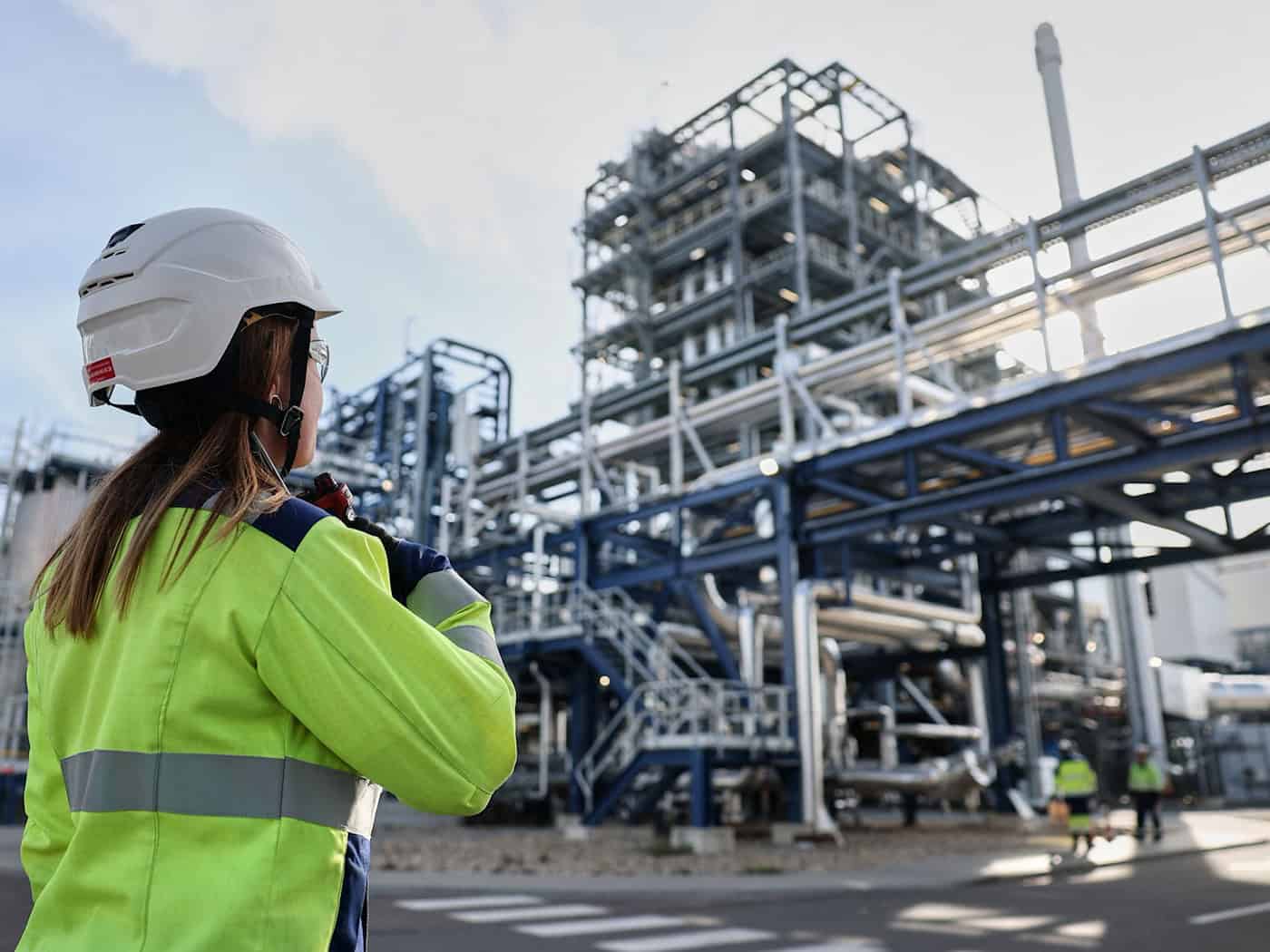
It all starts with a tree trunk. It’s brought to Leuna from a local forest, debarked, chopped up, and finally disappears into a large industrial plant. At first glance, what comes out the other end bears little resemblance to a piece of wood: chemical feedstocks that, until now, have been produced primarily from fossil raw materials. That is precisely the idea behind the new biorefinery of the Finnish company UPM at the Leuna Chemical Park. According to the company, it has invested 1.37 billion euros. With a planned annual capacity of 220,000 metric tons, UPM says it is the world’s largest facility of its kind. “This is a first-of-its-kind facility,” says UPM Vice President Harald Dialer. By this, he means a facility that does not yet exist anywhere else in this form. It is the world’s first facility “that produces chemicals from wood and biomass.” Behind the project lies a problem that cannot be solved by wind turbines and solar panels alone. Cars can run on renewable electricity, and homes can be heated with it. Many products in the chemical industry, however, require carbon as a component of their molecules. Today, this carbon still comes predominantly from fossil sources. UPM wants to obtain it from renewable biomass instead. Dialer sees this as a way to achieve several goals at once. “I believe we’re achieving three goals at once here.” In addition to replacing fossil raw materials and contributing to climate protection, the aim is to promote economic growth and reduce dependence on imports. Recent years have shown just how dependent Germany and Europe are on fossil raw materials from other parts of the world. However, the new raw material has to come from somewhere. According to UPM, the plant will require approximately 500,000 solid cubic meters of wood annually once it reaches its planned production volume. It is to come from within a radius of about 150 to 200 kilometers around Leuna. The wood used will primarily consist of beech trees from thinning operations as well as waste materials from sawmills. During thinning, individual trees are removed from a forest stand. “No clear-cutting takes place,” Dialer emphasizes. UPM therefore uses certified wood biomass, which, according to the company, would otherwise have been largely burned. After delivery, the logs are debarked and processed into wood chips about two centimeters in size. They are transported deeper into the plant via a conveyor belt approximately 500 meters long. There, they are soaked and further processed. According to Operations Manager Matthias Schleicher, the wood now has a consistency similar to that of coffee grounds. From there on, things get more complicated. Wood consists primarily of cellulose, hemicellulose, and lignin. These components are separated from one another in several steps. Cellulose and hemicellulose are converted into sugar solutions, which can then be further processed. Lignin, in turn, can be used for specialty chemicals and novel fillers. Among other things, the sugars are used to produce so-called glycols—chemical building blocks needed, for example, in plastics and textiles. The key point here is not that consumers will eventually end up with a completely new product in their hands. Rather, the raw material at the beginning of the production chain is to change: wood instead of petroleum. For manufacturers, this should ideally entail no disadvantages. The requirements are particularly high for car tires. They consist of numerous different materials and are critical to safety. As explained in a video presentation during the inauguration, renewable raw materials for tires are only viable if they achieve the same performance as fossil-based materials, are available in consistent quality, and can be used economically. Proving that it works technically in the lab is one thing; turning it into a continuously operating industrial plant is quite another. There was no blueprint or manual for commissioning a biorefinery of this type and size, says Dialer. Various mechanical, biotechnological, and chemical processes must interact in such a way that, in the end, large quantities of consistent quality are reliably produced. Schleicher, the operations manager of the new plant, compares the current stage of development to the petrochemical industry of the 1960s and 1970s. The processing of fossil raw materials has been optimized over decades. With the new technology, however, there is still much to learn. By-products of the production process could also be utilized even more effectively in the future. The official inauguration therefore does not mean that the plant is already operating at full capacity. Production of lignin-based specialty chemicals and sugars is running steadily, while other areas are currently being ramped up. UPM aims to reach full production capacity by 2027. Then comes the next test: enough customers must buy the new raw materials. An annual capacity of 220,000 metric tons sounds enormous, but it pales in comparison to the global demand of the chemical industry. “Of course, this has to scale up,” says Dialer. PET bottles alone account for millions of metric tons of material. Nevertheless, hundreds of thousands of metric tons represent a significant contribution. The plant can demonstrate that fossil-based feedstocks can be replaced on a larger scale. The German Chemical Industry Association (VCI) also sees the investment as a “ray of hope” during a difficult time for the industry. The industrial use of renewable raw materials opens up new economic prospects, explained Nora Schmidt-Kesseler, CEO of the German Chemical Industry Association (VCI). Whether this leads to further investments, however, depends on whether companies can produce competitively in the long term. UPM is well aware of this. CEO Massimo Reynaudo points out that the Finnish company has been trying for decades to develop ever-new products from wood—ranging from wood products and paper to biofuels. Now chemicals are being added to the mix. For the company, Leuna is not meant to be the end point, but rather the starting point for a new business segment. No one in Leuna expects fossil-based chemistry to disappear anytime soon. Schleicher sees the new technology as a complement for now. It is intended to demonstrate that some of the raw materials previously derived from petroleum can also be produced in other ways. Following the billion-euro investment and the inauguration, the crucial phase is only just beginning: The plant must operate reliably, its products must find buyers—and ultimately, they must also be profitable. Copyright 2026, dpa (www.dpa.de). All rights reservedWhy does the chemical industry need carbon at all?
Half a million solid cubic meters of wood per year
From Wood Chips to Chemical Feedstock
There was no manual for the plant
Technology alone is not enough