


Dresden: Stress Test Will Determine the Future of the Budapester Straße Bridge
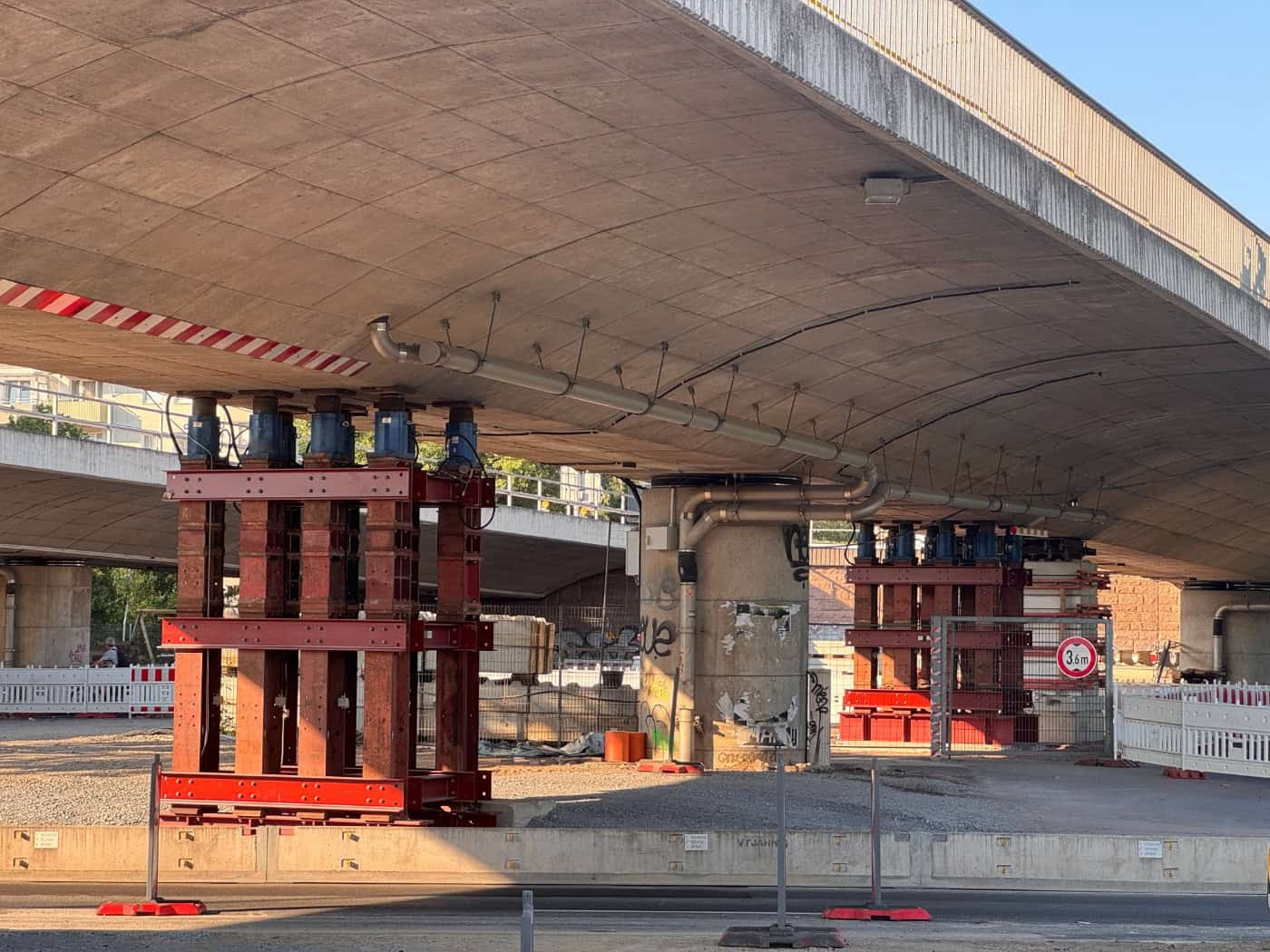
Dresden. Next week, when the city is asleep and the last trams have stopped running, the heavy machinery will roll in. Through a massive nighttime stress test, the city administration is assessing the load-bearing capacity of the dilapidated Budapester Straße bridge to prevent this important structure from being completely closed for years.
Heavy-Load Experiment in the Dark
From August 10 to 12, self-propelled, modular special-purpose vehicles will roll in. During the night, the machines will gradually apply an enormous weight of up to 326 metric tons to the bridge structure. Sensors and surveying equipment will monitor every tiny movement and deflection of the concrete. To ensure absolute safety during this risky maneuver, strict road closures will be in effect: On the test days, the city will completely close Ammonstraße—which runs under the bridge—as well as the bridge itself to traffic from 6 p.m. to 6 a.m. Additionally, the delicate load test will take place deep into the night exclusively when no trains or streetcars are running under the bridge.
Fighting Creeping Deterioration
The reason for this complex procedure is progressive stress-corrosion cracking inside the concrete. Temperature-induced wire breaks in the prestressing steel—a problem similar to that on the Carola Bridge—had already forced the city to implement a partial closure back in May. To prevent a impending collapse, the Department of Roads and Civil Engineering had massive emergency steel supports erected in recent weeks. As department head Simone Prüfer explained, the steel cables have been snapping with increasing frequency on warm weekends, even though traffic had already been banned from the bridge. The structure was essentially supporting only itself and yet still threatened to fail.
Hoping to Gain Five to Ten Years
City officials are now fervently hoping for the best-case scenario. If the load test shows that the steel supports and the remaining concrete can safely bear the loads, the bridge is to be reopened in the future as a single-lane bridge for passenger cars and buses weighing up to 16 metric tons. Heavy trucks remain strictly prohibited. Bridge expert Professor Steffen Marx underscores the seriousness of the situation and emphasizes that without the current emergency supports, the structure would inevitably have collapsed onto Ammonstraße. With the planned partial reopening, Dresden hopes to buy itself a buffer of five to ten years. This time is urgently needed to plan a new bridge over the tracks at the main train station without triggering total traffic chaos in the city.
A Multi-Million-Euro Hole in the City’s Budget
Meanwhile, saving the bridge is turning into an enormous financial burden. Stephan Kühn, the city’s mayor in charge of construction, submitted a proposal to the city council to approve ten million euros. The city has already budgeted around 5.5 million euros for the emergency supports and the upcoming load test. Kühn makes no secret of the fact that these unplanned expenses will further increase the deficit in the current city budget. If the load test next week yields negative results, Dresden would face the worst-case scenario: The bridge would have to remain permanently closed, which would necessitate immediate and extremely costly planning for a new bridge under enormous time pressure.

