


Over 7,000 people in Germany are waiting for a donor kidney. The waiting time is often several years. This makes it all the more important that every donated organ reaches the recipient in the best possible condition. Leipzig University Hospital has now become the first hospital in Germany to use a new method to achieve this.
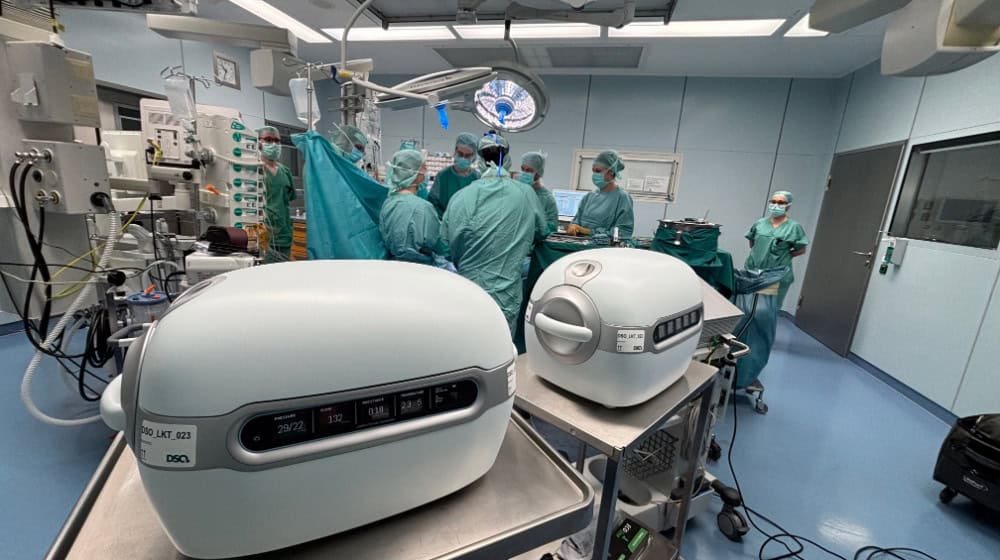
One day after the revised guidelines of the German Medical Association came into force, doctors at the UKL performed two kidney transplants. They used so-called mechanical perfusion for the first time. One woman and one man received the kidneys of a donor over 70 years old.
Organs travel under constant care
Until now, donor organs have been cooled and transported on ice after removal. With mechanical perfusion, things work differently. A device continuously flushes the kidney with a special nutrient solution during transportation. Depending on the procedure, the organ is also supplied with oxygen. "Mechanical perfusion represents a significant scientific and clinical advance in organ preservation," says Prof. Dr. Hans-Michael Tautenhahn, Deputy Head of Hepatobiliary Surgery and Visceral Transplantation at the UKL. The procedure enables significantly gentler transportation and a reduction in damage to the transplant.
The method has several advantages. Doctors can assess organ function immediately before transplantation. This increases patient safety. Studies also show that longer transport times are possible and more organs can be used.
More older donors require new approaches
The new directive allows the use of mechanical perfusion for certain donor organs. These include kidneys from people over the age of 60 and from 50 to 59-year-olds with risk factors such as high blood pressure. "As the donor fell under the donor criteria of the new guideline, we had the opportunity to use mechanical perfusion as part of this organ donation," explains Prof. Tautenhahn.
Dr. Jan Kowald, Medical Director of Transplant Coordination at the UKL, emphasizes the importance: "As there are still too few donor organs available, patients on the waiting list have to wait a critically long time for a transplant." At the same time, the age and pre-existing conditions of donors are increasing. The new technology could help to make better use of existing organs.
The two transplanted kidneys are developing well in the recipients. Scientists in Leipzig are also researching whether organs can be therapeutically improved during perfusion. The German Organ Transplantation Foundation is providing the necessary equipment.

