


Every excavator, every factory press, every wind turbine has them: metal parts that rotate, rub against each other and gradually wear out. To make them last longer, they are coated with a protective metal layer. This takes time, energy and money. Researchers at the Fraunhofer Institute for Material and Beam Technology IWS in Dresden have now developed a much more efficient process.
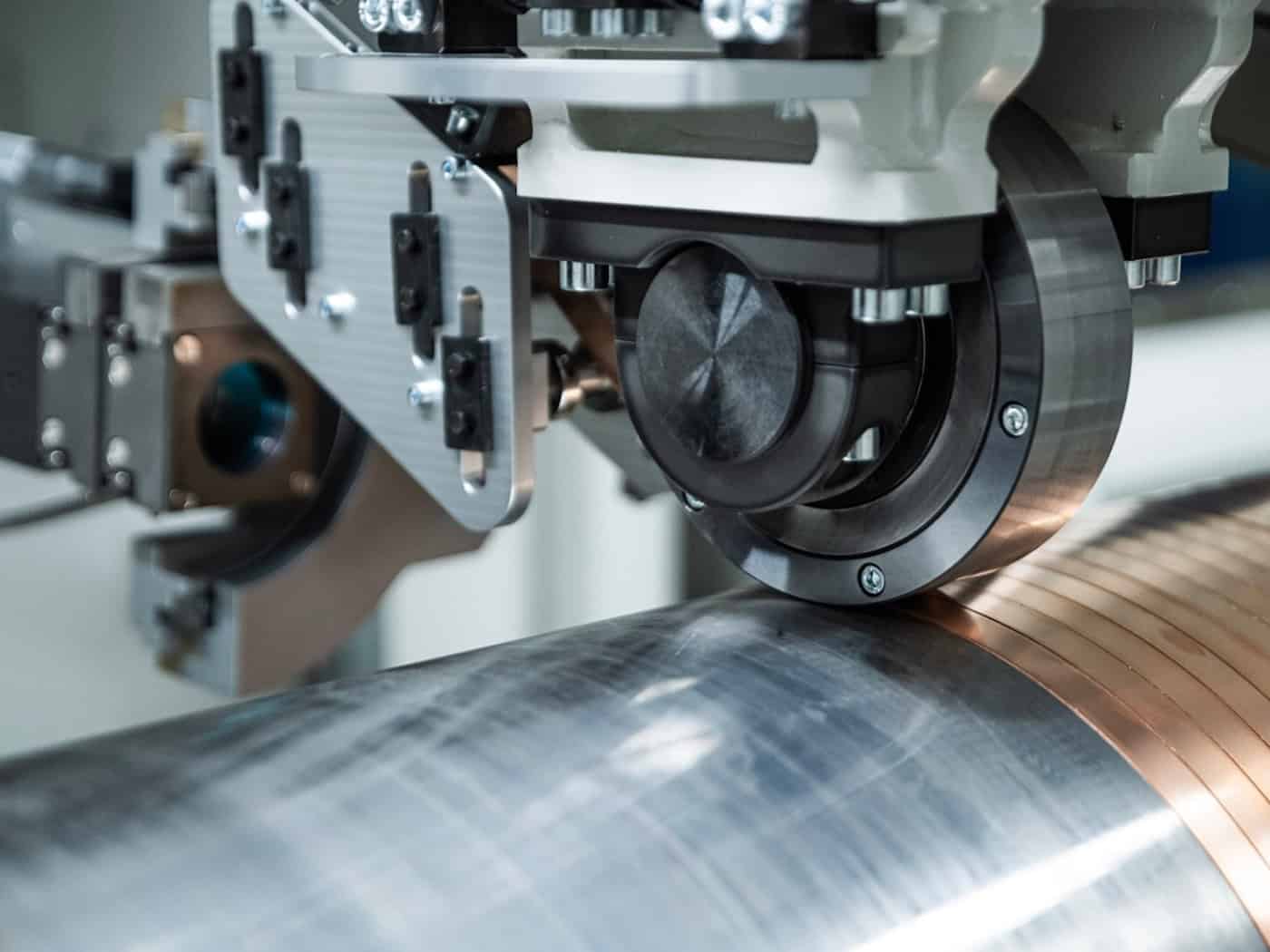
The process is called laser direct cladding. A ribbon-shaped metal strip is wound spirally around a cylindrical component, similar to thread on a spool. A laser briefly heats only the contact point, while pressure is applied at the same time. In this way, the metals bond permanently without melting over a large area. This saves energy and results in a surface so smooth that hardly any post-processing is required.
Metal coating without melting
“We try to minimize or even avoid the molten phase,” explains Marko Seifert from Fraunhofer IWS. “We activate the contact zone with very little energy and thus achieve dense, uniform coatings in significantly less time.”
A hydraulic cylinder used to take around 20 hours to coat; with the new process, it takes only about six. Energy consumption is reduced by up to 90 percent. This lowers costs and reduces environmental impact. Worn components can also be rebuilt instead of being completely replaced.
A new generation of manufacturing
Researchers around the world are working to make metal coatings more efficient. Conventional processes heat the material to high temperatures or melt it completely, which requires a lot of energy and often involves costly post-processing. The Dresden process takes a different approach: it combines laser energy with pressure and requires significantly less heat. This places it among a new generation of technologies that save material and are easier to integrate into industrial production.
Fraunhofer IWS has filed a patent for the process and built a pilot plant capable of processing components up to two meters long, with the entire process enclosed. “We want to combine energy and cost efficiency within a robust process window,” says Seifert. The goal is to integrate the process into existing production lines while ensuring consistent quality, even for large components. The researchers are already working with industrial partners to bring the technology into industrial use.

