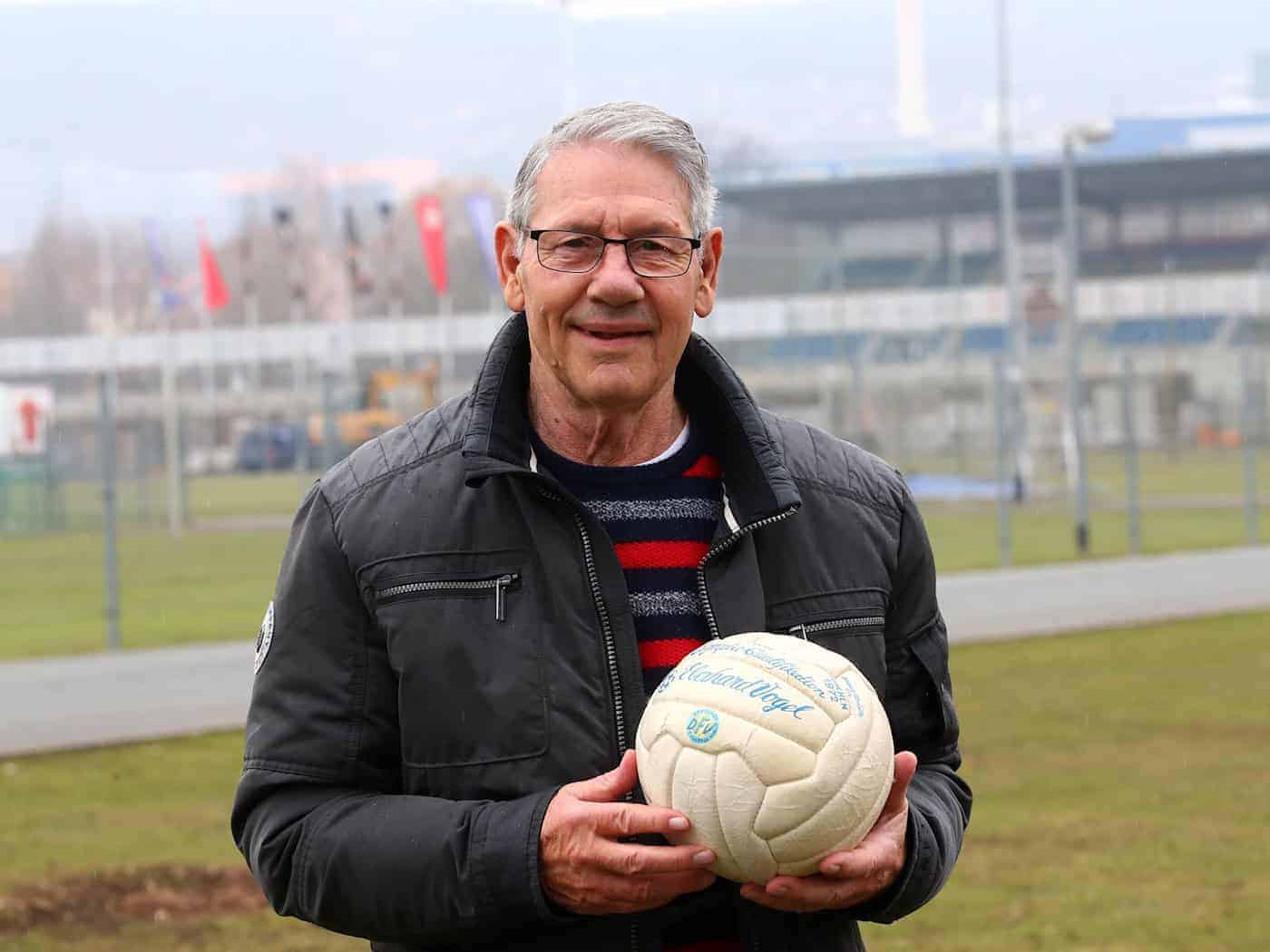
Eberhard Vogel had long since secured his place in the history books of soccer. The modest, always highly professional former forward for FC Karl-Marx-Stadt and FC Carl Zeiss Jena lost his long battle with a treacherous illness at the age of 83. What remains are memories of many beautiful goals and countless runs down the wing, with which he not only outwitted defenders in 440 GDR Oberliga matches, but also earned respect and recognition abroad. So much so that even the legendary Pelé wanted to bring Vogel to FC Santos as his striking partner. That was in the 1970s. Back then, an offer from Pele’s club in Jena—one that was considered outrageous by the standards of the time—arrived from Brazil. The terms of the deal: two million Deutschmarks—1.5 million for Carl Zeiss, and half a million for Vogel as a signing bonus. “Well, I would have liked to have had the money,” Vogel once told the *Leipziger Volkszeitung*: “But I was very attached to my home; I didn’t want to leave my parents and friends. And by the way: My father would have strangled me if I’d run off. But a transfer was never really on the table.” Vogel found happiness anyway. The numbers prove it. His 440 Oberliga appearances made him the GDR’s all-time leader in appearances. His 188 league goals place him second behind Joachim Streich (229 goals). His career stats are highlighted by 74 appearances for the GDR national team with 25 goals and 24 games for the Olympic team with ten goals. The GDR championship title with Karl-Marx-Stadt in 1967 and the three FDGB Cup victories with Jena (1972, 1974, 1980) are topped by the two Olympic bronze medals in 1964 and 1972, as well as the 1981 European Cup Winners’ Cup final with Jena against Dynamo Tbilisi (1–2). He was also part of the squad for the 1974 World Cup. “He was a gifted forward who could have played on any world-class team,” his former teammate and later coach Hans Meyer once said in an interview with the German Press Agency, adding another superlative: “The way he played the left wing position would have been perfect for instructional videos.” As a coach, Meyer included his striker in his strategic decisions, and Vogel supported him to the best of his ability. In Vogel’s final season—he was already 39 in 1982—Meyer left it up to him whether he wanted to start or come off the bench. The older Vogel got, the more professionally he dedicated himself to soccer. Never seriously injured, focused on soccer—and good genes—that’s how Vogel once described why he was able to maintain such a high level of performance in soccer for so long. “He was a modest, honest person who made phenomenal progress because he had the right attitude for his job,” said Meyer. Vogel’s coaching career, by contrast, was marked by significant success only in youth soccer. From 1983 to 1990, he worked for the GDR Soccer Association. In 1986, he led the junior national team—featuring Matthias Sammer—to the European Championship title; the following year, the U-20 team finished third at the World Cup. Finally, the U-16 team won silver at the European Championship in 1989. Vogel witnessed the end of GDR soccer as an assistant coach for the last national team alongside Eduard Geyer. After German reunification, he took on various stints as a club coach in Jena, at Hannover 96, at 1. FC Magdeburg, and at Dresdner SC, as well as a stint as a national team coach in Togo—none of which lasted longer than a single season. Still, he led Magdeburg to a victory over Ottmar Hitzfeld’s FC Bayern Munich in the second round of the 2000–2001 DFB Cup and guided Jena to promotion to the 2. Bundesliga in 1996. Copyright 2026, dpa (www.dpa.de). All rights reservedRecord-holding player with many successes
Successful Only as a Youth Coach