

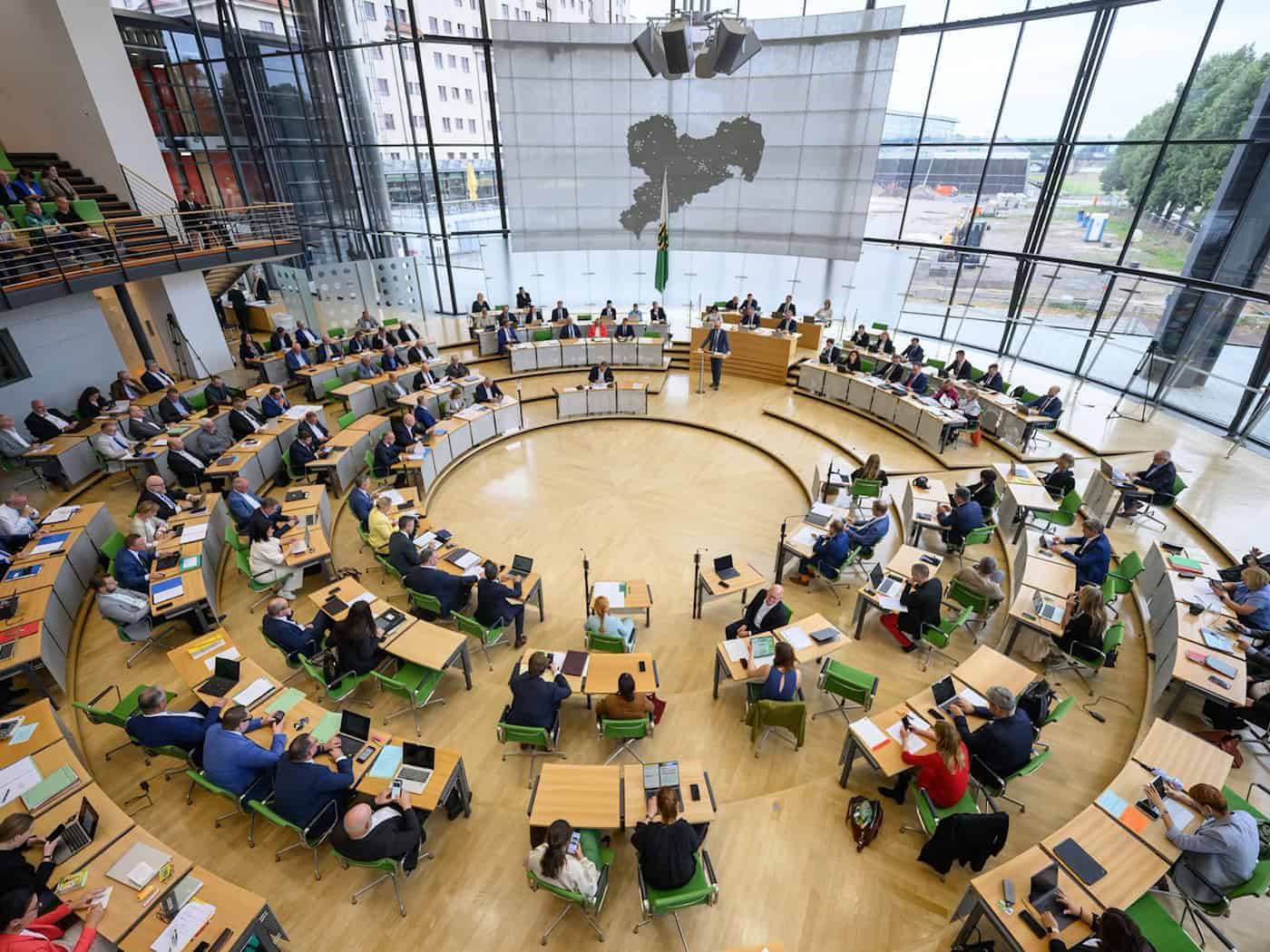
The debate on Saxony’s two-year budget for 2027 and 2028 has begun. When presenting the government’s draft budget in the state parliament, Finance Minister Christian Piwarz (CDU) also addressed fundamental aspects of the Free State’s fiscal policy. He emphasized that the new borrowing currently being undertaken should remain the exception. After the Bundestag amended the Basic Law to allow the states to take out loans, Saxony is making full use of the allotted framework and will take on nearly 1.5 billion in debt over the next two years. Half of this amount is earmarked for the municipalities. The minister said that, for him, it was crucial that the new borrowing remain temporary. It must not be a convenient tool for shifting financial burdens into the future. “If future generations benefit from it, borrowing can be justified. But it must never be merely a response to structural problems,” said Piwarz. The minister called for sound fiscal policy. “In the long run, a government cannot promise more than it can finance. And politics cannot maintain trust in the long run if an ever-widening gap emerges between political promises and financial capabilities.” Only real economic growth leads to more tax revenue in the long term. The government’s draft budget includes total expenditures of approximately 53.5 billion euros. This marks the highest level of spending in Saxony’s history. Despite tight financial constraints, the state intends to prioritize investments, education, research, and local municipalities. Investments are set to rise from 3.18 billion euros this year to 3.21 billion euros in 2027 and then to 3.25 billion euros in 2028. The investment ratio stands at 13.5 percent and 13.4 percent, respectively. Funds from the federal government’s special fund are also being allocated. Piwarz sees a need for urgent action. “The structural deficit hasn’t gone away. It hasn’t vanished just because we can finance it for 2027 and 2028.” The coming years must therefore be used to review government tasks and services, adjust structures, cut red tape, and continue the staff reductions that have already begun. By 2040, approximately 8,700 positions are to be eliminated; in 2027 and 2028, the figure is 523. Since the CDU-SPD coalition is ten votes short of a majority in parliament, it relies on opposition parties for budget approval. The Left Party and the Greens, which provided the necessary votes for a majority on the previous budget, made it unmistakably clear that their approval would be subject to specific conditions. In the ensuing debate, the opposition leveled ample criticism at the draft budget. AfD caucus leader Jörg Urban strictly rejected new borrowing. “The only thing about this budget that’s likely to set a record is your inability to set the right priorities and to manage our citizens’ hard-earned tax dollars properly,” he told the government. Green Party caucus leader Franziska Schubert recalled the consequences of the heatwave, which claimed more than 400 lives in the Free State, and called for more investment in climate adaptation and nature conservation. Climate change also has a second dimension: “Because society is also in turmoil. Politicians must urgently turn their attention to those who shape this society, hold it together, and represent the friendly, committed face of Saxony.” Susanne Schaper, leader of The Left parliamentary group, claimed on behalf of her party that they had analyzed the 4,200-page government draft and assessed it objectively and with nuance. Not everything in it is bad, she said, but the draft is miles away from being good for Saxony or acceptable to The Left. “It simply doesn’t address any of the major social issues.” Speaking on behalf of the Sahra Wagenknecht Alliance, parliamentary group leader Ronny Kupke accused the government, among other things, of lacking its own ideas. He said it had let valuable time slip away and was failing to shape the state’s future. On behalf of the SPD, which is part of the governing coalition, Representative Juliane Pfeil announced her own proposed amendments. The SPD wants to improve the draft. CDU finance expert Jan Löffler called for clear regulations on debt repayment. Independent lawmaker Matthias Berger, who sits in parliament for the Free Voters, summed it up this way: “Zero real reforms, but instead new debt with lots of zeros.” In my view, this is a continuation of their palliative policy with a new painkiller called loans. The Saxon CDU-SPD government has run out of options, and the budget in its current form is not acceptable.” Copyright 2026, dpa (www.dpa.de). All rights reservedSaxony Is Taking on Nearly 1.5 Billion Euros in Debt
The government cannot promise more than it can finance
Saxony aims to cut red tape and reduce staff
AfD Strictly Rejects New Debt
Greens: “Society Is Also in Turmoil”
The Left: Draft Fails to Address Any of the Major Social Issues
Ruling SPD Party Wants to Improve Government Draft
Berger: Zero real reforms, but debt with lots of zeros


