

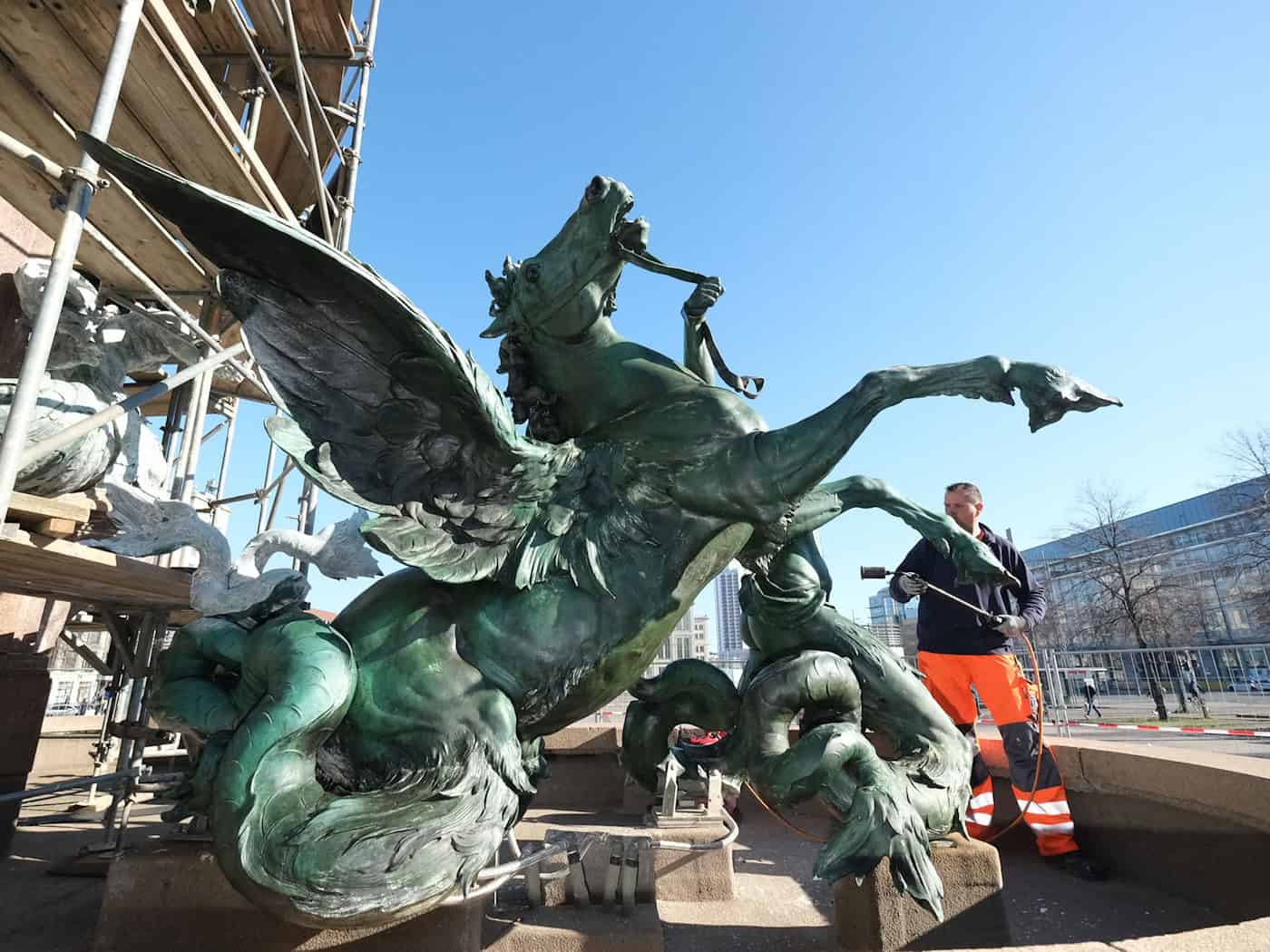
Preparations for the fountain season in Saxony's largest cities are in full swing. More than 100 fountains will soon be waking up from hibernation, as the cities of Dresden, Leipzig and Chemnitz announced on request. The facilities have been checked and cleaned. This Monday, the contemporary Fritz-von-Harck fountain at the Federal Administrative Court in Leipzig will start flowing again, according to the Leipzig city cleaning service. As early as 1900, there was a representative decorative square with a fountain in the Wilhelminian style on this site, but it lost its effect after the Second World War. The newly designed fountain on the 4,500 square meter square consists of geometric bodies with a bright glass covering. The fountain, which is up to six meters high, is illuminated at night. A total of 26 urban water features will once again be a feast for the eyes of Leipzig's residents. In addition to the Mendebrunnen fountain on Augustusplatz, the Pusteblumen fountain on Richard-Wagner-Platz, the Froschbrunnen fountain on Rabensteinplatz and the water feature on Grimmaische Straße will also be bubbling away. Even though many Leipzig residents use the water features for refreshment, bathing in them is not recommended. The water quality does not meet the hygiene requirements for bathing water and the fountains are often historical and listed buildings with sensitive structures and delicate sealing systems that can be damaged. Maintenance of the fountains is, however, associated with costs. Last year, this amounted to almost 350,000 euros for all the water features managed by Stadtreinigung Leipzig. For this reason, Stadtreinigung Leipzig is once again looking for fountain sponsors who would like to contribute financially to the management of the facilities. "The fountains and fountains contribute to a lively and attractive cityscape. We are delighted when Leipzig companies and citizens support us financially," said Elke Bröcker, Commercial Operations Manager at Stadtreinigung Leipzig. In Dresden, the fountain season starts a little later. However, 94 fountains, drinking water fountains and water technology systems are due to go into operation in May. In recent years, three new fountains, two new drinking water fountains and a rainwater cistern for the irrigation of green spaces have been added, according to the city. The financial outlay for a fountain season is also high in the state capital. The budget should be between 390,000 and 700,000 euros, it said. This should enable the facilities to run from April to October, damage and vandalism to be repaired quickly and wearing parts to be replaced promptly. However, the funds have not yet been released due to the current budget freeze. In Chemnitz, on the other hand, six fountains have been bubbling since the end of March. The other 19 municipal ornamental and artificial fountains will be put into operation by May 26. Six fountains, on the other hand, will not be in operation this year because the basins need to be renovated and the fountain technology is outdated and no longer fit for use. For the 2026 financial year, 205,000 euros have been budgeted for the maintenance of the fountains. Fountains make a noticeable contribution to cooling, especially in densely built-up inner-city areas of overheated cities, and are therefore part of climate-adapted urban development. In addition, they are part of the Central European cityscape, promote tourism and increase the quality of stay. Copyright 2026, dpa (www.dpa.de). All rights reservedBathing is prohibited in fountains and sponsors are being sought
Dresden starts a little later and still has financial worries
In Chemnitz, fountains are already bubbling in some places
Fountains enhance the cityscape and are good for the climate


