

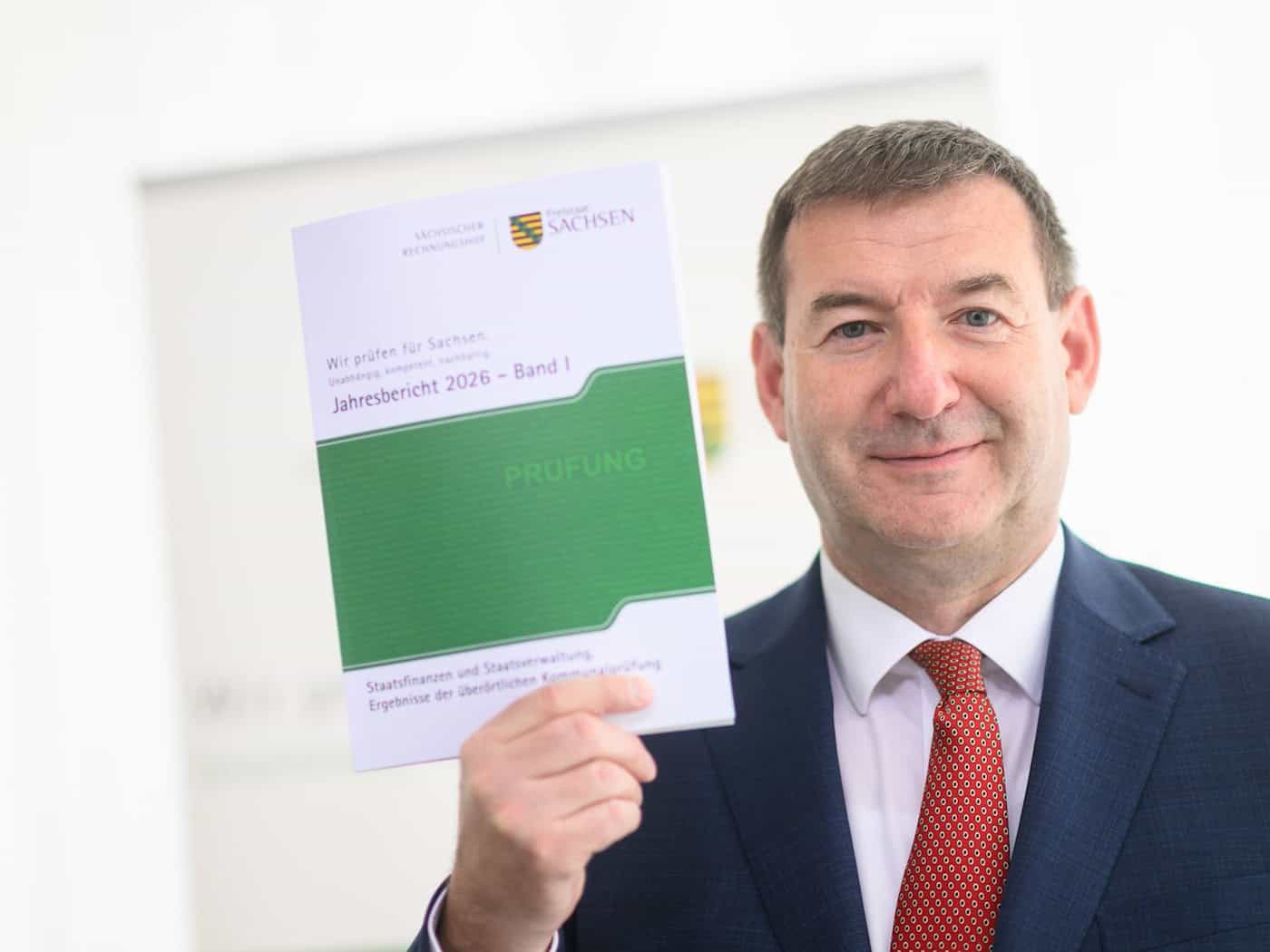
The Saxon Court of Auditors remains highly critical of the Free State’s fiscal policy. “The use of taxpayer money is still too rarely subject to honest scrutiny regarding its impact,” says Jens Michel, head of the agency, in his foreword to the first part of the auditors’ annual report. Saxony does not have a revenue problem. “That is why one thing is crucial now: We in Saxony must learn once again to set priorities. Not every wish can be fulfilled. Not every new project is truly necessary. And not every expenditure is still appropriate for the times we live in.” For the Court of Auditors’ examiners, this is about more than just numbers. Michel speaks of intergenerational justice. “We must not solve existing problems at the expense of future generations. All the debt we take on today will have to be repaid tomorrow by our children and grandchildren.” From the perspective of the Court of Auditors—which sees itself as a voice of warning and a watchdog—this does not constitute a financially responsible policy toward future generations. The state’s core functions must be financed without incurring debt. If debt is incurred, a well-thought-out short-term repayment plan is necessary. From the Court of Auditors’ perspective, new debt does not solve the existing structural problems. The actual cause of the difficult financial situation facing the Free State and its municipalities lies elsewhere: In recent years, high standards have been set, and the Free State “will find it difficult to scale back from them without the courage to make decisions,” Michel emphasized. Challenges have been postponed into the future without being resolved. “Many initiatives were started but not consistently seen through to the end.” The Court of Auditors views the efforts to address the budgetary imbalance positively. Among other things, the current annual report criticizes the low investment rate, which stood at only 11.9 percent in 2025. In 2021, it was still 18.3 percent; in the 1990s—the “founding years”—the rate hovered around 30 percent. The ratio indicates what percentage of expenditures goes toward investments. In addition, the Court of Auditors advises the Free State to exercise more influence as a shareholder of Mitteldeutsche Flughafen AG. “In light of the withdrawal of several airlines, steadily declining passenger numbers, and competition from other airports, we recommend that the Free State take a more active role as a shareholder than it has in the past,” explained Court of Auditors Director Skadi Stinshoff. However, this requires an overall strategy. Another problem is interest payments. By 2029, the interest burden will already exceed 300 million euros. The point at which Saxony will have to pay one million euros in interest per day is already on the horizon, said Michel, who also provided an outlook on the upcoming budget process. “The Free State is at a crossroads, at the latest with this two-year budget, because the reserves are almost entirely depleted.” Copyright 2026, dpa (www.dpa.de). All rights reservedAudit Office Highlights Intergenerational Justice
Court of Auditors Calls for “Courage to Make Decisions”
Criticism of Low Investment Rate
The Free State Should Exert More Influence on Flughafen AG
Saxony Will Have to Pay One Million Euros in Interest Per Day in the Future


