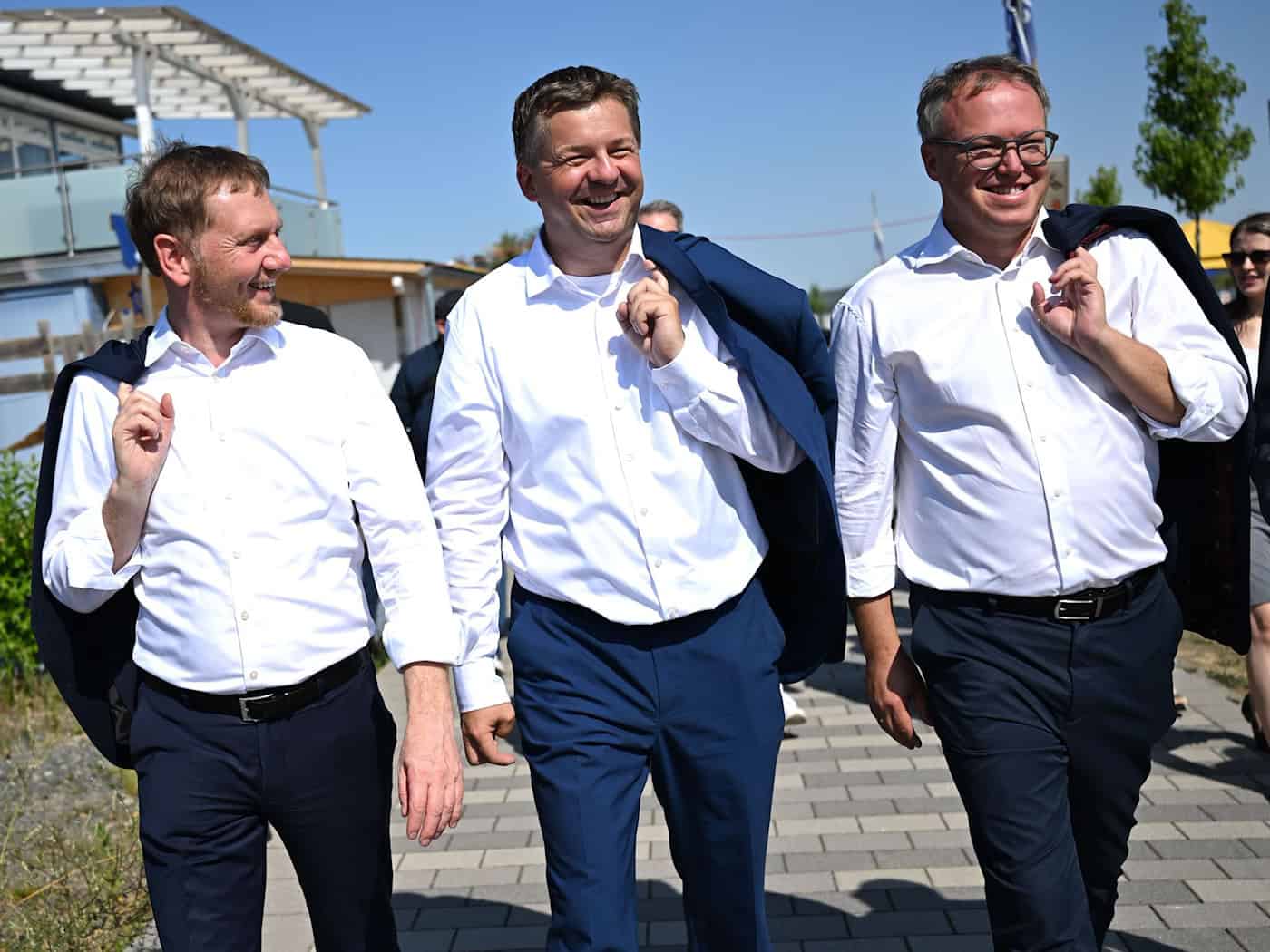
The Geiseltalsee in Braunsbedra is as smooth as glass; the sun is shining, and only a light breeze cools the skin. Three state premiers have arranged to take a short boat tour—the focus is on structural change in the former lignite-mining region, as well as tourism. But in reality, there’s much more at stake: Saxony’s Minister-President Michael Kretschmer and his Thuringian counterpart Mario Voigt have also come to Braunsbedra to support their CDU party colleague Sven Schulze, who is in the midst of an election campaign. And he’s currently facing a rather harsh headwind, given the poll numbers: The AfD, with its lead candidate Ulrich Siegmund, stands at 41 percent in the latest “Sachsen-AnhaltTREND” poll by Infratest dimap, commissioned by MDR, WDR, “Magdeburger Volksstimme,” and “Mitteldeutscher Zeitung.” Schulze’s CDU is at just 24 percent—a drop of two percentage points compared to a poll by the same institute in May. The gap is huge, and the trend may not be in Schulze’s favor. “The poll clearly showed that no one has a majority in this state,” says Schulze, describing it as a neck-and-neck race. But in Saxony-Anhalt, it is no longer a neck-and-neck race between the CDU and the AfD, but rather between the AfD and all the other parties combined. The party—classified as far-right by the state’s Office for the Protection of the Constitution—has a realistic chance of securing an absolute majority in the state election. Schulze’s CDU finds itself in a tricky situation. Although his CDU has lost percentage points compared to an earlier poll by the same institute, However, the smaller parties—the SPD and the Greens—are gaining slightly. If the Social Democrats and the Greens remain in the state parliament, it will be significantly harder for the AfD to secure an absolute majority and thus appoint the minister-president. This is good news for Schulze, who wants to remain minister-president of Saxony-Anhalt. But he must expect that strategic voting decisions could then come at the expense of his own party. Schulze is currently facing headwinds not only from the seemingly overwhelmingly strong AfD, but the wind is also blowing in his face from Berlin—from his own CDU, which is dominating the headlines in Germany with personnel issues and how they’re being handled. The discussions surrounding the personnel shake-up in Berlin have hampered his campaign, Schulze says on the ship in various remarks to cameras and microphones. It’s important, he says, to talk to people about state issues during an election campaign—such as education, the economy, or the future of Saxony-Anhalt. “But that’s just incredibly difficult when federal political issues keep overshadowing everything,” Schulze says. And: “My expectation now is that the debate is over.” Instead, other issues should take center stage. To that end, the three eastern German MPs have also brought a paper with them. In it, they oppose plans to abolish the pension after 45 years of contributions. “Anyone who has paid into the system for 45 years has paid enough. We will not abandon this principle,” they write in the paper. Voigt comments: “After all, we weren’t elected to make a pleasant impression in Berlin, but to achieve the best for the people in our state.” Schulze, Kretschmer, Voigt—the three of them demonstratively display unity on this day, posing for photographers and bantering with journalists, but also repeatedly emphasizing that a united East German voice is needed to be heard in Berlin. This fits with Schulze’s narrative; during the campaign, he repeatedly warns that Saxony-Anhalt could become a “testing ground” if the AfD were to take power and find itself isolated among the other federal states. “Saxony-Anhalt must not be a walled-off island within Germany,” he said in May. The three state leaders set aside several hours before, during, and after the boat tour to answer questions from journalists. Voigt and Kretschmer know exactly how tough an election campaign like this can be. Both govern their states without a majority in their respective state parliaments due to the strength of the AfD. Schulze could face a similar situation—though for him, that would likely be the better scenario. Copyright 2026, dpa (www.dpa.de). All rights reservedPoll helps Schulze—despite a decline
CDU in a tricky situation
Personnel Shuffle in Berlin Overshadows State Issues
East German Unity vs. Isolation