

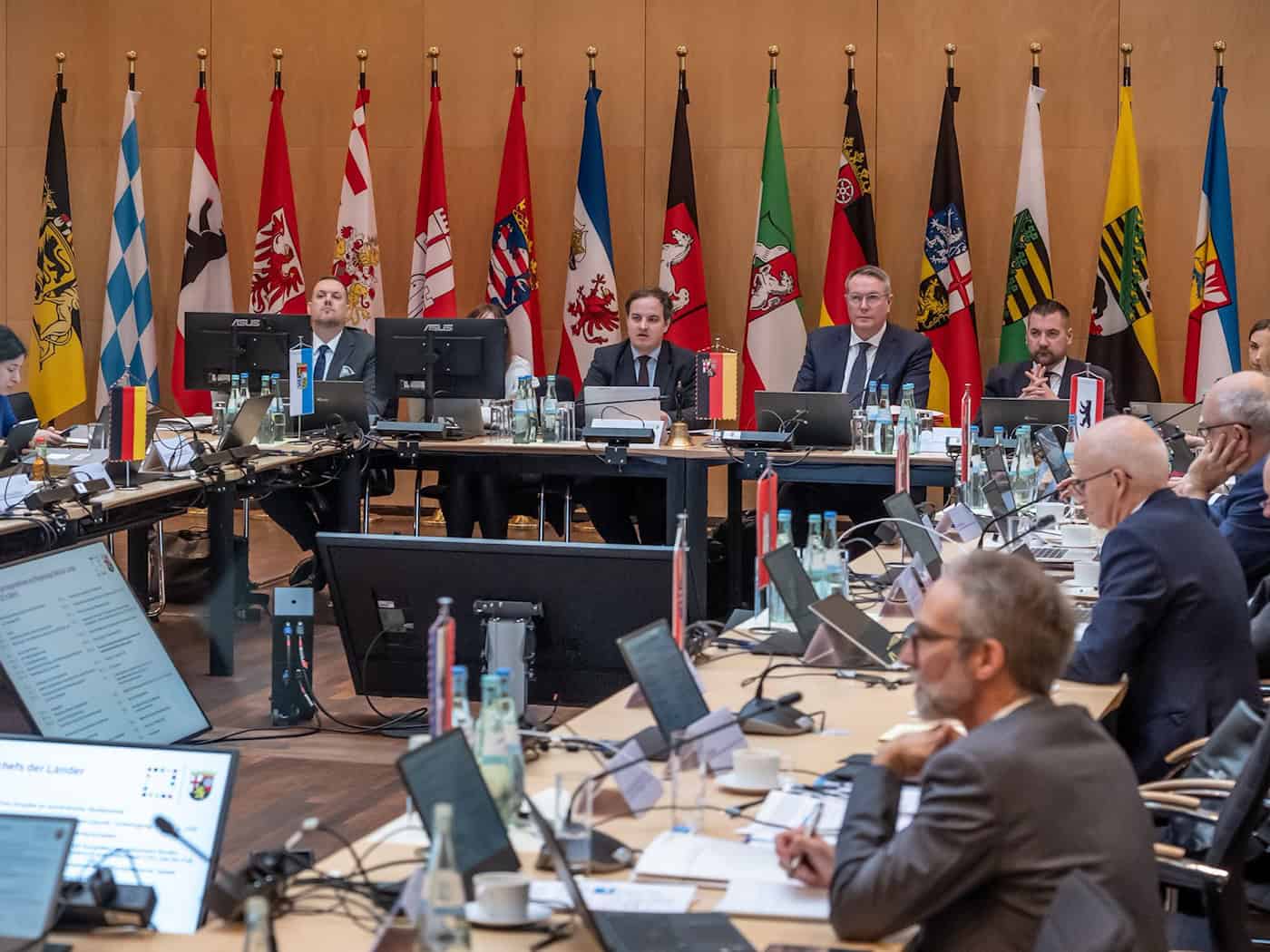
The heads of the state governments are calling on the federal government to take action against the sharp rise in fuel prices, insisting on a solution to the financial plight of local authorities and sympathizing with restrictions on social media use by young people. The Minister Presidents' Conference (MPK) in Berlin formulated concrete demands for more safety on trains. The federal and state governments are far apart when it comes to municipal finances. Saxony's Minister President Michael Kretschmer (CDU), who is co-chair of the MPK, said with regard to the sharp rise in fuel prices as a result of the Iran war: "This is not right". He spoke out in favor of taking action against possible additional profits at the expense of consumers. "The Cartel Office must now take action and ensure that this stops." If the fuel at the pumps still comes from stocks that have been purchased at lower prices, the anger of many motorists is understandable, said MPK Chairman and Rhineland-Palatinate Minister President Alexander Schweitzer (SPD). There are legal means against such practices, he said, referring to antitrust law. This must now be "used proactively". Mecklenburg-Western Pomerania's Minister President, Manuela Schwesig (SPD), said: "Either prices will fall. Or we have to increase the commuter allowance." Federal Economics Minister Katherina Reiche (CDU) had previously rejected a fuel price brake to ease the burden on motorists. Schweitzer received support for his proposal to add a passport photo to the Deutschlandticket in future. This would make ID checks, which are often the cause of assaults by passengers, superfluous. Kretschmer and Lower Saxony's Minister President Olaf Lies (SPD), for example, were open to the idea. The latter said: "If direct identification could help to provide more security (...), I am open to any solution for the time being." Following the violent death of a train attendant on a regional train in Rhineland-Palatinate, the heads of state governments are also in favor of introducing body cameras for train staff across the board. These cameras should also be able to record sound, emphasized Schweitzer. The heads of government are open to considering age restrictions for social media. In a resolution, they welcome the establishment of the expert commission "Child and Youth Protection in the Digital World" and call for its findings to be jointly evaluated. Schweitzer pointed out that media regulation is the responsibility of the federal states. "I have a high regard for expertise. In politics, we should perhaps listen to experts much more often. But nobody is going to take the decision-making responsibility away from us." At its party conference, the CDU had spoken out in favor of a minimum age of 14 for social media, stating that there is a "special need for protection" up to the age of 16. The SPD is also calling for an age limit of 14 and youth versions of platforms for everyone under 16. The federal states are demanding billions in emergency aid for local authorities from the federal government. "It is quite clear that the current situation has arisen and is being exacerbated by federal laws, by federal benefit laws," emphasized Kretschmer. Schweitzer warned that if a local authority could no longer guarantee services of general interest, this would have an impact on its citizens. Nothing less than the future of democracy was at stake. Lower Saxony's Minister President Olaf Lies (SPD) spoke out in favor of reducing bureaucracy. "We must also look at the expenditure side to see where the system is too expensive." The federal states and local authorities are also demanding that the federal government assume all costs for tasks it assigns to them in future. "The principle of 'he who orders, pays' must finally become reality," said Schweitzer. He had announced a special meeting on this topic for the first quarter. Now he said: "A special MPK only makes sense if we know that we will come together to produce a result. But we don't know that yet." That is why there is no date for such a meeting yet. Copyright 2026, dpa (www.dpa.de). All rights reservedFuel prices
Safety of train staff
Social media
Municipal finances


