

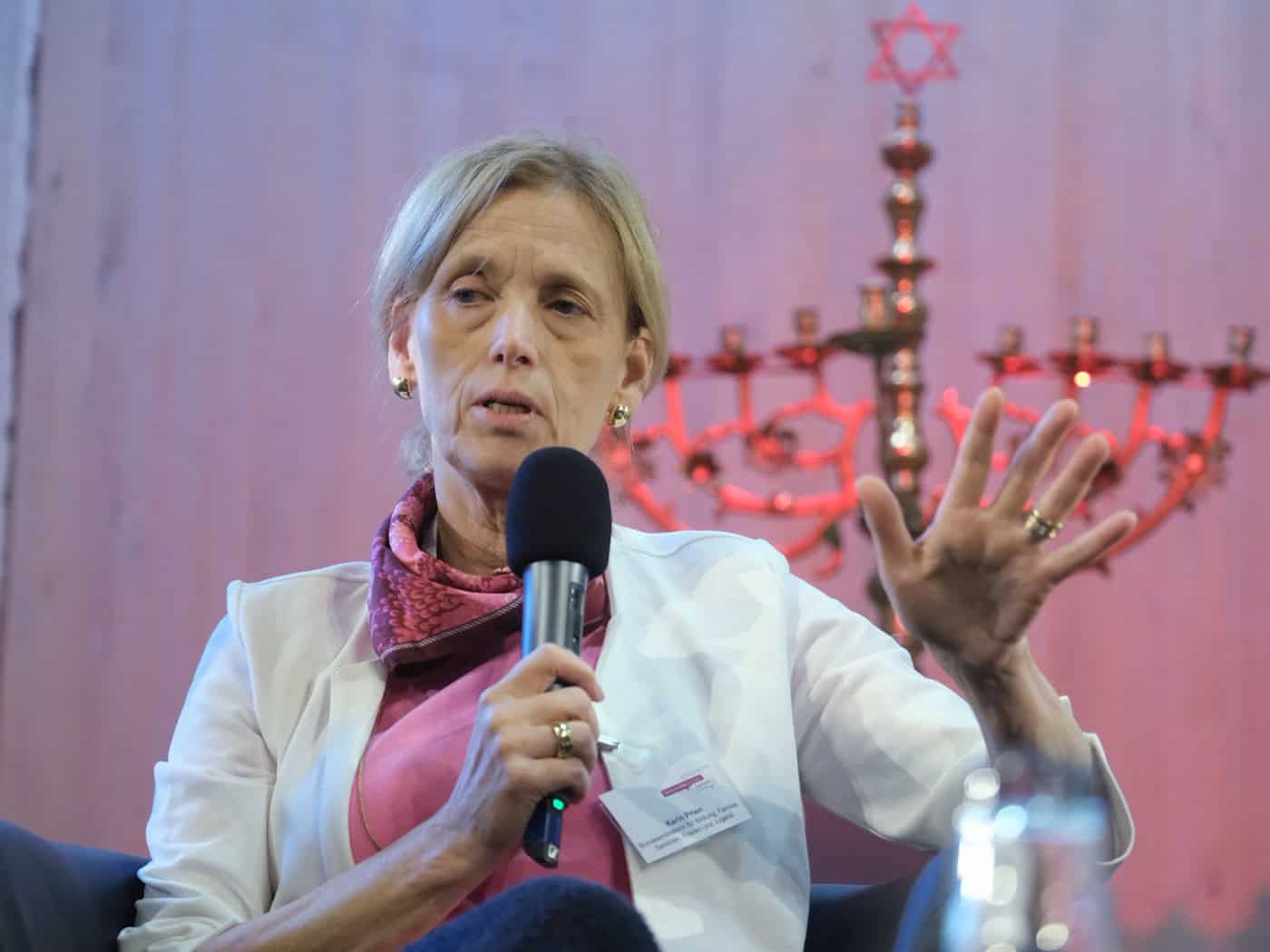
Federal Minister of Education Karin Prien believes that teacher training must also be improved as part of the fight against antisemitism. To date, efforts to establish anti-Semitism as a subject in higher education have not been successful nationwide, the CDU politician said during a panel discussion at the site of the future Yad Vashem branch in Leipzig. However, educators must be trained to engage with young extremists from the right or the left. The same applies to the training of local government officials, police officers, and judges. “Often, anti-Semitic code language and stereotypes go completely unrecognized by the courts,” Prien said. “That is why it is important, for example, to have specialized prosecutors’ offices that know exactly what anti-Semitism is.” The federal minister visited the Ariowitsch House in Leipzig to learn about the future branch of the Israeli Holocaust memorial Yad Vashem. The educational center is scheduled to open next year, said Saxony’s Minister of Culture Conrad Clemens (CDU). The state is currently working with Yad Vashem on an agreement. Saxony plans to support the educational efforts with five million euros per year. In May, Yad Vashem announced plans to establish its first branch outside of Israel in Germany. An educational center is to be built in Munich, and Leipzig will host a branch of it. The plan is to create interactive learning spaces for young people, as well as for teachers and other key influencers. During a subsequent panel discussion on the future of Jewish life in Germany, Prien—along with Saxony’s Minister of Social Affairs, Petra Köpping (SPD)—emphasized the necessity of educational initiatives. “I believe we have to be honest: Jewish life has not been a given in Germany since 1945,” said the CDU politician. Even now, she noted, Jewish people are being marginalized—and to an increasing extent. This must be countered through education and the promotion of democracy. “Of course, we’ve had strong anti-Semitism in Saxony for years,” said Köpping. The state government is therefore trying to prioritize the issue in its programs to promote democracy. There are more than 100 organizations in Saxony that address this issue, Köpping said. According to Prien, there is also a certain indifference in society when it comes to the issue of antisemitism. This is evident in incidents such as those in Heidenau, where it was decided to ban the culture of remembrance from the city. However, this culture of remembrance must take place at the heart of society—even if it is often painful. Following a motion by the AfD and CDU, the Heidenau City Council had decided to no longer install Stolpersteine in public spaces. The stones are intended to keep alive the memory of the expulsion of Jews, Sinti and Roma, the politically persecuted, as well as homosexuals and other groups under National Socialism. Minister of Culture Clemens called the decision by Heidenau unspeakable. “It’s inexplicable.” The politicians demonstratively laid flowers at eight Stolpersteine not far from the planned Yad Vashem branch. Copyright 2026, dpa (www.dpa.de). All rights reservedAnti-Semitic Code Often Goes Unrecognized
Yad Vashem Branch Planned for Leipzig
Prien: Jewish Life Cannot Be Taken for Granted
Criticism of the Decision on Stumbling Stones in Heidenau


