

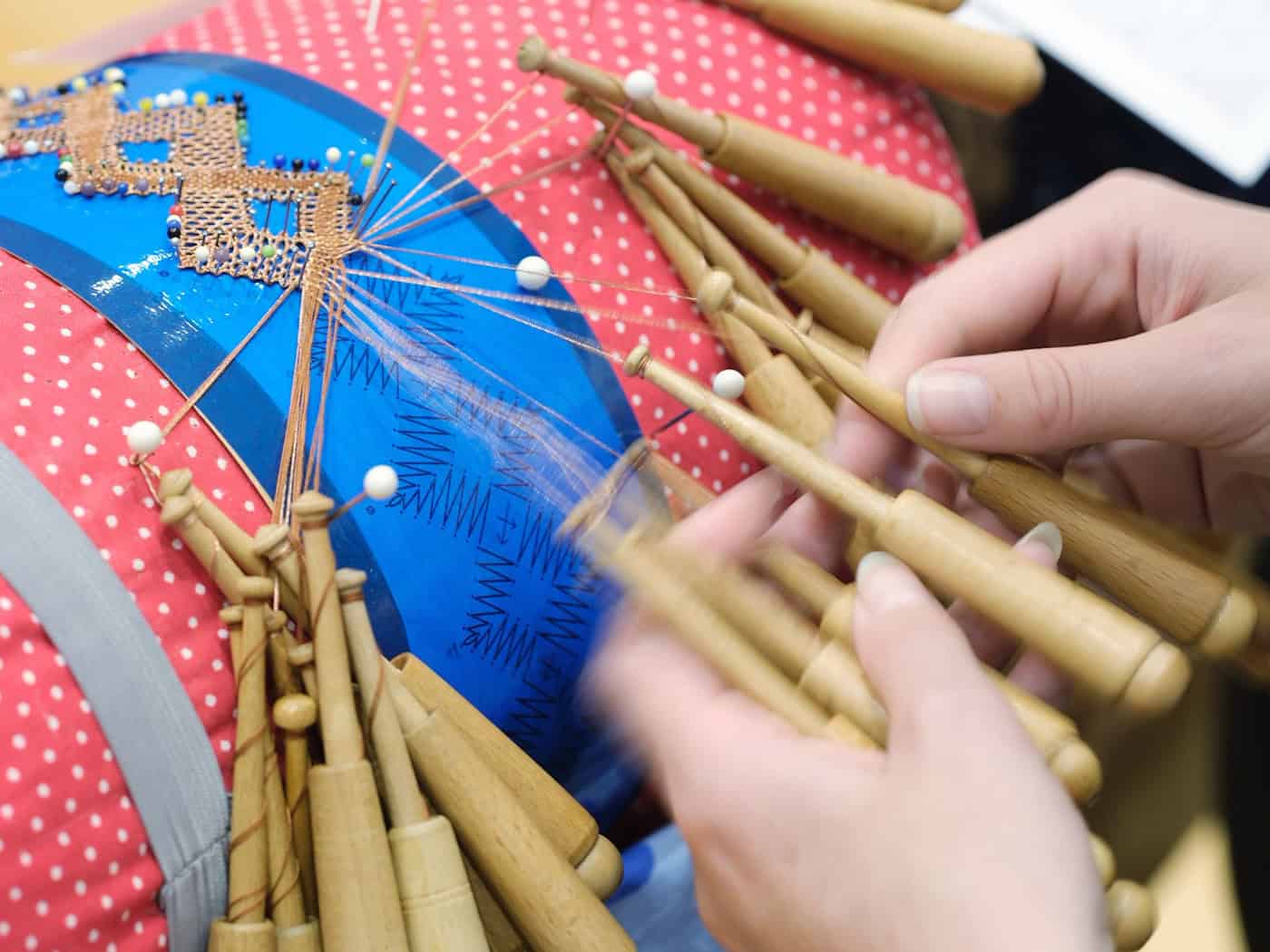
Once upon a time, miners extracted silver and cobalt from the rock; now, dexterous women descend into the mine carrying their bobbin lace bags. Before the 37th annual Bobbin Lace Days are celebrated this weekend in Annaberg-Buchholz, this Friday the action moves to the Markus-Röhling-Stolln this Friday for some bobbin lace-making underground. This event combines the centuries-old mining tradition with bobbin lace-making—a handicraft that is also widespread in the Ore Mountains—says Kristin Baden-Walther, director of the Erzhammer Cultural Center. That’s why the participants in the bobbin lace-making course aren’t just indulging in their hobby in an unusual location—the machine room of the former mine. They’re also using a special material. Instead of thread, they make bobbin lace underground using wire, as Baden-Walther explains. The silvery sheen of the wire is reminiscent of the ore that was once mined here for centuries. The Ore Mountains are a hotspot for bobbin lace-making in Germany. For more than 460 years, delicate lace has been crafted by hand using this technique. According to reports, there are more than 15,000 active lacemakers in the region today. “Bobbin lace-making takes place in every town in the Ore Mountains,” explains Baden-Walther. “This tradition is still passed down from generation to generation today.” In addition, there are three bobbin lace schools in the region, one of which is in Annaberg-Buchholz itself. There, the weekend is all about this special handicraft technique. The event features demonstrations, exhibitions, fashion shows, and a special guided tour of the town. In addition, the winners of the “GRUNDverschieden” competition will be announced. The Bobbin Lace Days are expected to draw visitors not only from the Ore Mountains themselves, but also from other regions of Germany and abroad. Copyright 2026, dpa (www.dpa.de). All rights reservedBobbin Lace-Making Is Widespread in the Ore Mountains


