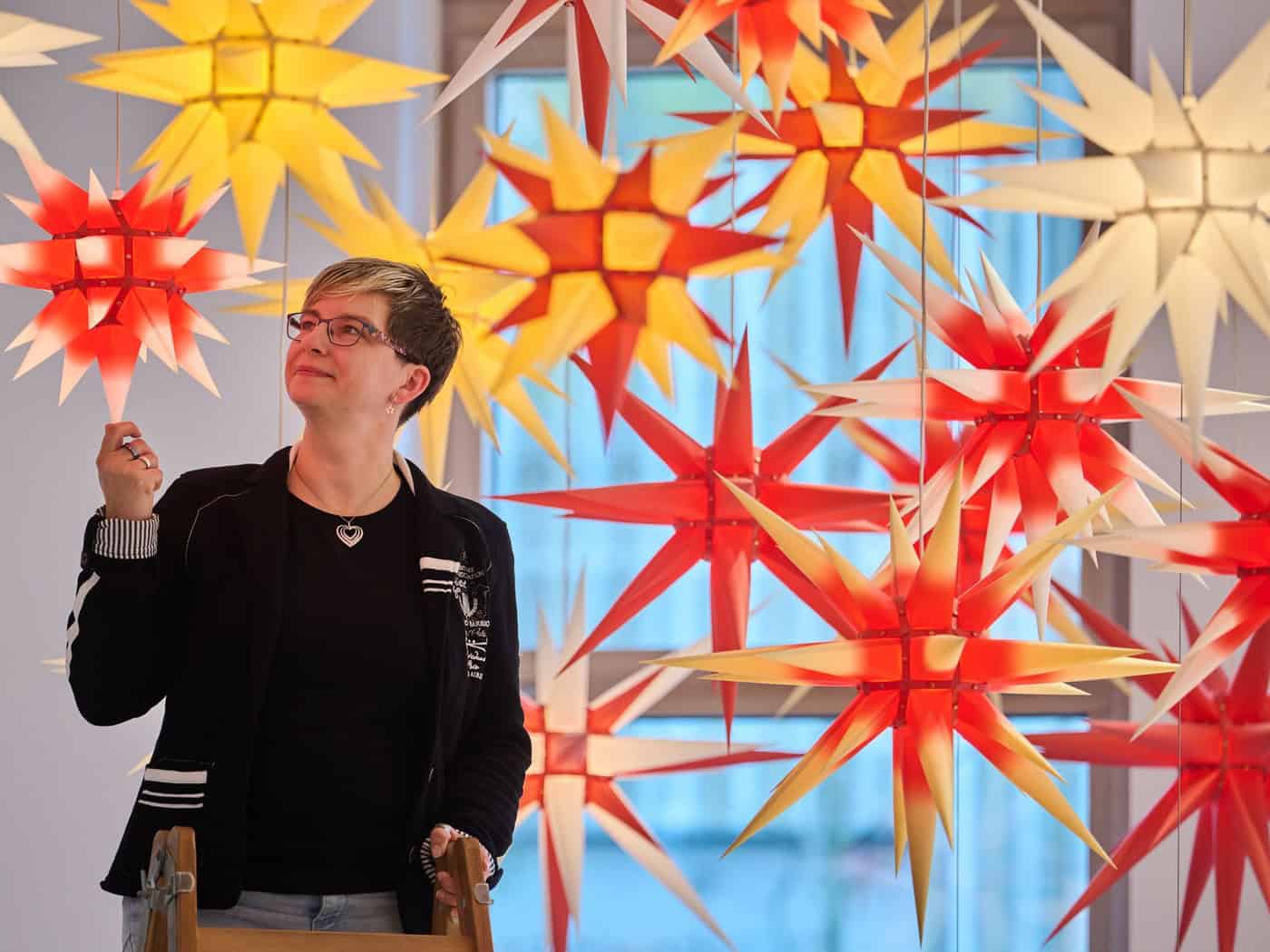
Silke Mantke takes a pre-cut piece of paper and skillfully places it over a metal cone. She smooths the glued ends a few times before placing the newly formed lace next to the others in a cardboard box. These movements seem to have become second nature to the 53-year-old. She has been working at Herrnhuter Sterne GmbH for 26 years. “I’ve made boxes full” of paper lace, she says, as she deftly reaches for the next piece. On a typical workday, an experienced employee shapes 2,500 to 3,000 points for the famous originals from Upper Lusatia. “It takes up to a year to reach that level of productivity,” Mantke reveals. The star manufactory in Herrnhut employs around 240 people. “About 80 percent of them are women,” says Managing Director Katja Ruppert. The number of employees has continued to grow—most recently by about ten compared to 2025. The stars, with eight triangular and 17 square points, are in high demand. For the current fiscal year, she expects sales of about 850,000 stars, most of which are made of plastic. The company offers its stars in more than 80 different color and size combinations. “We really reach our limits during the Advent season,” admits the managing director. Some items are already out of stock, such as the yellow and white miniature stars or certain versions of the 13-centimeter plastic stars. There are also regional preferences. In some parts of eastern Germany, the designs with a red center and yellow points are in high demand. Customers in the Czech Republic often ask for green or blue stars. The star with white and red points is considered the most traditional design, with white symbolizing purity and red representing the blood of Christ. This color combination recalls the history of its origins within the Moravian Church. In the 19th century, the first stars were crafted from paper and cardboard in the dormitories of the Herrnhut Moravian Church. The activity was also intended to help children develop a better understanding of geometric shapes and forms. Mass production as a commercial product finally began in 1897. The Moravian Church, which is now widespread worldwide, is a 100 percent shareholder in the star manufacturer. Katja Ruppert believes that the brand’s products are now widely available throughout Saxony. Their presence is also evidently growing steadily across Germany. “Herrnhut stars have really become something of a self-sustaining success,” the managing director notes. The fascination with them is difficult to explain. “The star seems to trigger something,” Ruppert believes. In fact, she says, it is not simply a decorative item, but a traditional product with a history that many associate with identity and home. “Very often, stars are bought as personal gifts—for example, for a baptism, confirmation, or wedding.”» Time and again, the company’s success story inspires unauthorized imitations. “Incidents start to rise in October,” says Ruppert. Counterfeits or fakes marketed as Herrnhut Stars usually come from Germany itself, rarely from the Far East. The company has the market closely monitored by specialized attorneys. According to the managing director, the law firms retained in Dresden and Berlin consistently issue cease-and-desist letters when they determine that the star’s shape has been copied or the copyright-protected word “Herrnhuter” has been used. “Every violation is penalized, regardless of whether it involves a company or a private individual.” The products are primarily made by hand. Even for the electric lighting, the lamp sockets and plugs are soldered by hand to the thin wires. Ruppert estimates that machine production accounts for 15 to 20 percent of the workshop’s output. Certainly, some processes could be automated to a greater extent, but that is simply not the intention. “It is and remains handcrafted,” emphasizes the managing director. “We want to be able to afford that.” In recent years, special projects have often drawn particular attention when Herrnhut stars with ingenious designs were installed at unique locations, such as on the cast-iron tower in Löbau, at a dizzying height between two church towers in Göda near Bautzen, or on the Lausche, the highest peak in the Zittau Mountains. The management of the Promenaden shopping center at Leipzig Central Station has also deliberately chosen these “eye-catching Christmas symbols.” “We want to establish a connection to the region with this classic decoration,” says center manager Thomas Oehme. Last year, for the first time, more than 100 yellow Herrnhut stars shone above the cross-platform of the heavily trafficked terminus station. To create a “uniform and harmonious overall look,” about 80 more stars have now been ordered. “The glow is unique and is part of my family,” says Silke Mantke. She admits that as many as 70 to 80 different stars shine in her own home. As a child, she says, she was automatically “infected” with a passion for them. Her mother, too, worked at the company for 40 years. “We identify with it and are proud to work here.” Copyright 2026, dpa (www.dpa.de). All rights reservedStars with the famous points
The Moravian Church as a Shareholder
Stars are primarily handmade