

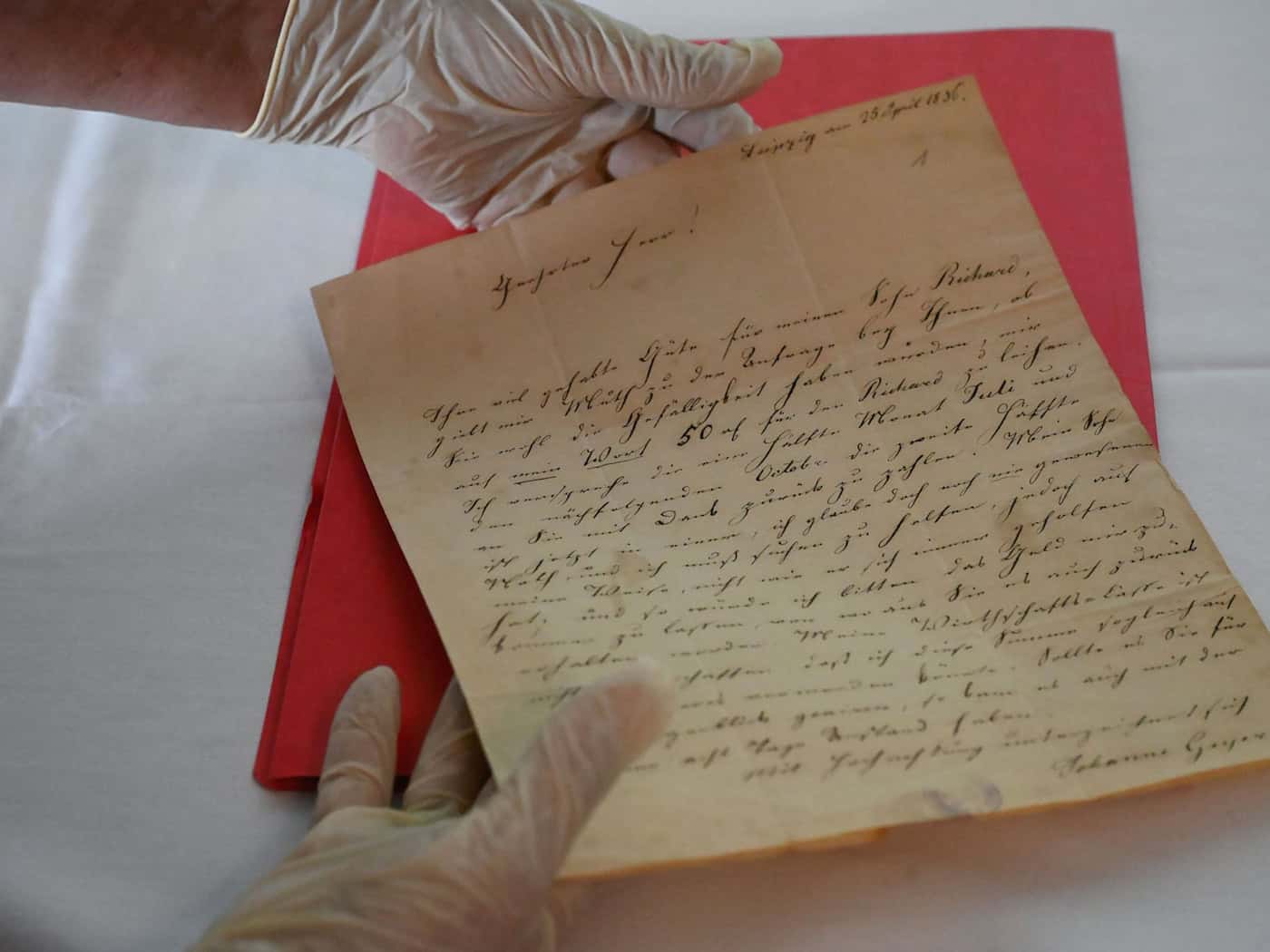
The Richard Wagner Sites in Graupa near Dresden have added a fascinating original document from the composer’s family to their collection. 190 years after it was written, a letter from Wagner’s mother, Johanna Rosine Wagner, was added to the collection. Dated April 25, 1836, it is addressed to Wagner’s friend Theodor Apel. Wagner’s great-granddaughter, Dagny Beidler, was expected to attend the handover, but she had to cancel due to illness. The letter will be on display at the Lohengrinhaus through the end of August 2026. Johanna Rosine Wagner, a twice-widowed woman who by then had taken the surname of her second husband, Ludwig Geyer, was apparently distraught over her son’s financial difficulties. His venture in Magdeburg—the production of his opera *Das Liebesverbot*—did not bring in the hoped-for revenue. After the Magdeburg theater troupe disbanded, Wagner was out of work. His mother therefore asked her friend Theodor for a sum of money to support her son. She intended to repay the loan of 50 thalers in two installments. It is not known how Apel responded to the request. Richard Wagner’s second opera, *Das Liebesverbot oder Die Novize von Palermo* (The Forbidden Love, or The Novice of Palermo), premiered on March 29, 1836, at the Magdeburg City Theater. The performance, conducted by the composer himself, turned into a fiasco. “It is a great stroke of luck that this letter is now being handed over to us in its original form,” emphasized Katja Pinzer-Hennig, chief curator of the Wagner Sites in Graupa. Last year, the museum had already received numerous objects and documents from the composer’s life. The Richard Wagner Sites in Graupa are considered the world’s oldest residence of the composer to be used as a museum. At the Schäfer Estate—now known as the Lohengrin House—he spent his summer vacation in 1846 and created the musical sketches for his opera “Lohengrin.” Museum visitors gain insight into the way of life of people nearly 180 years ago. The neighboring Graupa hunting lodge has hosted a permanent exhibition on Wagner since 2013. Copyright 2026, dpa (www.dpa.de). All rights reservedWagner in Financial Distress After Failure in Magdeburg
The Wagner Sites in Graupa possess an extensive collection
This is because the Wagner collection of Armin Trösch—honorary president of the Swiss Wagner Society—was transferred to Graupa. It comprises more than 500 artifacts and books, including handwritten letters by Wagner, the first printing of the piano score for the opera “Rienzi,” and numerous first editions. It also includes a suitcase that Wagner presumably took with him when he fled Dresden for exile in Zurich following the failed revolution of 1849.


