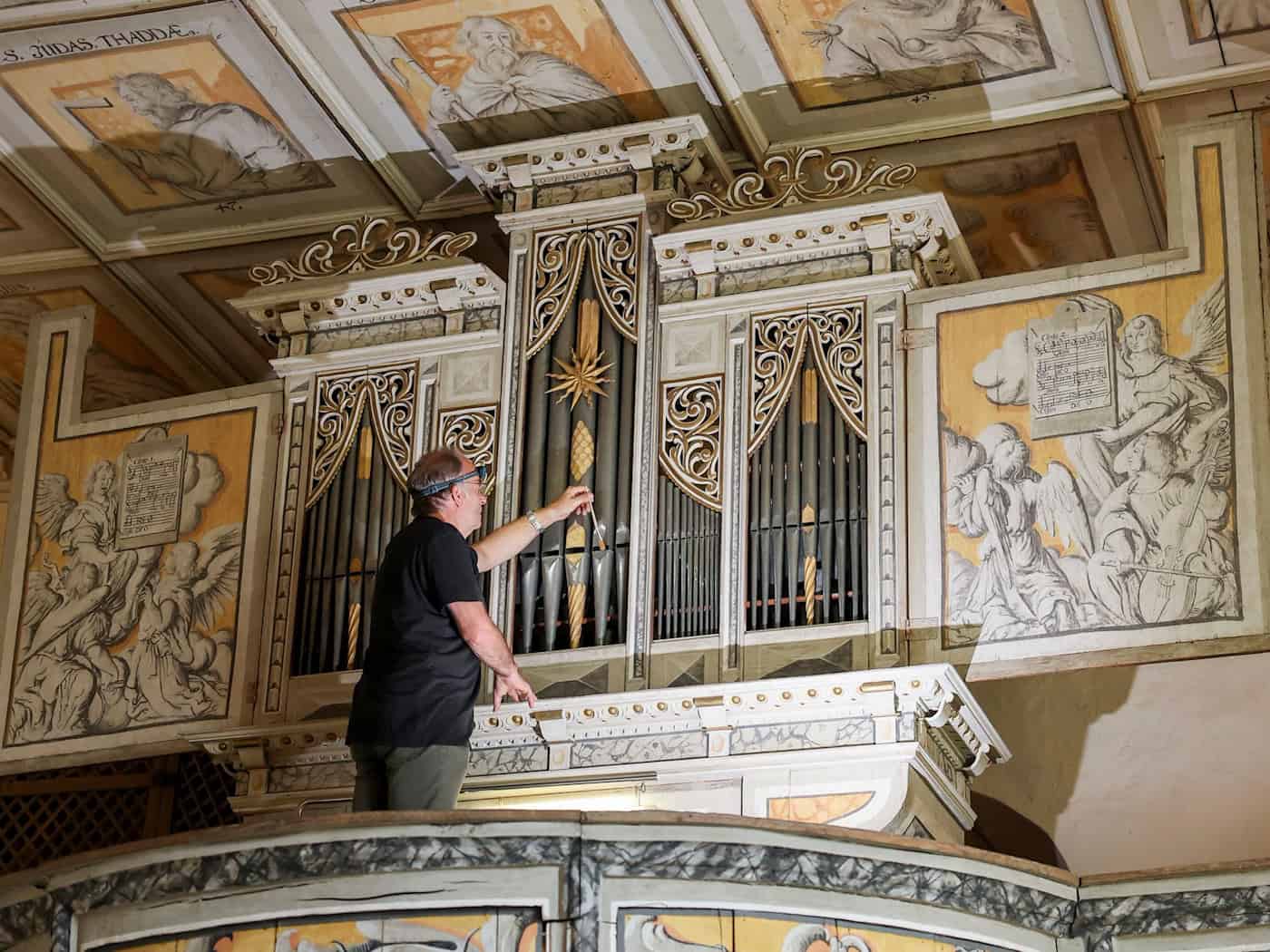
Michael Wetzel peers at an ornament on the historic organ of the fortified church in Pomßen and points to a small orange-brown pile of wood dust. “That comes from the instrument,” says the organ builder. The crumbs do not bode well, for they mean that woodworms are infesting the organ, which was built in 1671. Experts are struggling to combat the infestation—and the insect is not the only problem making the preservation of Saxony’s church organs increasingly difficult. The Free State of Saxony boasts one of the most valuable organ landscapes in Germany, says Tobias Haase, the specialist in charge of organ affairs at the Evangelical Lutheran Regional Church in Saxony. Of the 1,450 organs in churches, 1,000 are more than 100 years old. Eighty instruments even date back to before 1800 and are listed as individual historical monuments. But the rich history and the great names in organ building—such as Silbermann and Hähnel—do not protect the instruments from today’s problems. And those problems are manifold, as Haase explains. When it comes to woodworm, for example, the dilemma is that all effective pesticides are no longer approved. “It’s a trade-off between protecting health and nature versus preserving cultural monuments.” Haase estimates that between 10 and 20 percent of church organs in Saxony are infested with woodworm. At Saxony’s oldest surviving playable organ in Pomßen in the Leipzig district, organ builder Wetzel brushes wood dust—traces of the infestation—out of the cracks. “What a mess,” he grumbles. The only thing he can use against the insects are so-called molting inhibitors. “If I don’t apply enough, I won’t kill the woodworms—I’ll just make them resistant.” Fumigation is still an option, but it’s extremely labor-intensive and expensive. “We’re currently at an impasse when it comes to woodworms,” says expert Haase. The effects of climate change are also being felt in the churches. “Ten years ago, our biggest problem was mold. It’s hard to believe today that we used to wish for more dryness,” says Haase. “Today, we mourn every percentage point of humidity that’s gone.” There is a range of 50 to 70 percent relative humidity that is ideal for organs. If the humidity falls below this range due to increasing heat and dryness, the wood changes. “The dimensions change, tension builds up, and things get stuck. It also manifests as ‘howlers’: you press a key and it doesn’t spring back up,” explains Haase, who is a trained organ builder himself. To mitigate this problem, church congregations are looking for simple, inexpensive solutions. One method that has proven effective is a baby bathtub filled with water, over which cloths are hung. “That takes care of things for one to two weeks,” says Haase. In the charming church in Pomßen, cantor Cornelia Schneider is very familiar with hygrometers—devices for measuring humidity. She, too, says, “The churches are getting too dry.” It’s part of her job to go around and ensure that a certain level of humidity is maintained in the sanctuary. The increasing dryness affects not only the organs but also all works of art and furnishings in the churches. Church musician Schneider also reports on a fundamental trend affecting the preservation of organs: the declining number of church members. As a result, the instruments are simply used less—and that’s not good for them. An organ needs to be played—literally, all the stops must be pulled regularly. She herself, working a 70-percent position, is responsible for ten churches in the Leipzig area. “That involves a lot of driving and a lot of organization,” says Schneider. Instead of sitting at a desk, she’d rather be making music. However, due to structural changes in the church, positions are more likely to be cut and service areas expanded. The organ in Pomßen is faring comparatively well because of its prominent status. A support association, co-founded by former music conservatory professor Roland Börger, was instrumental in the organ’s restoration and now also supports its regular maintenance. “It’s an instrument whose sound is truly one of a kind,” he enthuses. When asked what his greatest concern is regarding the preservation of Saxony’s treasure trove of church organs, Professor Börger rubs his thumb and index finger together, silently conveying: money. Organ builder Wetzel takes a more fundamental view. “It pains me that we neglect our culture,” he says. At the State Church Office, however, the specialist in charge of organ affairs doesn’t want to paint too bleak a picture. “Organ concerts are working surprisingly well. The demand is there,” says Tobias Haase. From his perspective, the goal is to get people beyond the circle of church members excited about the instrument. “We need to create a lobby for organs,” he says. Copyright 2026, dpa (www.dpa.de). All rights reservedAt an Impasse with Woodworm
Dry conditions take a toll on instruments
Shrinking congregations, less use
Creating a Lobby for Organs