


A Rare Spectacle in the Evening Sky—Experts Offer Tips
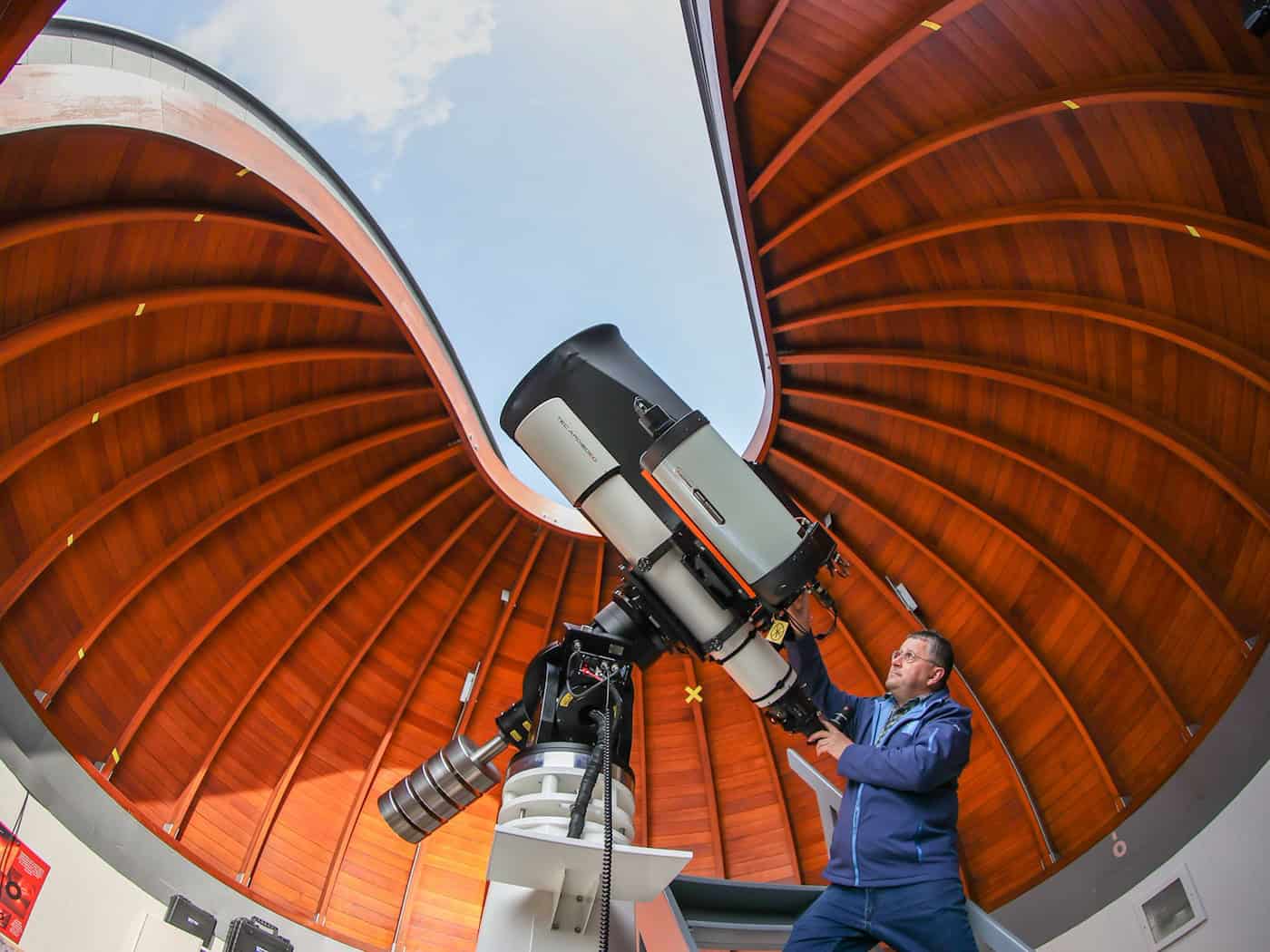
Romantics and astronomy enthusiasts will soon have the chance to witness a rare celestial spectacle in Saxony. As the sun sets on August 12, it will be partially obscured by the moon. Partial solar eclipses do occur from time to time in this country—most recently at the end of March 2025. “But this one is something very special because it happens at sunset, and the sun will set while partially eclipsed,” explains Florin Stroe of the North Saxony Observatory. This poses special challenges for some professional stargazers. The observatories in Drebach and Schneeberg in the Ore Mountains, for example, are advising against it. Anyone who wants to observe this event properly needs an unobstructed view of the horizon, says Mike Behnke of the Zeiss Planetarium and Observatory in Schneeberg. That’s difficult at both locations. Instead, those interested are advised to find a mountain with a clear view to the west. In the Ore Mountains, this is possible on the Dittersdorfer Höhe, for example, but also on the Auersberg, the Katzenstein, the Sauberg, as well as on the Fichtelberg and Keilberg, according to reports. Stargazers in Radebeul are also out of luck. “Unfortunately, during most of the eclipse, the Sun will already be so low in the sky that it can no longer be observed properly from the Radebeul Observatory,” reports the local astronomy club. That’s why they’re inviting people to Dresden. At the Gönnsdorf Observatory on the outskirts of town, the program begins in the late afternoon with expert presentations. Starting at 7:00 p.m., interested visitors can then watch the spectacle in the evening sky using special glasses and telescopes equipped with special filters—provided clouds don’t block the view, as Frank Bok from the observatory emphasizes. In that case, there will be a livestream from another observation site in the seminar room. According to the European space agency ESA, the sun will be completely obscured on August 12 in Greenland, Iceland, Spain, and a small part of northeastern Portugal. In Saxony, the eclipse will still cover more than 80 percent of the sun. The spectacle in the evening sky will begin around 7:17 p.m. and reach its peak around 8:10 p.m. However, experts warn against looking directly at the sun, as this can damage the retina. “Anyone who wants to watch this natural phenomenon live should definitely protect their eyes,” warns the Federal Office for Radiation Protection. Sunglasses do not provide adequate protection. Instead, special protective glasses and filters should be used. They filter out a large portion of the sunlight. People in the Vogtland region and northern Saxony are also eagerly awaiting this special celestial event. The Rodewisch Observatory will get visitors in the mood ahead of the event with a lecture titled “In Pursuit of the Black Sun”; in the evening, observations through telescopes will be offered. At Eilenburg and Schkeuditz, interested visitors can also view the partial solar eclipse under expert guidance—not at the observatory itself, but at special locations with an unobstructed view. These events are already fully booked. Once the sun has set on August 12, there will still be plenty to see in the sky over Saxony. From midnight into the early morning hours, many shooting stars will be visible under a cloudless sky, according to experts. That’s when the Perseids reach their peak. They’ll be particularly easy to spot because the moon won’t interfere, experts say. That’s why Rodewisch, Eilenburg, and Schkeuditz are hosting “Shooting Star Nights.” They’ll be best observed starting at midnight, explains expert Stroe. And August offers another highlight in the sky. However, anyone who doesn’t want to miss it will have to get up early. On the morning of August 28, the moon will be obscured by the Earth’s shadow. The partial lunar eclipse is expected to begin around 4:30 a.m. and reach its peak around 6:12 a.m., before the moon sets a good ten minutes later. Special programs and viewing events are planned for this occasion in Eilenburg and Schneeberg, among other places. Copyright 2026, dpa (www.dpa.de). All rights reservedCaution advised—experts recommend special protective glasses
More highlights in the sky: shooting stars and a lunar eclipse

