

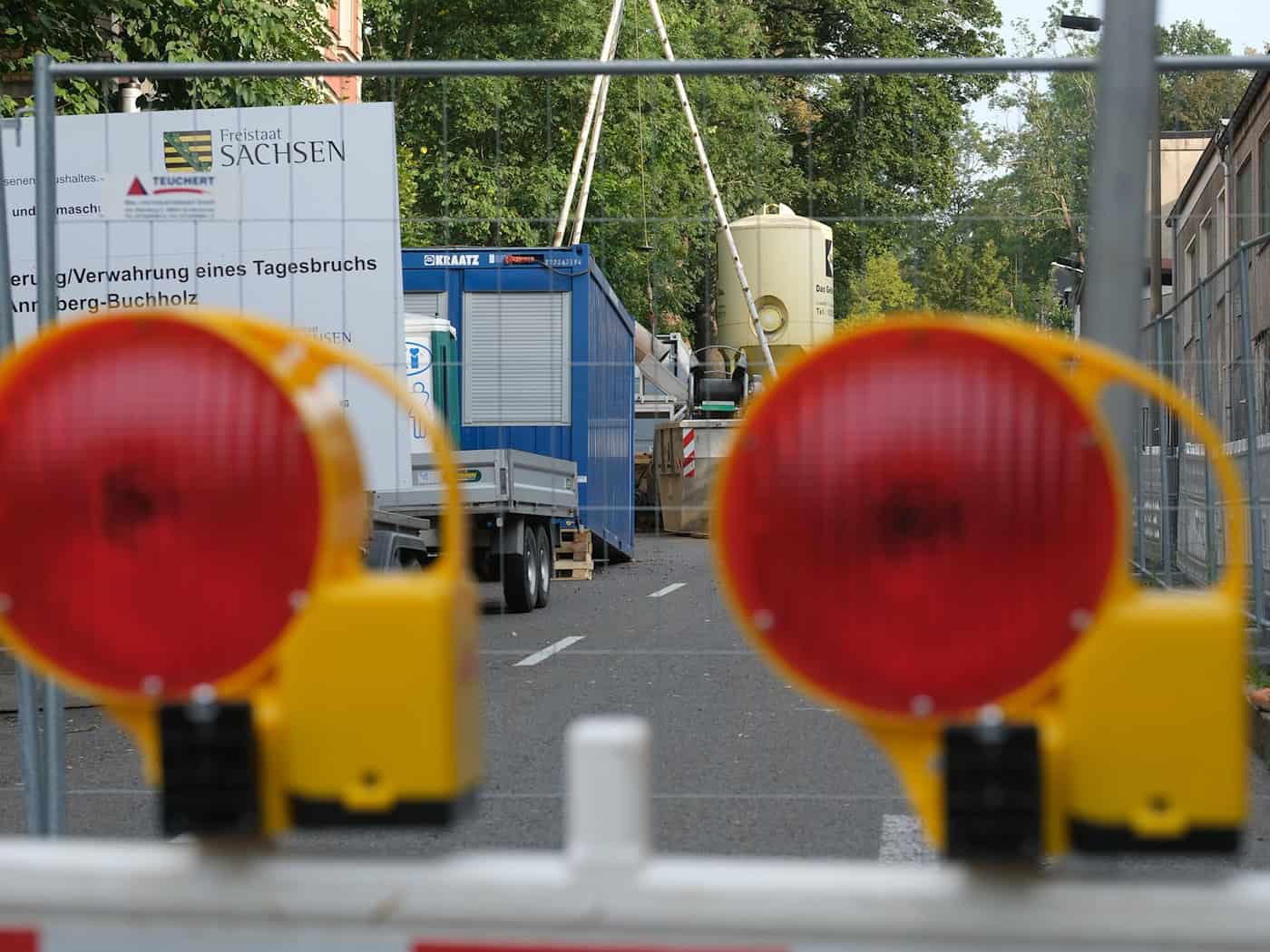
The consequences of mining continue to cost Saxony millions. Last year, the State Mining Authority spent approximately 17.4 million euros on hazard mitigation related to abandoned mines, according to Mining Commissioner Bernhard Cramer in response to a dpa inquiry. According to him, more than 40 incidents of damage have already been reported this year as well. These range from cracks and fissures, subsidence, and crater-like sinkholes to shaft collapses and uncontrolled water leaks. A sinkhole on a road in Annaberg-Buchholz recently caused quite a stir. A large hole opened up there in June, but no one was injured. Bärensteiner Straße has been completely closed off since then. Cramer explains that a geological survey of the sinkhole is currently underway. Only once the results are in will it be possible to make more precise statements regarding the scope of further work, the timeline, and the costs. “Afterward, the mine workings will be secured.” The city most recently reported that the sinkhole was about five and a half meters deep. Between 2020 and 2025, approximately 80 to 110 incidents of damage resulting from legacy mining were reported annually, explains Cramer. “Thanks to extensive hazard mitigation measures and preventive measures to address the consequences of mining, a downward trend in damage incidents is evident.” However, extreme weather events such as flooding and heavy rainfall could lead to significant damage even in areas surrounding former mining sites, as the years 2002 and 2013 demonstrated. The Ore Mountains are particularly affected, where silver and cobalt were mined for centuries, and later uranium as well. “But reports of damage are also regularly recorded in the coal-mining regions of Zwickau, Lugau/Oelsnitz, and Freital,” explains Cramer. He cited the collapse of the Augustus shaft into a garden in Freital in 2022 and the ground collapse on Dörfler Weg in Annaberg-Buchholz in 2013 as particularly major damage incidents in recent years. Former uranium mining in the GDR also occasionally causes damage. For example, in December 2014, there was a ground subsidence near Shaft 38 in Bad Schlema. “This created a sinkhole measuring approximately 6 by 8 meters and about 10 meters deep,” explains Ina Mättig, spokesperson for Wismut, the federally owned mining remediation company. At the time, the shaft was considered to have been properly sealed; the cause was identified as a geological fault zone deep underground. All newly discovered cavities were filled with concrete. Abnormalities were also detected in late 2023 in the spa park of Bad Schlema, which is located on former mining land. Monitoring data had indicated changes in the subsurface and the risk of a ground collapse. However, according to Mättig, more than a dozen boreholes failed to locate any major cavity. According to the information provided, there had previously been ground collapses there in the 1990s, which were filled in at that time. Copyright 2026, dpa (www.dpa.de). All rights reservedIn some years, more than 100 incidents of damage caused by legacy mining
Ground subsidence from former uranium mining


