

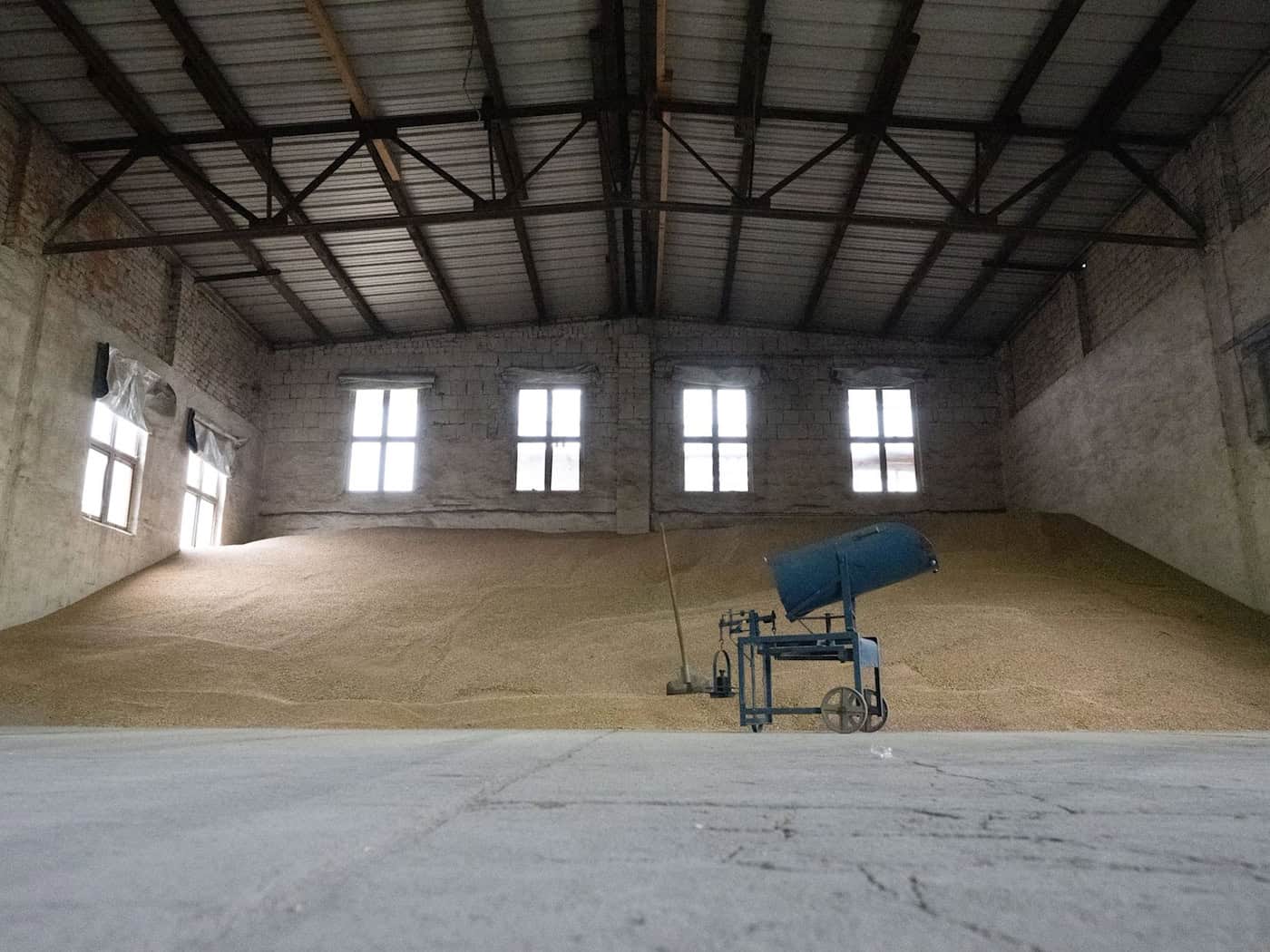
This year’s harvest is taking a heavy toll on Saxony’s farmers, as heat and drought are reducing both yield and quality. “For many grain crops as well as for rapeseed, temperatures exceeding 35 degrees over a period of more than a week led to an abrupt end to the grain-filling phase,” the State Farmers’ Association reported. This brought the yield increase to a halt, and in some regions, the grain entered a state of so-called “emergency ripening.” Even the rain in July contributed little to further yield growth. According to Farmers’ Association President Torsten Krawczyk, grain quality deteriorated significantly during the heat wave. “It was virtually impossible to produce high-quality wheat under this year’s conditions.” This is also reflected in the prices that Saxony’s farmers were able to command for their products. “To make matters worse, the costs of fertilizer, diesel, seed, crop protection, logistics, and wages have only risen in recent years.” “The gap between revenue and costs is widening more and more. Even the best yields are no longer enough. We lack the financial resources for urgently needed investments in our farms,” Krawczyk emphasized. We are far from being able to build up reserves for future challenges. We expect policymakers to take decisive and swift action at all levels of the entire value chain—to ensure fair economic conditions rather than imposing further one-sided burdens. According to Krawczyk, results vary depending on the crop and region. Overall, the harvest must be described as slightly below average. For farms, however, this still feels “bad to catastrophic.” “We’ve planted the most expensive crop ever in the fields. Our costs have skyrocketed over the past year—and have been trending that way for the past few years. Of course, this isn’t necessarily related to the weather or climate change,” he told the German Press Agency. Rather, the president of the farmers’ association said, the conditions resulting from political decisions in Germany are so poor that even an average harvest is no longer enough to make a decent living. “There is currently no longer any connection between the harvest and the success of the farm.” Climate change and heat should not distract from the fact that farmers are under extreme strain due to completely misguided political decisions. In this context, he pointed, among other things, to high energy prices. We need to dispel the myth that farmers have to learn to adapt to climate change, said Krawczyk. Twenty years ago, with this water scarcity, they wouldn’t have come close to achieving the yields they’re currently achieving. “Farmers are extremely well-prepared for this, especially those in eastern Germany.” Here, they have been struggling with water shortages since 2018. “2026 is a year that has hit our agricultural sector hard. Heat, pests, and rising costs are taking a toll on the industry. The situation is particularly dire for rapeseed, not least because the lack of approvals for effective pesticides is tying our farms’ hands,” explained State Secretary for Agriculture Ulrich Menke. This is not an act of nature that we simply have to accept. “It is also the result of framework conditions that we can and must change through policy.” According to preliminary estimates, the average yield for grain overall was 70.3 decitonnes per hectare. This result is 0.8 percent above the six-year average. However, there are significant differences among the crops. For winter wheat and rye, the yield is about six percent below the long-term average, while for winter barley, it is 13.8 percent above the average of the last six years. For winter rapeseed, the yield is 11.6 percent lower. Copyright 2026, dpa (www.dpa.de). All rights reservedMassive Deterioration in Grain Quality
Results feel “bad to catastrophic” for farms
Farmers Have Already Adapted to Climate Change


