

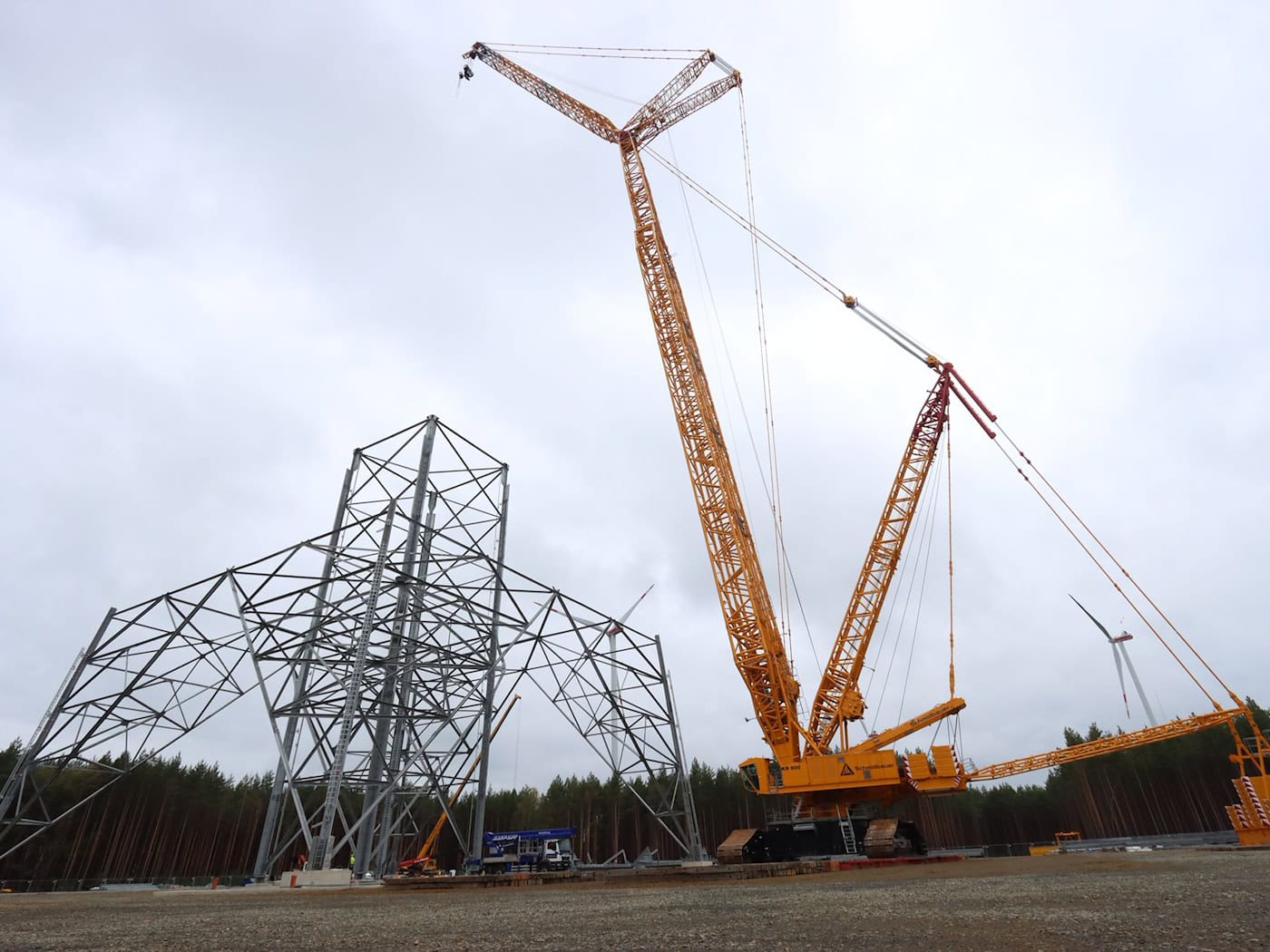
The world's tallest wind turbine is set to begin operating in southern Brandenburg. According to the company Gicon, construction work on the gigantic tower, which is expected to reach 365 meters, is nearly complete. At the site in Schipkau, in the coal-mining region of Lusatia, the project’s developers aim to set a world record. However, the schedule for the decisive phase has been delayed due to weather conditions and strong winds. Instead of this Sunday as planned, the colossus is now set to reach its final height sometime next week, as the Dresden-based company explained. A community festival is still scheduled to take place today as planned. In the coming years, it remains to be seen whether the XXL prototype—designed to achieve higher electricity yields—will set a precedent and lead to the upgrading of wind farms. The developers describe it as a pioneering achievement and call it a key project for the energy transition. The wind turbine, which was erected in an existing wind farm, is considered an innovation. It consists of a type of lattice tower and a steel structure that is more reminiscent of power poles. “With over 2,000 metric tons of steel and 22,000 individual parts, the lattice tower is an engineering masterpiece,” Gicon enthuses. The turbine was initially assembled at an easily accessible height. It must then be raised to its final position using a telescoping mechanism attached to the inner tower. Of course, there are also large rotor blades, which—contrary to plans—could not yet be installed due to the weather. According to Gicon, the hub height of the turbine is 300 meters, bringing the total height to 365 meters. By comparison, Berlin’s TV Tower, at 368 meters, is currently considered Germany’s tallest structure. According to the current assessment by the German Wind Energy Association, it is indeed the world’s tallest wind turbine. Conventional wind turbines have a hub height of well under 200 meters. However, according to the Wind Energy Association, particularly tall wind turbines are already in operation, especially in southern Germany, where there is less wind than in the north, for example. Max Bögl recently launched a 199-meter-high hybrid tower as a mass-produced product. With the rotor blades included, the turbines stand a total of 280 meters tall, according to the association. The Gicon Group, headquartered in Dresden, is building the wind tower on behalf of the Federal Agency for Breakthrough Innovations, which was founded in 2019. Its mission is to help groundbreaking ideas achieve a breakthrough and it can provide government funding for them. “SPRIND aims to build a bridge between the spirit of research and entrepreneurship,” writes the Federal Agency in Leipzig. According to its own figures, it has funded more than 300 projects since its founding. “Our funding typically ranges in the single-digit millions, but can amount to up to 35 million euros in individual cases,” the Federal Agency states on its website. Gicon does not specify the total investment costs for the high-altitude wind tower. At higher altitudes, wind conditions are generally stronger and more consistent. According to Gicon, this allows the giant wind tower to generate roughly twice the energy output of a conventional wind turbine with the same rotor diameter. There is talk of a more consistent power feed-in. This is expected to improve renewable energy generation even at sites with low wind speeds. The high-altitude wind tower is expected to eventually produce electricity for up to 7,500 households. According to the company, the pilot plant will be commissioned with a rated output of 3.8 megawatts. Future turbines are expected to reach more than 7 megawatts, the company said. In addition, high-altitude wind towers could be erected within existing wind farms in the future, thereby supplying additional energy without requiring new land outside these farms, the company stated. The Wind Energy Association initially describes the project in southern Brandenburg primarily as a feasibility demonstration: The lattice tower is not a mass-produced product. “It will therefore be crucial to see what operational data the turbine provides and whether it actually achieves the yields forecast in the wind studies,” the association said. However, Gicon plans to begin mass production in the early 2030s. In Germany alone, there is currently the potential to retrofit up to 4,000 high-altitude wind towers in existing wind farms as a so-called “second story,” according to the developer. Together with the Federal Agency for Breakthrough Innovations, a concept for the future commercialization of the technology is being developed. “To this end, we are already in close contact with several potential partners and interested parties from the wind energy industry.” Copyright 2026, dpa (www.dpa.de). All rights reservedWhat makes the tall wind tower special?
Is this actually the world’s tallest wind turbine?
Who else is involved in the pilot project?
Why is a wind turbine being built at this height?
A milestone for the future of wind farms?


