

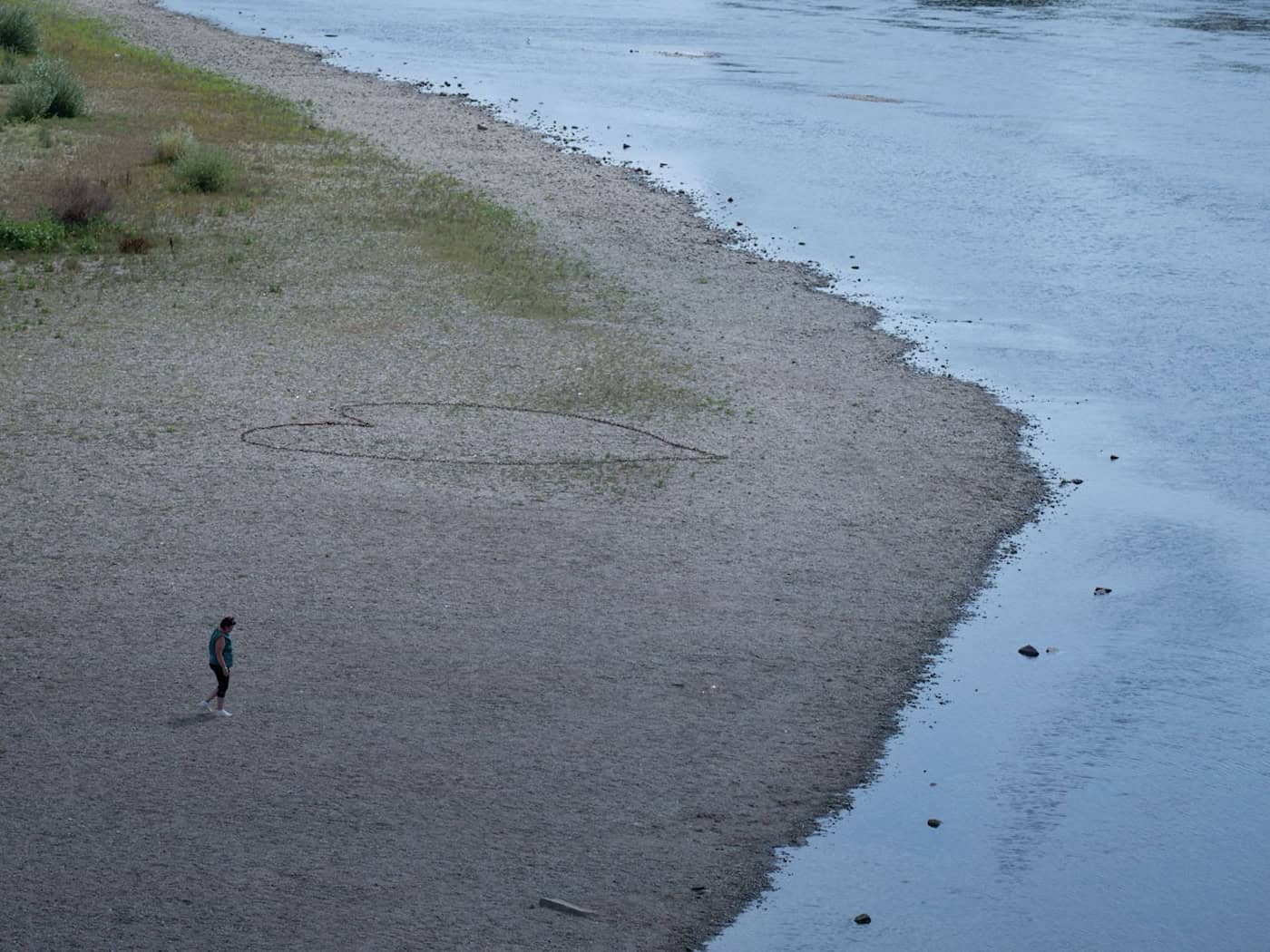
Anyone looking at the Elbe or other rivers right now will see one thing above all else: low tide. The water level at Dresden is still just over half a meter. Twenty-four years ago, the situation was completely different. In August 2002, the Elbe in Dresden rose to a previously unseen high of 9.40 meters and flooded parts of the city. Since then, the feeling of having far too much water has faded. Even though there was another once-in-a-century flood in 2013 and the river has overflowed its banks on several occasions since then, the prevailing impression today is different. In light of drought and heat, the anxious question arises: What will the future of our water supply look like? What if climate change continues at this rate? Where will our water come from? In Saxony, this is a major concern, particularly at the State Office for the Environment, Agriculture, and Geology. This is where the Free State’s water experts are based. This is also the location of the State Flood Center, which is responsible not only for flood management but also for the state’s general hydrology. Climatologist Daniel Hertel points out the unique situation of eastern Germany. Unlike the west, the east is characterized by a continental climate and generally receives less precipitation even without climate change. Hertel explains the so-called westerly circulation: Clouds from the Atlantic release their rain over various low mountain ranges on their way east and can lose additional moisture over land. Even within Saxony, variations in precipitation distribution can be observed. Rainfall is heavier in the Ore Mountains than in eastern Saxony. Lusatia is considered a cause for concern regarding water for another reason: Here, decades of lignite mining have practically drained an entire region of its water. Two and a half years ago, Saxony’s previous government launched the “Future Water for Saxony” program. It outlines future requirements—ranging from public water supply and adjustments to dams to water retention across the region and management during periods of low water. The investment need was estimated at the time at 1.6 billion euros. Given the scale of the tasks, water expert Andy Philipp believes the need could grow even further in the long term. Given the Free State’s tight budget situation, it is doubtful whether all measures in the program can be implemented. One thing is certain: Securing the water supply is a generational task that will require many more billions of euros. Officials at the responsible state agency are far from scaremongering. But people like Philipp know that the public, too, will have to adapt to changes in the long run. In fact, Saxons are already the biggest water savers in Germany today. In Germany, current water consumption stands at about 125 liters per day; in Saxony, it’s less than 100 liters, says Philipp. This is primarily due to investments in water infrastructure following German reunification. New pipelines and new technology in the east ensure less water loss on the way to consumers. Philipp considers it a great luxury that, in this country, water of excellent quality is delivered free of charge—more or less at cost—right to your doorstep. About 40 percent of the population in Saxony gets their drinking water from reservoirs—a high figure by national standards. When an expert like Philipp talks about a water problem, he isn’t necessarily referring to the quantity of water, but rather to its availability at certain times. According to the State Reservoir Administration, Saxony’s reservoirs received only one-third of their usual inflow this July compared to the average for this month. The consequences are particularly evident at the Lehnmühle Dam in the Eastern Ore Mountains. It is currently only about half full. A stone bridge in the reservoir, which is usually completely submerged, has reappeared. A “dry spell” in Saxony has been evident—at least to experts—for more than ten years. Groundwater levels have been declining since 2013. This was followed by three severe drought years starting in 2018. Only 2021 was an exception. There are no longer any significant snow reserves from the winter, which in turn affects groundwater levels. Evaporation is increasing, partly because the temperature and intensity of sunlight are rising as the atmosphere becomes increasingly cleaner. “The water balance has come under pressure in recent years because we’ve almost always had below-average precipitation,” reports Philipp. In 2026, we’ll be on that same path again. “That in itself isn’t dramatic, but it accumulates from year to year.” So far, there has still been enough water to meet everyone’s needs. But without precautions, that won’t remain the case. According to Philipp, the focus in the future will be much more on retaining stormwater in cities and rural areas—keyword: “sponge city.” It remains unclear to what extent the population will need to reduce water consumption in the future, for example during the summer months. The counties are already responding today with bans on water withdrawals from surface waters. Overall, pressure on water as a strategic resource will increase. To promote more sustainable water use, Philipp advocates for a nationwide model based on the Bavarian example: There, a so-called “water cent” is levied on larger-scale water use. A uniform fee of 10 cents per cubic meter (1,000 liters) is now charged for groundwater extraction, with an exemption of 5,000 cubic meters per year. “That’s certainly a lever we could pull,” Philipp is convinced. It does no good to gloss over the problems. With sound arguments, consumers could certainly be persuaded. The need to think outside the box is demonstrated by another requirement facing Saxony’s water management sector. Under an inter-state agreement with Berlin and Brandenburg, the Free State is required to release sufficient water into the Spree, especially during dry periods. During low-water periods, about half of the water in the Spree comes from the “dewatering” of open-pit lignite mines—the pumping out and removal of groundwater, seepage water, or mine water. This raises the question of what will happen once the lignite era comes to an end. According to Philipp, a complete cessation of water inflows from the open-pit mine could be problematic under certain circumstances, such as for water-based tourism in the Spreewald. To maintain the available water volumes in the watershed—especially during dry spells—it would be necessary to continue “dewatering” at least intermittently or to create more storage capacity. A third option being considered is a transfer pipeline from the Elbe to the Spree—but there is resistance to this as well. The transfer pipeline—a system of pipes with pumps—is likely to be a financial challenge above all else. Depending on the estimate, several hundred million euros have been budgeted so far just for the transfer route alone. The annual operating costs—for pumping the water, for example—can be estimated at a single-digit million figure. Philipp also points out the timeframe for such a project. “This isn’t something you can just build in a few years.” That is another reason why water management remains a task for generations to come. Copyright 2026, dpa (www.dpa.de). All rights reservedEastern Germany is drier than the west
“Future Water for Saxony” Program
Saxons are a national role model in water consumption
Inflow into the reservoirs has dropped dramatically
Pressure on water as a strategic resource is mounting
Convincing consumers with sound arguments
Saxony Must Supply Water to Brandenburg and Berlin


