

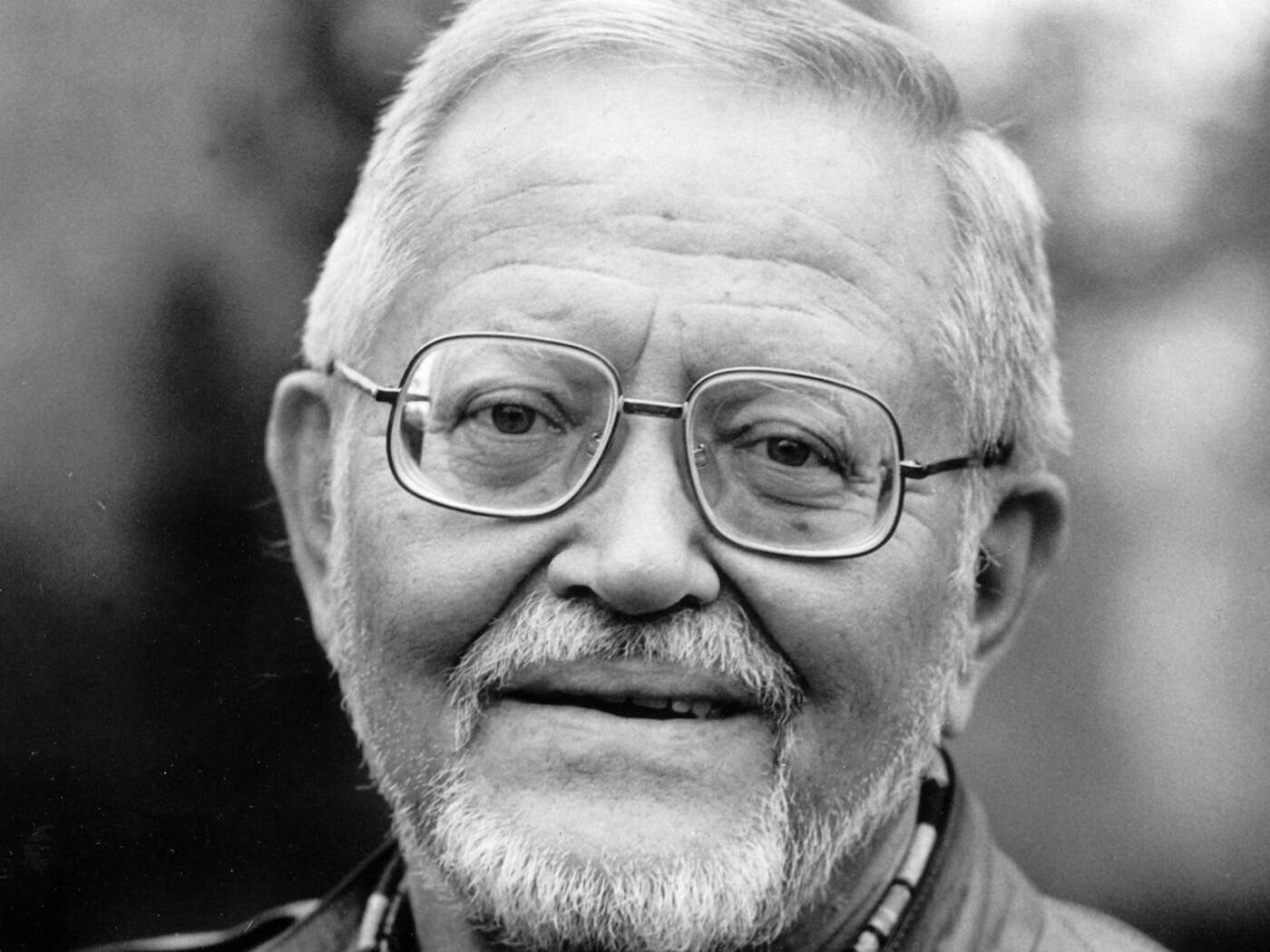
Even its very first sentences—spoken on the evening of March 21, 1960—are pure propaganda: “The ‘Black Channel’ we’re referring to, ladies and gentlemen, carries filth and sewage. But instead of flowing into irrigation fields, it pours daily into hundreds of thousands of West German and West Berlin households. It is the channel on which West German television broadcasts its programming … And from today on, we will devote ourselves to it every Monday at this hour, as a sort of sewage treatment plant …” Ever since that evening, Karl-Eduard von Schnitzler has commented on current events in the FRG every Monday around 9:30 p.m. with his sharp tongue. Always following the popular “Monday Movie” from the Ufa era. Schnitzler’s trademark: a jacket, shirt, tie, and thick-lensed glasses; all paired with a cutting tone. On the show “Der Schwarze Kanal”—the “Schwarz” (black) also referred to the CDU/CSU federal government—he engaged in polemics for nearly three decades. Until just a few days before the fall of the Berlin Wall. Schnitzler died on September 20, 2001—25 years ago now. The life story of this GDR TV agitator, born in 1918, is unusual: He came from an upper-class banking family in Cologne. His father, Julius Eduard von Schnitzler, had served the Kaiser as a diplomat. After graduating from high school, Karl-Eduard studied medicine for one semester in Freiburg im Breisgau. In 1937, Schnitzler joined the banned Communist Party of Germany, by his own account, and was expelled from the university a year later. In 1944, he was taken prisoner by the British. He became the editor-in-charge of the BBC program “German Prisoners of War Speak to Their Homeland,” which aired daily for 30 minutes. In 1945, Schnitzler was released from British captivity. On January 1, 1946, he helped found the Northwest German Broadcasting Corporation (NWDR) in Cologne. He became deputy director. But his time at the NWDR came to an end in December 1947. He was dismissed because of his socialist convictions, Schnitzler wrote later in a written statement. He moved to the Soviet Occupation Zone, joined the SED in 1948, and attended the Party College. The newcomer, with the aura of a “red nobleman,” repaid the favor on Berlin radio with paeans of praise for the party leadership. With his intellectual charisma and in-depth knowledge, he quickly made his breakthrough. Starting in 1952, Schnitzler took over as head of the State Broadcasting Committee’s commentary team for six years—and also became chief commentator for GDR television. “Treffpunkt Berlin” was the name of his political TV show, in which he primarily attacked Federal Chancellor Konrad Adenauer (CDU). Yet, according to Schnitzler’s own accounts, he had once enjoyed sitting on Adenauer’s lap as a child. As Schnitzler wrote in his biography *Meine Schlösser oder wie ich mein Leben lang Klassenkämpfer war* (1989), Adenauer used to be a guest at the Schnitzler family villa from time to time. In the very first episode of “Schwarzer Kanal,” Schnitzler took aim at the chancellor, who was speaking about improving NATO logistics in the event of a Soviet attack. The GDR’s chief television propagandist railed: “This man is not only a lying troublemaker, he is a dangerous troublemaker … he is cold-bloodedly and unscrupulously calculating for war.” The concept behind “Schwarzer Kanal”: Schnitzler presented clips from West German television programs and then interpreted them in line with GDR state doctrine. The host, who was nicknamed “Sudel-Ede” on both sides of the Wall, always provided supposed evidence that the GDR was the better German state: Layoffs, strikes, military buildup—in his view, symptoms of the West’s decline, from which the workers’ and peasants’ state remained spared. But the planned ideological indoctrination of GDR citizens went completely awry: Most switched over to Western television before the propaganda program even began. A joke circulating at the time went like this: “Von Schnitzler asks his neighbor why he always addresses him as ‘Mr. Schnitz.’ The neighbor replies: ‘You see how quickly I always switch off the TV as soon as your face appears.’” The program was mandatory, however, in barracks, apprentice dormitories, and student housing. And: In the West, some people watched it for amusement. As late as 1989, Schnitzler was still agitating as ever: He railed that the citizens’ movement in the GDR was organized by Western television. Meanwhile, participants in the Monday demonstrations chanted “Schnitzler to the open-pit mine” or “Schnitzler on The Muppet Show” (Source: bundesregierung.de). On October 30, 1989, East German television finally took “Schwarzer Kanal” off the air. A few days later, the Wall fell. Schnitzler was allowed four minutes to say goodbye—in his own unique way: “Some may rejoice that I am now continuing this television work in a different way. … I will continue my work as a communist and journalist for the only alternative to inhuman capitalism. As a weapon in the class struggle, to promote and defend my socialist homeland. See you again.” He could not save GDR socialism—but at least Schnitzler achieved a personal victory in the battle of the systems: He appeared on screen significantly more often than his ideological opponent from the West: Gerhard Löwenthal on “ZDF-Magazin.” This program was the epitome of the Cold War on West German television. Löwenthal’s run ended after 585 episodes—Schnitzler appeared in around 1,300 episodes. In 1990, he became a member of the DKP; in 1991, he briefly served as a columnist for the satirical magazine “Titanic.” As late as 1997, Schnitzler declared that it had been “entirely right to build the Wall.” Until the very end, he attributed the downfall of the GDR to betrayal by the Soviet Union. On September 20, 2001, the unpopular agitator died at the age of 83. Copyright 2026, dpa (www.dpa.de). All rights reservedCareer beginnings: BBC and Nordwestdeutscher Rundfunk
From Aristocratic Scion to Agitator
First a friend, then an enemy: Konrad Adenauer
Western TV More Popular Than “Schwarzer Kanal”
“Schnitzler on The Muppet Show”
A Communist Until Death


