

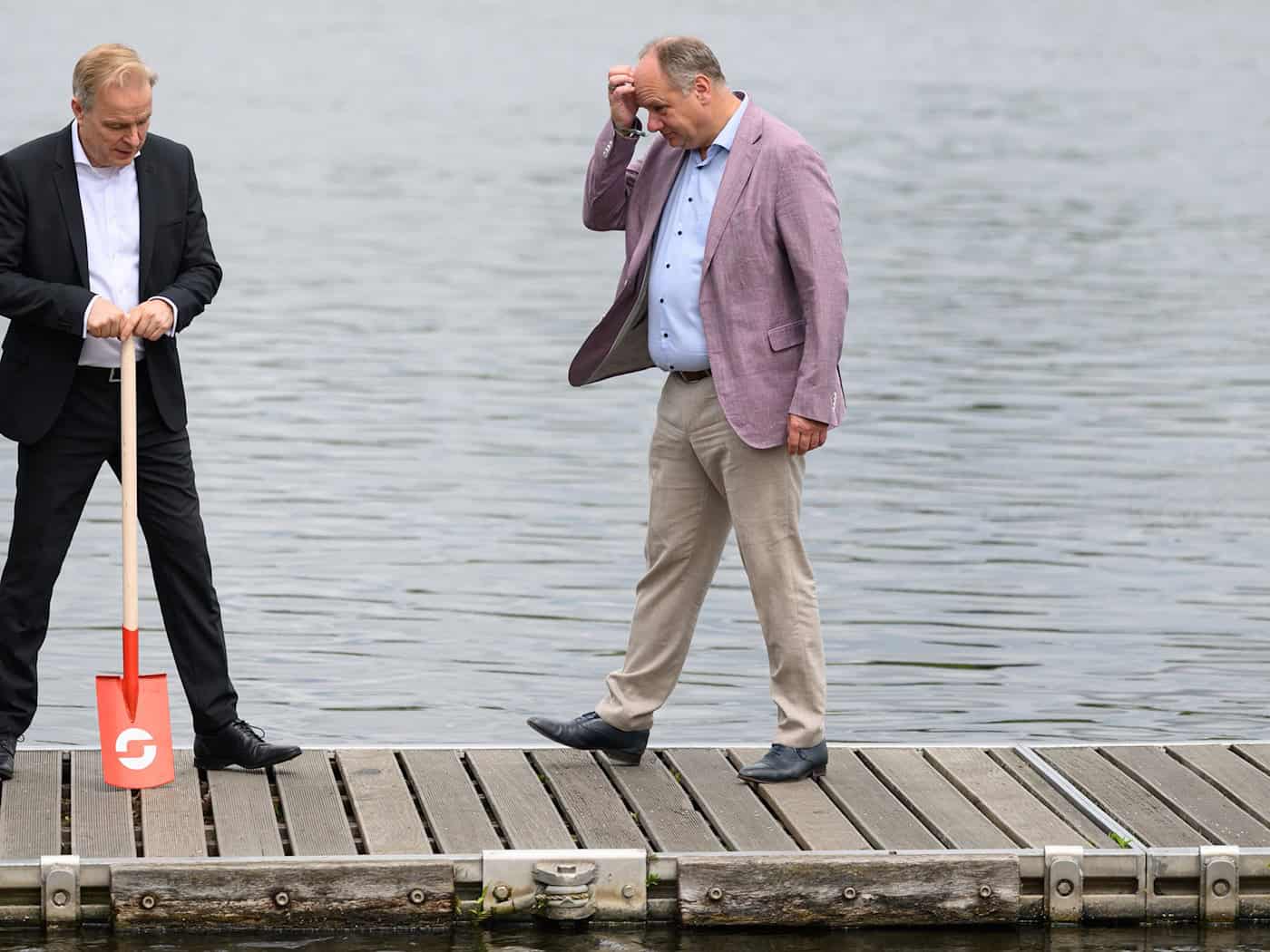
The semiconductor industry in Dresden is to obtain its process water from a river water plant on the Elbe from 2030. A general contractor, Hochtief, has now been commissioned with the planning, approval and construction of the plant, according to Sachsenenergie. The investment currently amounts to more than 300 million euros. The state of Saxony is contributing 100 million euros and the city of Dresden 50 million euros. "One of the basic requirements for semiconductor production is an efficient and reliable water and energy infrastructure," said Frank Bösenberg, Managing Director of the Silicon Saxony industry association. The river water plant provides an impetus for further growth in the local semiconductor industry. Silicon Saxony intends to announce exact figures on the development in the coming week. "The signs are pointing to growth," said Bösenberg, giving a foretaste. On July 2, Infineon will open its new plant in Dresden - three months earlier than planned. The ESMC chip plant is currently being built in the north of the city - a project by Taiwanese industry giant TSMC with Bosch, Infineon and NXP Semiconductor. The investment amounts to ten billion euros. Infineon is investing around five billion euros in its new production facility. Mayor Dirk Hilbert (FDP) sees the river waterworks as a key building block "to further strengthen Dresden's leading role as the heart of European microelectronics". The waterworks will conserve the valuable resource of water and create security of supply for Dresden as a semiconductor location. At the same time, the project is important for the population's drinking water supply because industrial water and drinking water are decoupled. "Anyone talking about Europe's semiconductor future cannot ignore Saxony. Silicon Saxony is already showing what European technology leadership can look like. Now it is important to consistently build on this strength and establish Saxony as a central building block of European technological sovereignty," emphasized Saxony's MEP Oliver Schenk (CDU). In order to future-proof the water supply for the population and industry, Sachsenenergie is gradually separating the drinking water supply from the supply of industrial water. The waterworks is being built in the Übigau district and will supply the chip manufacturers in the north of Dresden via two underground pipes from the end of 2030. Until then, a capacity expansion at the Hosterwitz waterworks is intended to quench the growing "thirst" of the industries. The plant can supply up to 67,000 cubic meters of water per day. Between 80 and 90 percent of the water used flows back into the Elbe via the urban drainage system after being cleaned. Even when the Elbe is at low water, less than 0.23 percent of the water that flows through Dresden every second is to be extracted. According to Sachsenenergie CEO Frank Brinkmann, the construction of the river water plant is also attracting international interest. The experience gained so far is already being requested by other regions in Germany and Europe. Inquiries have been received from the Netherlands and France, among others. The project could therefore serve as a model for other industrial locations. Copyright 2026, dpa (www.dpa.de). All rights reservedWaterworks to enable growth in the semiconductor industry
Waterworks for security of supply
Capacity expansion to quench the industry's thirst by 2030
Most of the extracted water flows back into the Elbe after being purified


