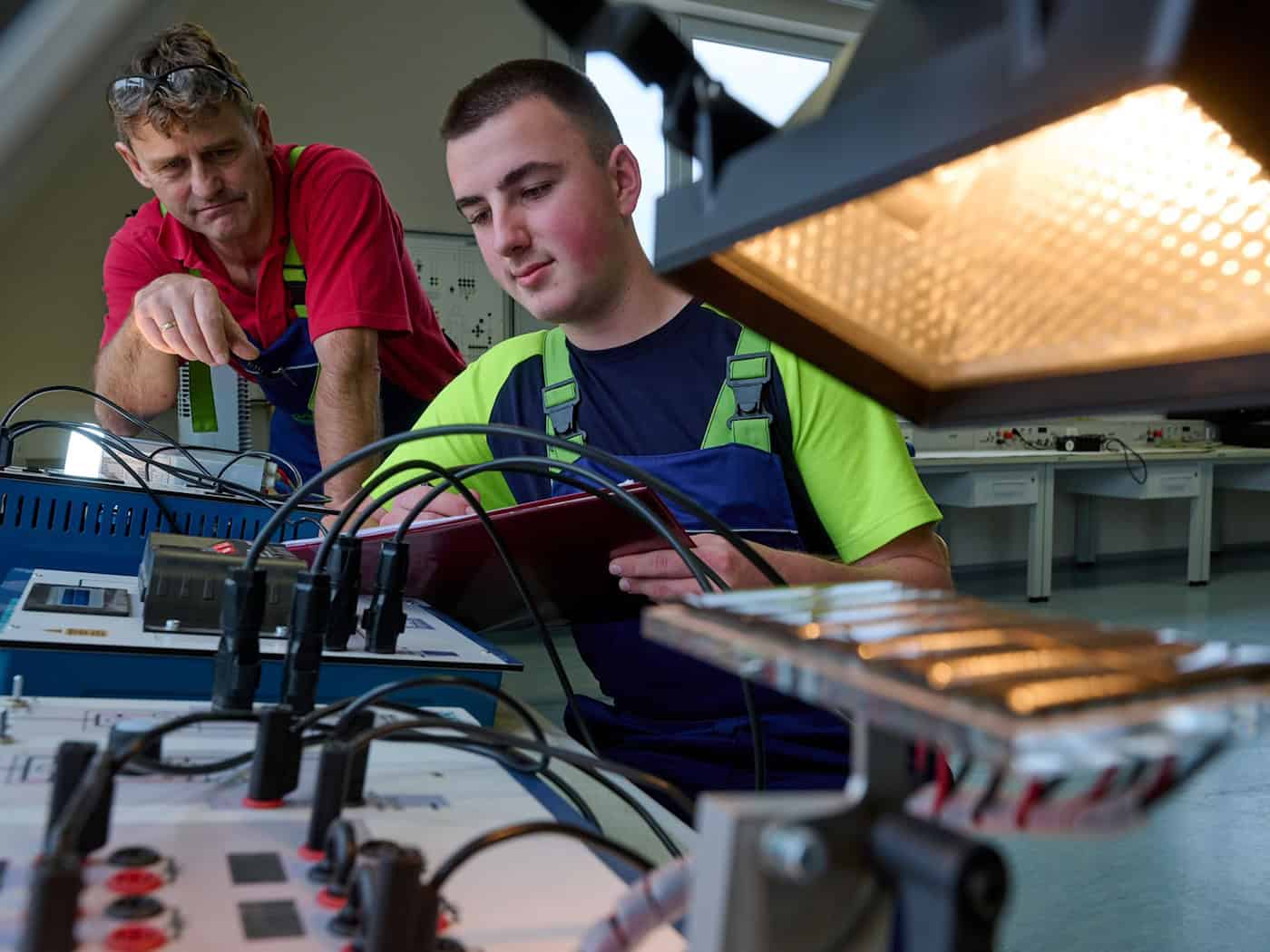
By the time Harald Spangler completes his apprenticeship as an electronics technician, only a few years will remain until the planned end of coal-fired power generation in the Central German mining region. And already, Mitteldeutsche Braunkohlengesellschaft mbH (Mibrag)—where the 19-year-old began his vocational training this year—is gradually winding down coal production in its open-pit mines. Just recently, the last coal excavator left the Schleenhain mining field. By the end of the year, coal mining there will come to an end after decades of operation. Nevertheless, the aspiring electronics technician from nearby Lucka is counting on the coal company for his professional future. Why is he doing this? “The electronics technician profession is still future-proof,” he says. What’s more, Mibrag is focusing on photovoltaics and wind power in the future. The 19-year-old is certain that his profession will still be “in demand and important” even then. Currently, however, the focus in the mining region remains on extracting lignite. And electricity is what powers coal production on both sides of the border between Saxony-Anhalt and Saxony. “Open-pit mining is simply still the largest area of application at the moment,” says Nico Pook, managing director of the group’s own Mibrag Training Center. Electronics technicians like Harald Spangler control and monitor the power grid at the open-pit mine and at the company’s own industrial power plant in Wählitz near Hohenmölsen. The power plant supplies the open-pit mines with electricity and also provides heat to the surrounding communities. Numerous cables as thick as an arm carry a voltage of 6,000 volts like lifelines to every corner of the coalfield. The open-pit excavators, weighing around 1,000 metric tons, kilometer-long conveyor belts, and numerous pumping systems that remove water from the mining fields—they all require electric drives. The scale is incomparably greater than that of the electrical system in a household moped. “Yes, you definitely have a lot of respect for that,” says apprentice Spangler. But the 19-year-old’s professional life will one day extend beyond coal. According to Mibrag, wind and solar power plants with a combined capacity of 100 megawatts have already been built. By the end of 2027, Mibrag aims to have renewable energy plants with a total capacity of 255 megawatts in operation. “We’ve now essentially moved from the planning phase to the implementation phase,” says spokesperson Swantje Ehlers. However, operating a wind farm does not require the same number of staff. Mibrag also focuses on engineering services, freight car maintenance, as well as recycling and resource recovery. Employees are also needed for land reclamation: Even after the last coal has been extracted, heavy equipment must be operated and maintained. Added to this is the monumental task of mine remediation. Harald Spangler may one day be involved in the decommissioning of the mining operation. The 19-year-old’s interest in the work was instilled in him by his own family. His father, too, trained as an electronics technician at Mibrag. Nico Pook hears stories like this time and again. In some families, the connection to Mibrag stretches back over generations, reports the managing director of the Mibrag Training Center. The majority of the trainees still come from the region. However, with the planned phase-out of coal, Mibrag’s staffing needs are declining. “Accordingly, our own need for apprentices has definitely decreased,” explains company spokesperson Swantje Ehlers. This is one reason why the Mibrag Training Center is set to work even more closely with other companies in the future. In April of this year, Mibrag therefore spun off its training center as a subsidiary. According to Managing Director Pook, 124 trainees are currently studying in Profen. Spangler is one of twelve aspiring electronics technicians in their first year of training. Other core trades include industrial and construction mechanics as well as mechatronics technicians. The trainees come from Mibrag and 23 partner companies. “Everything is represented, from large corporations to small businesses with ten employees,” says Pook. This includes, for example, Südzucker: The food conglomerate operates, among other facilities, a sugar and a starch plant in Zeitz. If Managing Director Pook has his way, the training center will continue to grow. He believes the conditions for this are in place: “This training center here is, so to speak, the last of its kind in the region.” There is no comparable option for inter-company training in technical professions in the Burgenlandkreis district. In the future, 45 to 50 trainees are expected to begin each year. In addition, there are continuing education programs, including executive development. For Harald Spangler, daily life during the first two years of his apprenticeship takes place primarily in the practical workshops and classrooms of the training center. Then come on-the-job assignments. What exactly will his daily work life look like in ten or twenty years? “I haven’t really given it that much thought yet,” he says. What appeals to him about the profession, however, he knows very well: laying cables, taking measurements, finding faults—and “then seeing what you’ve accomplished.” Whether it’s a conveyor belt or some other piece of equipment in the future: for him, it all starts with making sure the electricity flows to where it’s needed. Copyright 2026, dpa (www.dpa.de). All rights reservedElectricity Keeps Open-Pit Mining Operations Alive
Second-generation apprentices in the coal industry
Fewer in-house trainees, more partner companies
No definitive plan for the future yet