


Robotics Founder Tones Down Expectations for Humanoids in Dresden
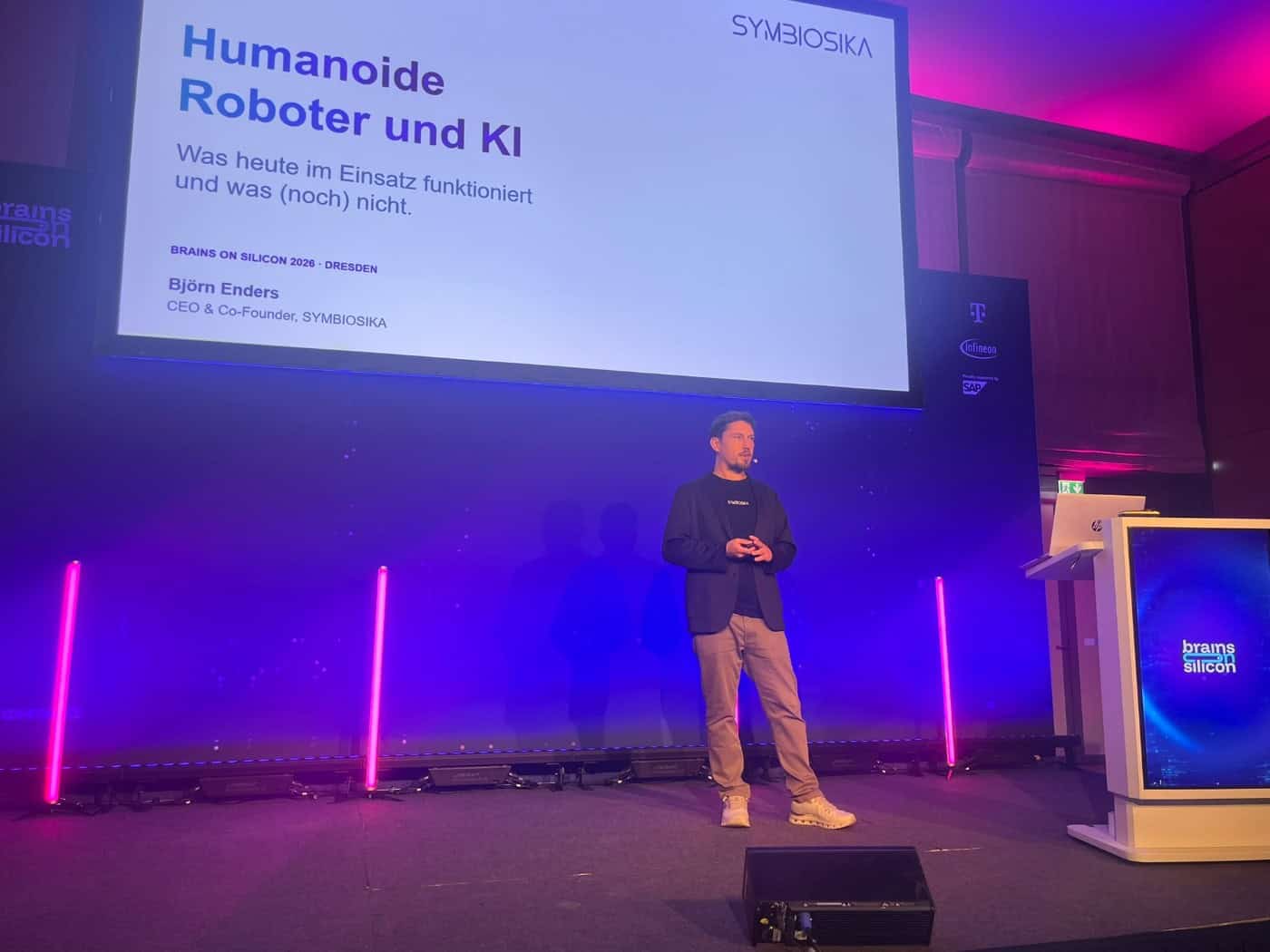
Dresden. Dancing robots, a robot half-marathon in China: Videos like these are circulating by the millions, yet humanoid robots are still rarely seen in everyday work life. Björn Enders, founder and CEO of the robotics startup Symbiosika, focused on this gap between spectacle and reality on Tuesday at the Brains on Silicon conference in Dresden. His presentation was a sober assessment of the current state of affairs, not a promotional pitch.
Although most humanoid robots are sold in China, they are used in research and laboratories rather than in production, Enders said. There’s no need to panic, but Europe shouldn’t rest on its laurels either.
The Bottleneck Is Data
Today, humanoid robots are no longer programmed but rather trained, Enders explained. At its core is a vision-language-action model that translates images and language directly into movement. To ensure that multi-step tasks are successful, a larger planning model in the cloud controls the individual steps.
The real problem is the lack of data. Current models may achieve a success rate of around 90 percent, but that is not enough for productive use. Until now, the data has been painstakingly collected through teleoperation, in which a human demonstrates movements to the robot while wearing a full-body suit in specially built training facilities. According to Symbiosika, as a partner of the manufacturer NEURA Robotics, it trains on that company’s platform.
“We don’t have the data advantage”
When asked what data Germany actually has, Enders refuted a common narrative. In his view, there is no German data lead in robotics; he had collected data in the industry for ten years and had never seen such a treasure trove there. Germany’s strengths lie elsewhere: in hardware and engineering, in skilled software developers, and in bringing technology to market in a stable, safe, and high-volume manner. However, Enders believes that the training itself is feasible in Europe in the medium term.
First Applications Expected in Retail
Walking, navigation, and speech already work quite well, Enders said. The robots still struggle with small parts, with deformable objects such as textiles, and with anything that requires quick reactions and a delicate sense of touch.
Nevertheless, Enders expects the first autonomous applications in retail as early as next year, with full autonomy in four to five years. Regarding the issue of liability raised by an automation engineer, he said that a learning robot cannot be reduced to a classical, precisely definable code. Instead, statistical analysis is used, and every movement is recorded along with forces and speeds - similar to autonomous driving - to demonstrate reliability.
Symbiosika, founded in 2024 in Hohenstein, Hesse, develops software for humanoid robots in the healthcare and hospitality industries. NEURA Robotics is based in Metzingen, Baden-Württemberg, and is currently establishing a network of training centers for such robots.

