


OpenAI Executive Speaks Candidly in Dresden: Where German Companies Are Falling Short in AI
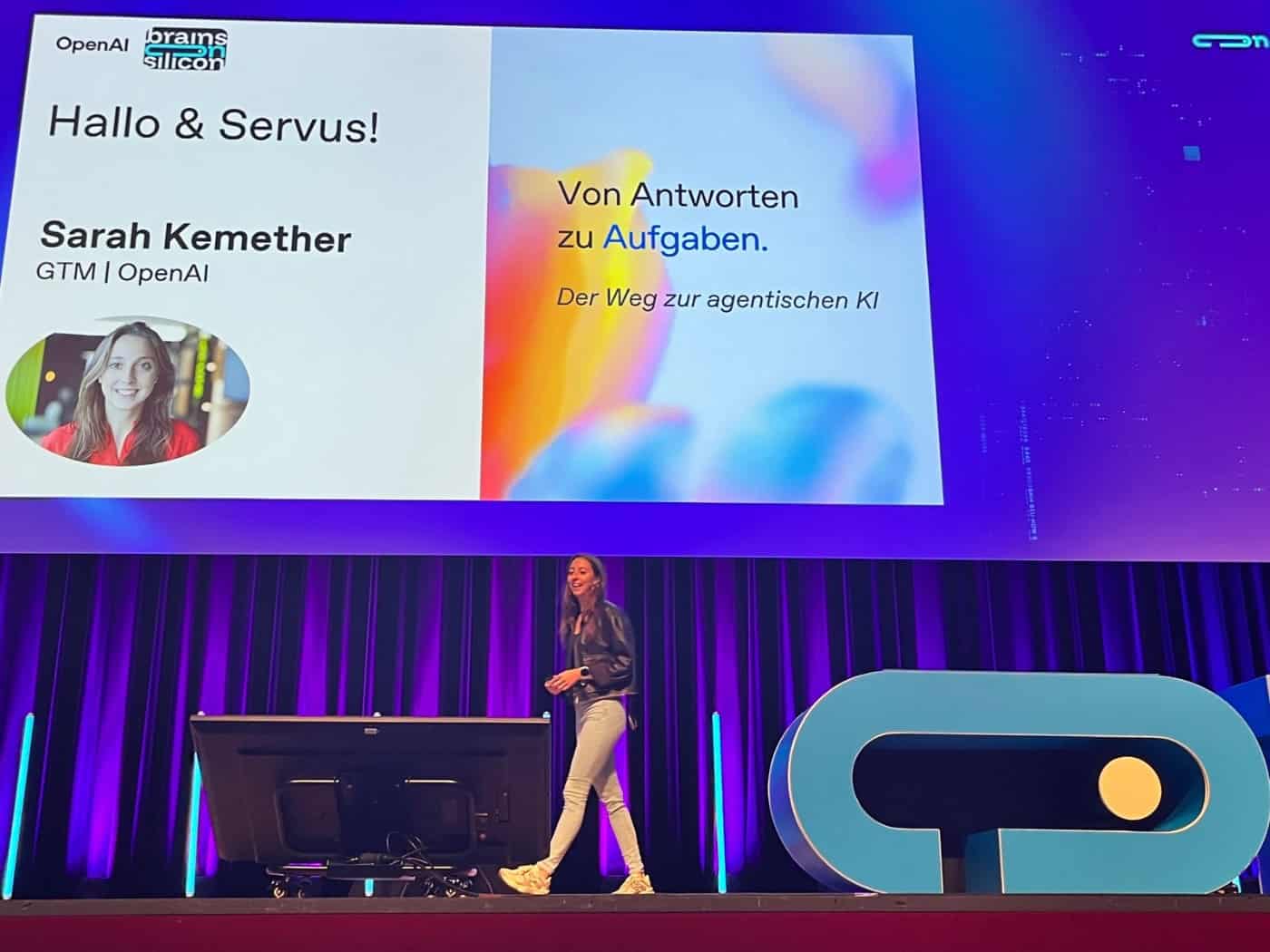
Dresden. Artificial intelligence should no longer just answer questions in business operations, but take on entire tasks. That was the call made by Sarah Kemether, who is responsible for corporate business at OpenAI, on Tuesday at the Brains on Silicon conference in Dresden. Germany uses AI more intensively than almost any other country in Europe, but is not yet reaping the full benefits within companies.
The key lies in delegation. In the past, people would ask an AI to perform a SWOT analysis, for example, said Kemether. Now, an agent can draft a complete proposal based on existing emails, customer documents, and meeting notes. Humans remain part of the process, reviewing the result and presenting it in the end.
Germany Leads in AI Adoption, but Lags in Implementation
In terms of weekly active ChatGPT users, Germany ranks number one in Europe, Kemether said. In terms of paying subscribers and developers using OpenAI’s APIs, the country ranks among the top three most active markets worldwide, and among the top five in terms of usage of the Codex software agent.
At the same time, Kemether pointed out a gap. According to an ifo study she cited, only one in five employees has access to a paid AI tool at work. Of these, about one-third receive the tool from their employer, while two-thirds obtain it on their own. Much of this remains unused, and at the same time, a control issue arises because many people use AI privately and without supervision.
Two German examples: Law Firm Network and Plant Manufacturer
As her first example, Kemether cited the HSP Group, a nationwide network of independent tax consulting, auditing, and law firms. About 900 employees there worked with ChatGPT Enterprise. The company reported a 98.6 percent increase in productivity and an 84.6 percent improvement in work quality; a deliberately conservative internal estimate puts the additional annual work capacity at around 40,000 hours. Quality checks by humans remain part of the process.
The second example was STADLER Anlagenbau, a family-run manufacturer of automated sorting and recycling systems with over 230 years of history and approximately 650 employees. Since 2023, every computer workstation there has been using AI, said Kemether. According to OpenAI, the company uses more than 125 customized assistants, saves 30 to 40 percent of the time on typical knowledge-based tasks, and arrives at a first usable draft about 2.5 times faster. Another motivation is knowledge transfer within an aging workforce.
Three Conditions: Performance, Costs, Security
According to Kemether, three factors must align for companies to delegate more work to AI. A platform is needed to identify worthwhile processes and provide the AI with context, access, and tools, with a human verifying the results. Costs are becoming a more significant factor; discussions with customers are increasingly centered on efficiency, and prices are trending downward. And security must be on the agenda for every executive board meeting: OpenAI offers models focused on cybersecurity designed to help security teams detect vulnerabilities. For agents, there must be clear rules governing which systems and data they are permitted to access.
Kemether advocated for increased use of voice communication with agents, as this allows for the conveyance of more context. OpenAI has operated an office in Munich since May 2025 and has announced a second one in Berlin.

