

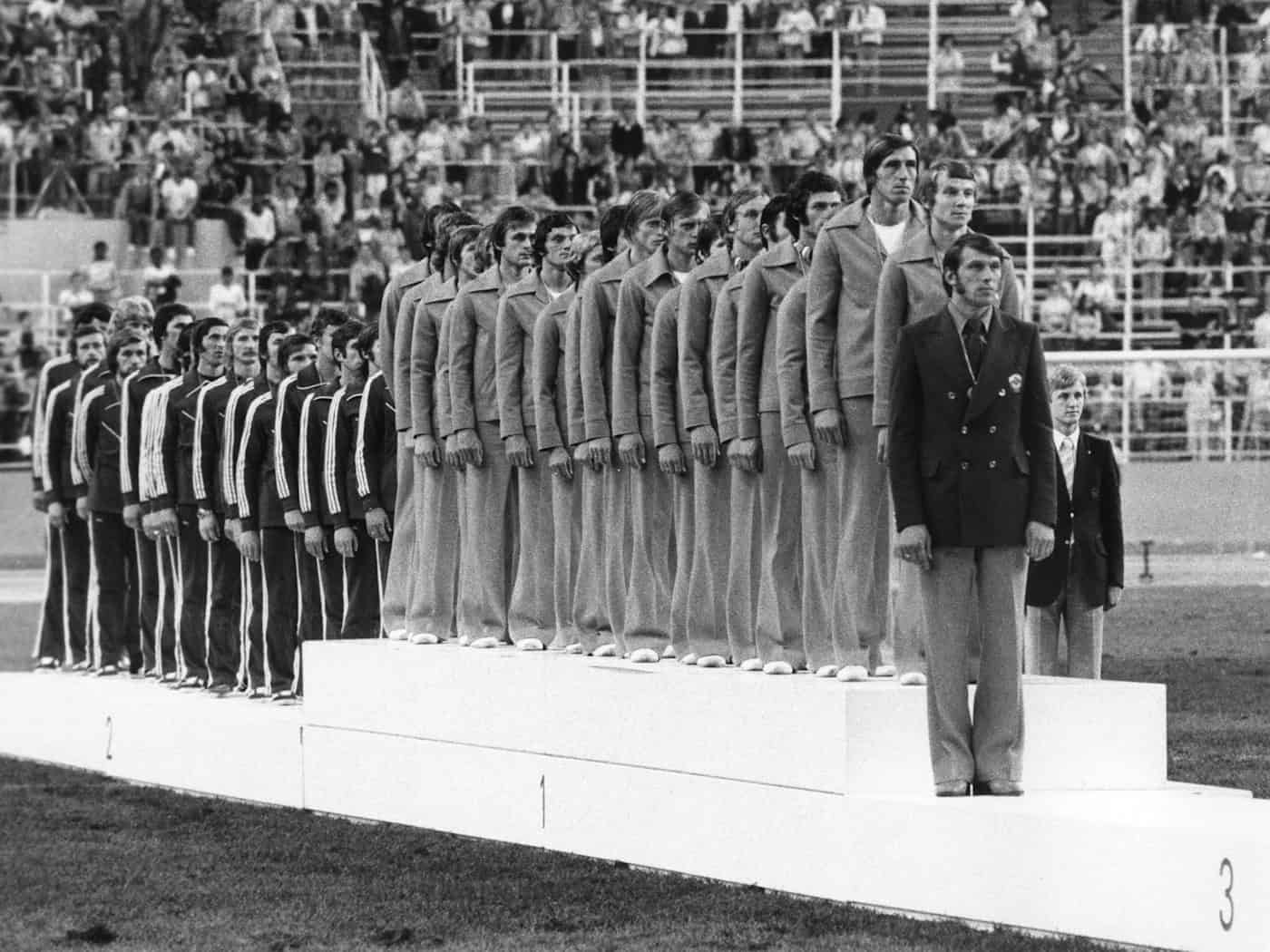
Most citizens of the workers’ and peasants’ state likely missed the GDR national soccer team’s greatest triumph due to the time difference. At around 5:35 a.m. Central European Time, the final whistle blew in Montreal at the Olympic soccer final on July 31, July 1976—the GDR had won the gold medal in the Olympic tournament with a 3–1 victory over Poland—in Montreal, the final whistle sounded in Canada shortly before midnight. “That 3–1 win was unforgettable for our national team. It’s something we’d dreamed of,” said Dieter Riedel of Dresden 50 years after the final victory, “it’s wonderful to be the 1976 Olympic champion.” On a field soaked through by rain—one on which no Bundesliga pro would set so much as a toe today— the team assembled by national team coach Georg Buschner—featuring a six-man core from Dynamo Dresden—laid an early foundation with two quick goals by Dresden’s Hartmut Schade in the seventh minute and Martin Hoffmann of 1. FC Magdeburg seven minutes later. The players squandered several other surefire chances, allowing Poland’s superstar Grzegorz Lato—who had led the Polish team to third place at the World Cup in West Germany two years earlier—to score the equalizer just shy of the one-hour mark. But the players led by Hans-Jürgen “Dixie” Dörner didn’t sit back; instead, they pressed for a decisive goal. “We were in great shape and could have played any game for 120 minutes,” said Gerd Weber, the team’s youngest player at 20 and merely a spectator in the final. But Weber, who was still a student at the time, naturally had to participate in the training sessions as well—and they were no walk in the park. “Buschner was an absolute pro when it came to soccer and how he taught us to play the game professionally,” said defender Lothar Kurbjuweit, specifying the training schedule: “Six hours on the field every day.” The strength and technique they’d trained for paid off in the 84th minute, when Dynamo Dresden’s Reinhard Häfner, after a solo run, put the finishing touch on a tournament that had begun with a rebuke from GDR sports chief Manfred Ewald. After the 0–0 draw in the first group match against Brazil, the most powerful man in sports would have preferred to send the team back home. After all, 17 athletes were needed at the Olympic tournament just to make another minor mark on the medal tally at best. But Buschner quickly got the team back on track. “Schorsch drew the right conclusions and said, ‘We’ll do our own thing,’” Weber said, “we weren’t the main attraction, but rather an afterthought to the entire Olympic team. They weren’t pleased when we actually went on to win the gold medal.” With a 1–0 win over Spain, the GDR soccer team advanced to the quarterfinals. There, they sent France—featuring the young Michel Platini—packing with a 4–0 victory, before defeating the Soviet Union, packed with star player Oleg Blokhin, 2–1 in the semifinals to send them to the third-place match. The “big brother” was so upset that the players stayed away from the medal ceremony and only two representatives collected the medals, while the GDR soccer players gradually began celebrating their achievement. “We’d already had a beer or two. Afterward, we went our separate ways in small groups,” said Hartmut Schade. Unlike the 1974 World Cup, where the players were under constant surveillance, the Olympic Village offered complete freedom. “We didn’t have that much time,” said Gert Heidler, who was part of the Dresden contingent, “but in our free time, we also wanted to go into the city, ride the subway, and visit the big shopping centers.” Gerd Kische, a player and later president of Hansa Rostock, enjoyed the unusual freedoms. “We often went to the movies; they were showing the latest films. We were very proud and happy that we could applaud the other athletes’ medals,” said Kische, who had invited everyone to the first reunion after the gold medal at the end of April 2026. Eight of the 17 players—four of whom have already passed away—came to Dierhagen near Rostock and also reminisced about the conditions in Montreal. “After 1972, the Olympic Village was a fortress,” said Weber, who nevertheless enjoyed sitting in the cafeteria next to a Cuban wrestler or swimming star Mark Spitz: “They were all in the village—unlike today.” Even though the victory over Poland paved the way for the biggest possible title, the soccer players had already gotten the toughest game out of the way during the qualifiers. With two draws against Czechoslovakia, Buschner’s team secured their ticket to Montreal. Czechoslovakia could take comfort in the European Championship title, which they had won in a penalty shootout against West Germany six weeks before the GDR’s gold medal. But even within the team, the Olympic victory isn’t necessarily the top priority. For Kische, it was the World Cup two years earlier, because the entire world of soccer was represented there—and not just the state-sponsored amateur teams from the Eastern Bloc, which, from 1952 to 1988, when the amateur rule was abolished, had divided the Olympic victories among themselves. “There, it was just us soccer players,” said Kische, who still mourns the missed opportunity at the World Cup a little: “In 1976, we were better and more successful than in 1974 because of the team’s composition. It was a harmonious unit, and the players from Dresden contributed greatly to that. We were incredibly effective and didn’t have as many self-centered players.” Copyright 2026, dpa (www.dpa.de). All rights reserved“Every game could have gone to 120 minutes”
Six hours of training per day
Soccer Players as an Afterthought to the Olympic Team
4–0 against France and Platini
Complete Freedom in the Olympic Village
Knocked Czechoslovakia out in the qualifiers


