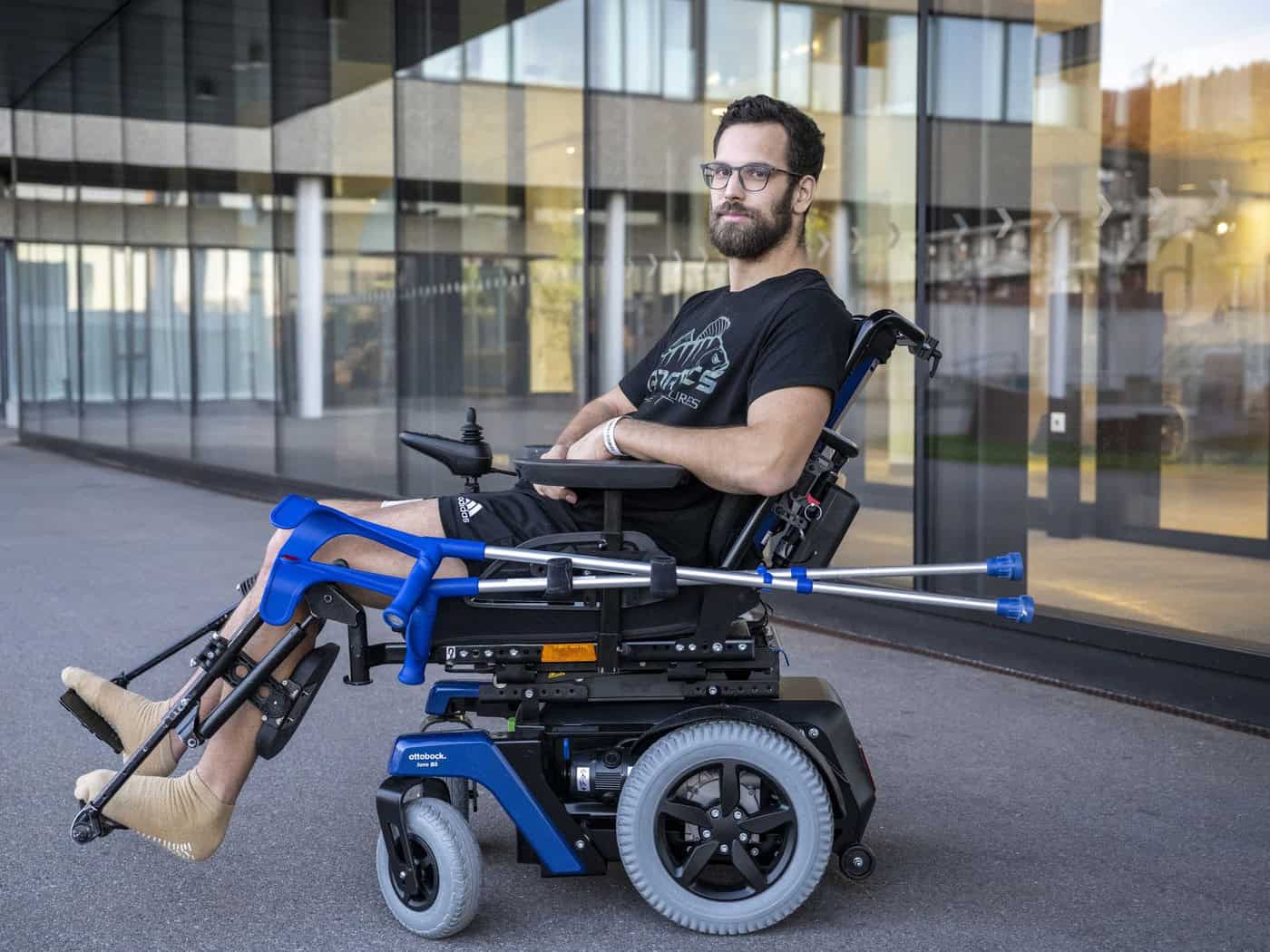
It was all about survival; bobsledding was out of the question. Four emergency surgeries on his hip and chest at Dresden University Hospital. Doctors saved the life of bobsled pusher Sandro Michel after the horrific accident in February 2024 on the challenging Altenberg ice track. The fully loaded sled, weighing 500 kilograms, had slid uncontrollably back onto the track from the ascending final curve. Michel had been lying there; the Swiss athlete had been dazed after being thrown from the bobsled. His injuries—a torn hip, a severed femoral head, 14 broken ribs, a fractured shoulder blade, and bleeding in the lungs—were severe. Giving up was not an option for Michel. “Almost three years ago, the doctors told me that if I worked hard at it, I might be able to walk more or less normally again. But bobsledding? I’d probably never be able to do that again,” the 30-year-old wrote on Instagram. He had to learn to walk all over again. After that, he lifted weights and returned to the tartan track. Agonizing weeks and months passed. His shattered hip caused problems during the first push-off tests, and his knee still wasn’t at the right height. Sitting in the bobsled was painful. For Michel, these were—and still are—just minor hurdles on the road to recovery. After 982 days, the miracle was complete: his first bobsled run on the upcoming World Championship track near Lillehammer with pilot Michael Vogt. “It was an incredibly emotional moment. After everything I’ve been through in recent years,” Michel said. “A moment I’ll never forget.” The journey there “against all odds” is just a milestone. Michel wants more. His World Cup comeback isn’t planned until next season. He’s still missing some finesse in the sprint. In the long term, his goal is to compete in the 2030 Winter Olympics in the French Alps. But he still needs patience. His pilot, Vogt, will race again this weekend at the World Cup opener in Altenberg for the first time since the crash—without Michel. Last season, the Swiss team boycotted the ice track in the Ore Mountains. “I won’t race on a track where one of our pushers nearly died and nothing has changed since then,” Vogt said at the time. Now, the Olympic bronze medalist from Cortina wants to achieve his goals in the overall World Cup standings. That’s only possible with Altenberg. Behind the scenes, work is underway at a feverish pace on potential solutions and prototypes. The latest innovation is a harness system. This might have prevented the pusher sitting in the fourth position from being thrown out of the sled. “We’re at the point where we can bring a functional harness system to the starting line for the last man. The Allianz Center for Technology is currently conducting a technical analysis of the deflection points so that testing can then be carried out in the Safety-Bob. A belt pulley was developed specifically for the bobsled for this purpose,” said Thomas Schwab, CEO of the German Bobsleigh and Sled Federation (BSD), to the German Press Agency. The BSD’s technology partner invested 220,000 euros in the project. “This is a personal priority for me. For 30 years, BSD wanted the bobsleds to go faster; now they need to be safer,” Schwab emphasized. A restraint system will also be put to the test shortly at Königssee in collaboration with two-time Olympic champion Johannes Lochner and the Ifosa Institute. A prototype of a rollover system similar to those used in Formula 1 is currently being tested. “To gather precise data, a bobsled is deliberately sent into a corner,” Schwab said. Copyright 2026, dpa (www.dpa.de). All rights reservedHe had to learn to walk all over again
The miracle happened in Lillehammer on the World Championship track
Vogt’s team returns to competition in Altenberg for the first time since the accident
Safety solutions currently being tested