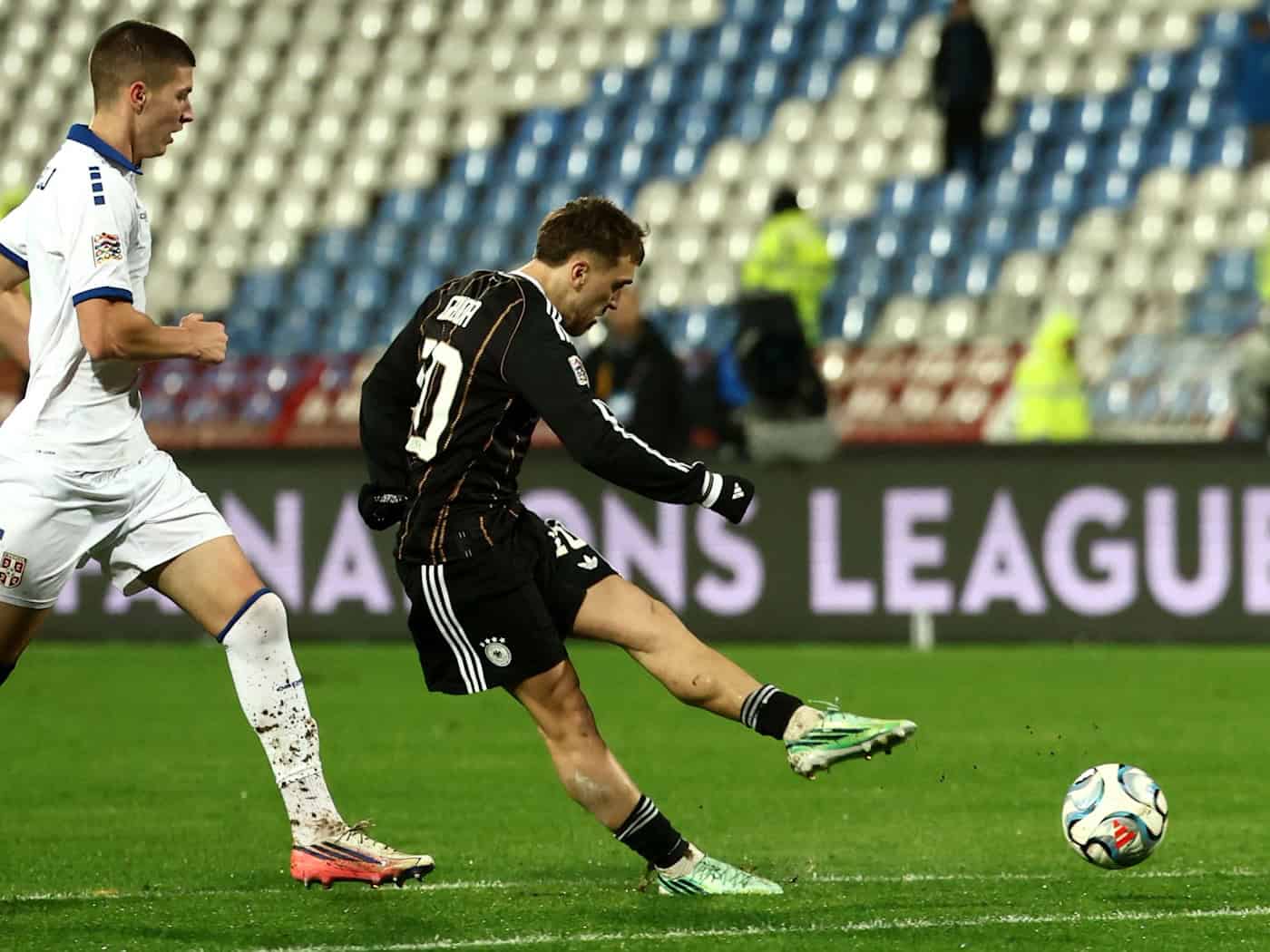
Brajan Gruda could practically watch the video of his irresistible solo run leading to his first goal in his international debut on a loop online. Twelve seconds elapsed between receiving the ball in his own half, a 50-meter sprint with the ball on his strong left foot across the muddy field in Belgrade, and finally the well-placed low shot into the right corner of the goal. Just as the 22-year-old played with such directness during the German national team’s 3-1 victory over Serbia—and not just in that moment—he also spoke later about his spectacular moment. “That was instinct. My dribbling—I just go for it,” said the man of the match from RB Leipzig. A player who relies on instinct—that’s something Jürgen Klopp has a soft spot for. “He set the bar pretty high. It was an extraordinary debut,” the national team coach commented enthusiastically. Klopp had previously praised the eleventh rookie of his tenure as either a “risk-taker” or a “street soccer player.” But he’s not the only one. Derry Scherhant (24), Lennart Karl (18), Saïd El Mala (20), or the 17-year-old Gladbach gem Wael Mohya—Klopp has several young players on his list. It’s a bet on the future—for the 2028 European Championship and the 2030 World Cup—that the national team coach is making right now. For him, there’s no alternative, because in Klopp’s 4-3-3 system, lightning-fast, skillful, and strong one-on-one dribblers are an essential feature. For the 59-year-old, the wingers are “today’s playmakers” because in modern soccer, opponents pack the center extremely tightly. But does German soccer have these types of players? Klopp immediately realized that a player like Leroy Sané—who, during the World Cup flop this summer under Julian Nagelsmann, was still allowed to start on the right wing in all four DFB matches—is no longer a viable solution. During player scouting, “a whole lot of talent” caught his eye—from Gruda to Bayern’s young star Karl, Freiburg’s speedy dribbler Scherhant, and Cologne’s El Mala. Klopp nurtures and challenges them. And when—as in Belgrade—he’s asked about Gruda’s top performance, he first talks at length about Karl, who also “trained superbly.” “I’ll go with Lennart Karl again, simply because he’s an incredible talent.” Perhaps even on Monday (8:45 p.m./ARD) at Berlin’s Olympic Stadium, when the DFB team absolutely must win its 50th clash with archrival the Netherlands to advance to the Nations League quarterfinals. Even though everything points to another starting spot for the daring Gruda, who—despite his lucky debut—didn’t want to make any demands, but simply said: “We’re in good spirits, 100 percent fit. We’re going to step it up again.” He can definitely take his black debut jersey with the number 10 home as a special keepsake. “I’ll keep it safe.” And he went on to describe the goal in a bit more detail on that cold, wet night in Belgrade. “Jo (Kimmich, Ed.) passed me the ball. And with my first touch, I had so much space. It was a bit of a shock that I wasn’t really marked. And then I shot the ball in.” “There’s no question that Brajan can play like that. What Brajan has shown is Brajan Gruda,” said Klopp. But he also addressed what Gruda still needs to work on. For example, making more varied decisions between dribbling, passing, and crossing. “But I’ll be damned if I’m going to tell him not to dribble.” Gruda is “a wonderful soccer player. I enjoyed watching him play, too.” Copyright 2026, dpa (www.dpa.de). All rights reservedKlopp: He’s set the bar high
Klopp: “Today’s playmakers” play on the wings
“In good spirits” ahead of the showdown with their archrival
What Klopp Will Never Forbid Dribbler Gruda to Do