

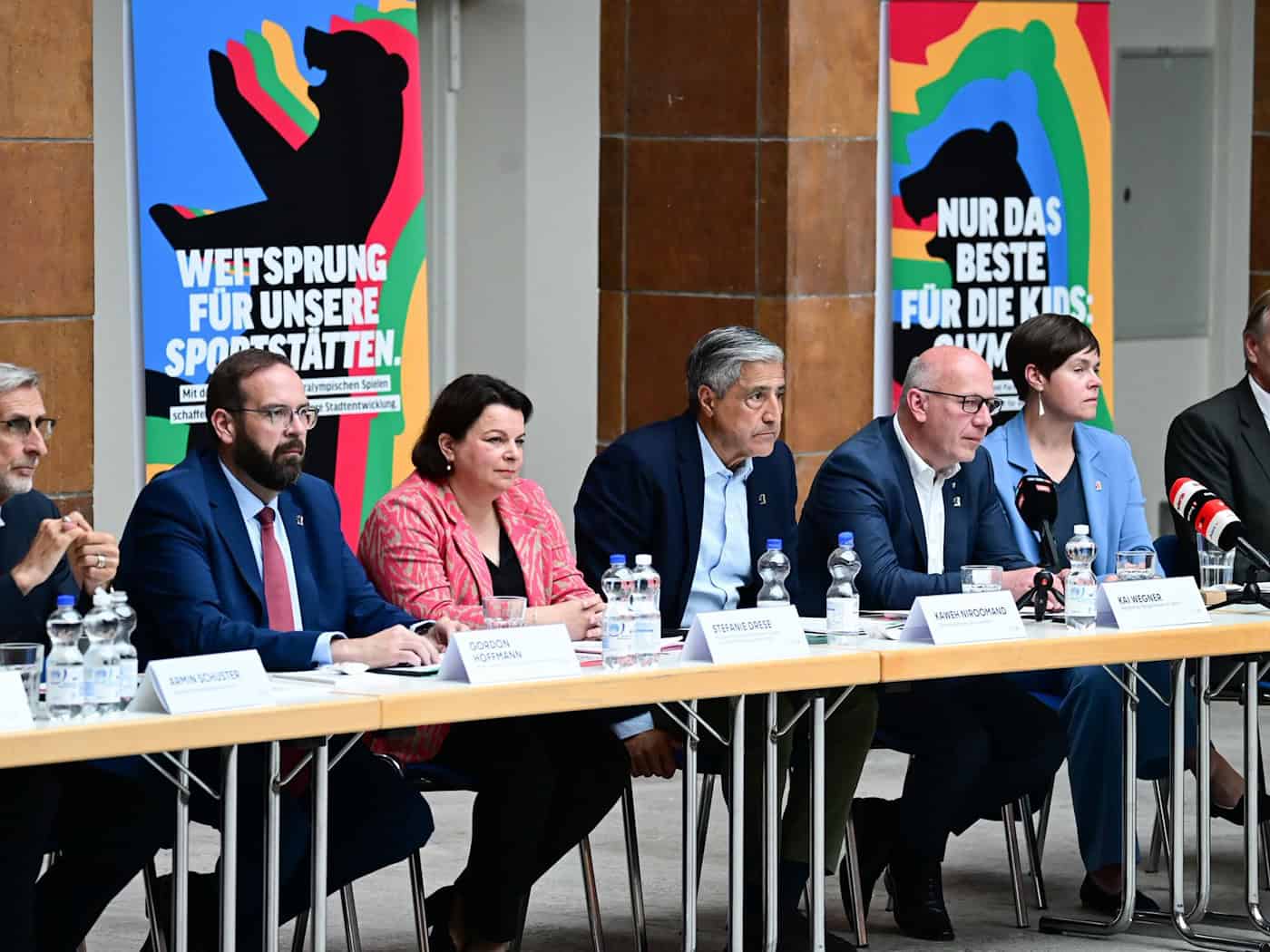
The representatives of the Berlin bid for the Olympic and Paralympic Games are entering the final stage of the national decision with great confidence. "Our concept is based on sustainability and the use of existing buildings," said Governing Mayor Kai Wegner (CDU) at the presentation of the "Berlin +" concept in the atrium of the Haus des Deutschen Sports in the Olympic Park. "These will be games of short journeys. Sailing in Rostock in the morning, medal ceremonies at the Brandenburg Gate in the evening. That's why our concept is unique and different from NRW and Bavaria." Berlin is competing with Saxony, Mecklenburg-Western Pomerania and Brandenburg for national approval. Munich and the Rhine-Ruhr region with the metropolis of Cologne are also in the running to host the Games in 2036, 2040 or 2044. Hamburg withdrew from the bid on Sunday following the negative referendum. On Thursday, the concept must be submitted digitally to the German Olympic Sports Confederation (DOSB). A decision on the national representative will be made at the DOSB General Assembly on September 26. Berlin's concept is based on 97 percent of the existing sports facilities. Three budgets are available. 4.8 billion euros are earmarked for the pure implementation budget. Revenues of over 5.2 billion euros are expected. 1.6 billion is included for the infrastructure budget, while the security budget remains an open item. "The financial framework conditions are transparent and solid," said Olympic Commissioner Kaweh Niroomand, "we have built buffers into the figures so that we can adjust them accordingly." In addition to Berlin, competitions will be held in the partner federal states. In Brandenburg, the regatta course on Lake Beetzsee and the golf course in Bad Saarow are among the venues available. Soccer will be played in Cottbus and shooting will take place in Hoppegarten. In Saxony, horse riding will take place at the Leipzig trade fair, and a new canoe park is being built. Rostock-Warnemünde will provide the sailing area and attract visitors with good visibility of the competitions from the beach. "Warnemünde is the Copacabana of Germany," says Stefanie Drese (SPD), Sports Minister of Mecklenburg-Vorpommern. According to Rostock's mayor Eva-Maria Kröger (Die Linke), the athletes will also be comfortably accommodated: "A cruise ship in the port will function as part of the Olympic Village." In view of the cooperation between the four federal states, the representatives also see the concept as an opportunity to exemplify cohesion in times of division. "We are completing reunification with a gigaproject," said Saxony's Sports Minister Armin Schuster (CDU), "there was a summer fairytale here. That was just a stage for the fairytale that is to come." And Leipzig's Lord Mayor Burkhard Jung (SPD) wants to "enter the race with Berlin to show the other Germany." Copyright 2026, dpa (www.dpa.de). All rights reserved4.8 billion euros for the implementation budget
Cruise ship in Rostock as part of the Olympic Village
Olympics as the completion of reunification


