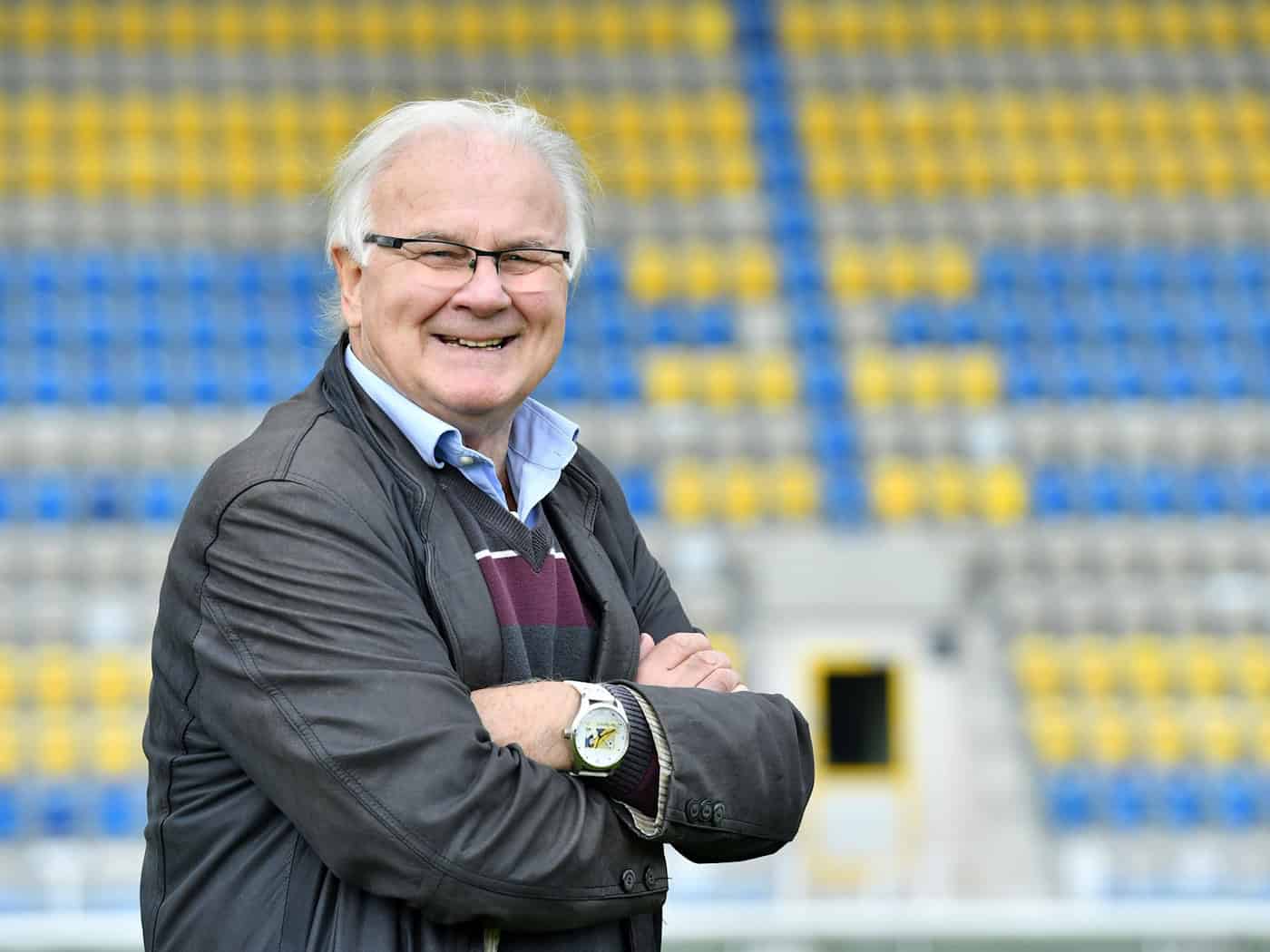
The brightest star in FC Carl Zeiss Jena’s soccer sky will also shine in the constellation Libra starting October 14. To mark his 85th birthday, Peter Ducke is receiving his own star, which is registered with the European Institute of Star Naming. “I can’t believe it—I’ll have to see it to believe that a star in the firmament bears my name. It’s unbelievable,” said the honoree about the gift from Elf5 Jena GmbH, the joint marketing team of FC Carl Zeiss Jena and the Science City Jena basketball team. Equally incredible is the career record of Ducke, who was born on October 14, 1941, in what was then the Reichsgau Sudetenland and was also nicknamed “Schwarze Peter” (Black Peter) because of his dark hair. The Ducke family spent the time after their escape in Schönebeck near Magdeburg before Peter joined SC Motor Jena in 1959—a club that was renamed FC Carl Zeiss Jena in 1966 and to which he remained loyal throughout his entire career. In his very first season, his team won the FDGB Cup, with the 1.77-meter-tall center forward scoring two goals in the 3–2 victory over Empor Rostock in the final. In total, Ducke scored 207 goals in 466 competitive matches over his 20-year career, winning both the championship and the cup three times each. “I had so many highlights, and I’m still proud and happy to have ended up in Jena, where I got to play with my older brother,” said Ducke. His brother Roland, seven years his senior, had already tried to get his younger brother a spot on Motor Jena’s roster before 1959, but it wasn’t until his performances in junior games in Magdeburg that the breakthrough came. Shortly after his first cup victory, he was called up to the senior national team, with which Ducke won the bronze medal at the 1972 Olympic soccer tournament in Munich. At the 1974 World Cup, the forward played only sporadically due to an injury and watched the GDR’s 1-0 victory over West Germany from the bench. The trips with the national team—for which he scored 15 goals in 68 games—were always a special treat for the Western movie lover. That way, he could watch Westerns like “Rio Bravo.” “I’d rather skip training once in a while and watch a movie,” said Ducke, who traveled through the Wild West in the U.S. after the fall of the Berlin Wall. Two major injuries in 1966 and 1974 explain why Ducke, with 153 goals, ranks only third on the all-time scoring list of the GDR Oberliga. But his temperament also held back the heartthrob of his day. In the 1965 cup final, which his team lost 1–2 to SC Aufbau Magdeburg, Ducke refused to accept the consolation trophy—using harsh language. “A good balance between passion and temperament is appropriate in a positive sense,” Ducke said. This combination earned him a ten-week suspension following the cup final. But there were also advocates, such as the GDR refereeing legend Rudi Glöckner, who appreciated the free spirit of the “crazy, rebellious, and unpredictable” forward that Ducke was. For his teammate Hans Meyer, who was a year younger, Ducke—given the limited opportunities for transfers in the GDR—was “a gifted soccer player who was born at the wrong time and played for the wrong team.” But Ducke himself “always felt very much at home” in Jena and can now, on the evening of his 85th birthday, see his own star with the naked eye under the open sky. Copyright 2026, dpa (www.dpa.de). All rights reservedDucke won the league title and the cup three times each
National Team and the Movies
A ten-week suspension after losing the cup final
Ducke remained loyal to Jena