

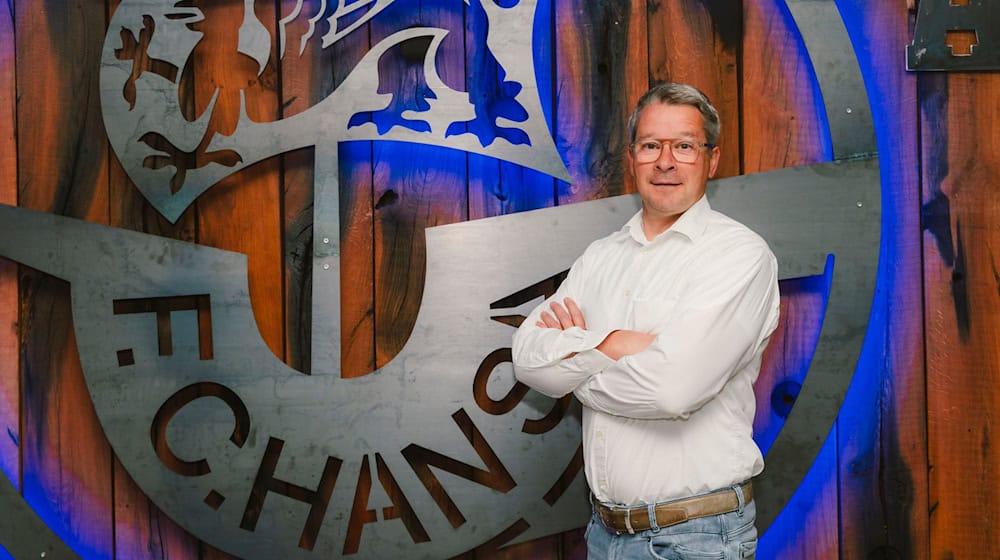
Last champion of the GDR Oberliga. Twelve years in the Bundesliga. Home to such important players as Joachim Streich, Thomas Doll and Gerd Kische: FC Hansa Rostock has an eventful history behind it. This Sunday, the club will be 60 years old. Chairman Ronald Maul (52) was already a player in Rostock for five years during the Bundesliga era. When asked by Deutsche Presse-Agentur, Maul spoke about... "Hansa Rostock is very, very special. In terms of emotionality and enthusiasm, it's only comparable to the Ruhr region, with clubs like Schalke or Dortmund. We are very lucky here that we have an entire federal state behind us. It's a large catchment area and the nearest competition is a bit further away." "The atmosphere was great back then too. But there has simply been a development in many soccer clubs over the years, which is also evident in Rostock: In my active days, the stadium was only really sold out two or three times a year - when Bayern Munich or Borussia Dortmund came. Now we have around 25,000 spectators here, even against Hoffenheim II. And the number of members has also increased: We now have around 30,000, which is incredible. So the club has become even bigger compared to my active time." "As a player, I had five years here from 2001 to 2006 in which I felt extremely comfortable and I think the way I played soccer was also quite well received here. But of course, in my four years in the Bundesliga, we weren't a club that played at the top. To stay in the league every year was extreme. That's why I mainly remember away trips where we played in front of over 10,000 Rostock fans at HSV or in Berlin. We had enormous support everywhere. Back then, it was still a phase in which we were perceived much more strongly as the representative of the East. That has changed somewhat due to the development of other clubs. But back then, we and Energie Cottbus also had this unique selling point. And you had the feeling that the whole East identified with you." "There's no other way to put it: from the perspective of a GDR citizen who grew up with the GDR top division, it was actually unimaginable. Really blatant. You would have always expected completely different clubs in this role. But Hansa Rostock used the momentum very well. After the fall of the Berlin Wall, nobody in the clubs really knew what would happen next and how to position themselves for professional soccer. I experienced the same thing in Jena. In Rostock, however, things usually worked extremely well with the people in charge. This also applies to the time after the club was promoted again in 1995, when a great stadium was built here within a short space of time. That still has a huge added value for us today." "There is no must in this soccer business. But one thing is clear: we are currently doing well in the 3rd division, we finished fifth last season and we naturally want to keep getting better. Of course we also want to celebrate promotion at the end of the season. As a club, we already have the perspective goal of returning to the second division in order to establish ourselves there. The whole environment and the whole club: It's all crying out for it and certainly deserves it. But you always have to take the first step before the second." "That's not true. We have extremely good cooperation with the committees. And then the composition of the supervisory board is always a democratic process: the members elect it. The Supervisory Board does not interfere in day-to-day business, that is clearly regulated. It's more like this: we are in constant communication with our fans and have established trusting discussions. I have a good feeling about that." Copyright 2025, dpa (www.dpa.de). All rights reserved... the importance of FC Hansa Rostock:
... the differences to his playing days in Rostock:
... about his greatest moments in a Hansa shirt:
... the reasons why Hansa Rostock, of all clubs, was so successful after reunification:
... on the sporting goals of FC Hansa Rostock:
... about the accusation that the fans at FC Hansa have too much influence on the club via the supervisory board:


