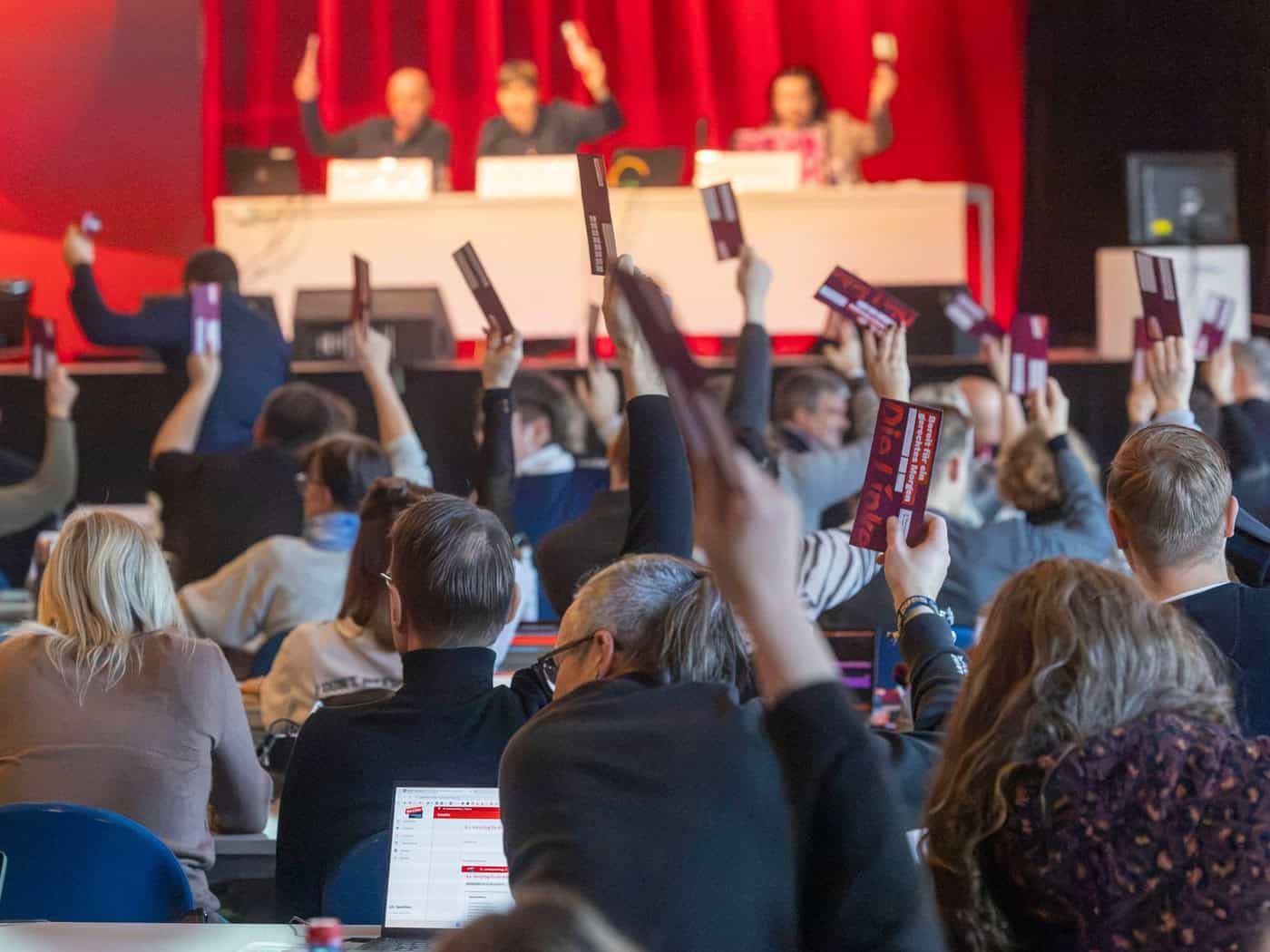
Under the slogan “More for You,” the Left Party in Saxony aims to advocate for higher taxes on large fortunes. According to the party’s calculations, a wealth tax could bring nearly 4.5 billion euros annually into the state coffers. “We don’t just want a slice of the cake—we want the whole bakery,” said Co-State Chair Marco Böhme at the state party convention in Riesa. Following the Left Party’s success in Berlin, the Saxony state chapter also aims to win control of City Hall in Leipzig. “First New York, then Berlin, and then Leipzig,” said mayoral candidate Skadi Jennicke at the party convention. In her view, a victory would be a “political bombshell” with nationwide repercussions. Federal Chairwoman Ines Schwerdtner had previously described Leipzig as the “next red beacon” in a welcoming address. Elif Eralp, chair of The Left’s parliamentary group in the Berlin House of Representatives, also encouraged her Saxon comrades in a video message with the rallying cry, “After Berlin comes Leipzig!” Böhme linked the party convention’s motto, “No one can get past us,” with a call for door-to-door campaigning. Jennicke will run for The Left in Leipzig on February 21, 2027. A possible second round of voting is scheduled for March 21. Burkhard Jung, the SPD mayor who has been in office since 2006, will not seek re-election. Other candidates include Saxony’s Minister of Economic Affairs Dirk Panter (SPD), Green Party politician Wolfram Günther, CDU city council faction leader Michael Weickert, and AfD politician Alexander Wiesner. Jennicke aims to become the first woman to lead Leipzig City Hall. After 139 men documented in the records, the city is “ready for a woman,” she said. An election victory could also serve as a “countermeasure against protest votes”: Dissatisfaction with city administration, housing, public transportation, daycare centers, or neglected neighborhoods could fuel protests. The mandatory tasks that the federal and state governments have shifted onto Leipzig without financial compensation amount to one billion euros out of a total budget of 2.8 billion. There must be no cuts to community gardens, cultural programs, or senior centers: “We must not put up with that,” she said. Co-state chair Anja Eichhorn also focused on social security and the fight against the far right. She highlighted concerns about affordable rent, long-term care, and jobs. “We oppose the normalization of fascism with every fiber of our being,” she said. Bundestag Vice President Bodo Ramelow also warned against the AfD’s power becoming the norm. He criticized the cancellation of funding for democracy projects in Saxony and other eastern German states. Even the mere accusation that an organization had invited representatives of the BDS movement or had not sufficiently distanced itself from it could be enough to trigger a funding freeze, Ramelow said. Correctiv and the Fritz Bauer Institute in Bochum were also affected. “I feel like we’ve landed right back in the Cold War,” he said. Böhme said that with around 11,800 members, The Left is the party with the largest membership in Saxony. In the negotiations over the 2027–2028 biennial budget, the party aims to reverse cuts to democracy projects, hospitals, school social work, housing assistance, mobility, and culture. “We are negotiating to stop these cuts as much as possible,” he said. Starting in 2027, a mentoring program will bring together 20 mentees from the party’s grassroots with 20 mentors. The program is designed to prepare members for leadership roles in the party and parliament. For 2029, Böhme mentioned European, Bundestag, state parliament, and local elections. For the local elections alone, Die Linke plans to field several thousand candidates across Saxony. Copyright 2026, dpa (www.dpa.de). All rights reservedWarning Against the Normalization of the AfD
The Left Wants to Stop Cuts