Logo Die Sachsen News
News / Environment

Spherical armadillo with offspring at Dresden Zoo

Spherical armadillo with offspring at Dresden Zoo
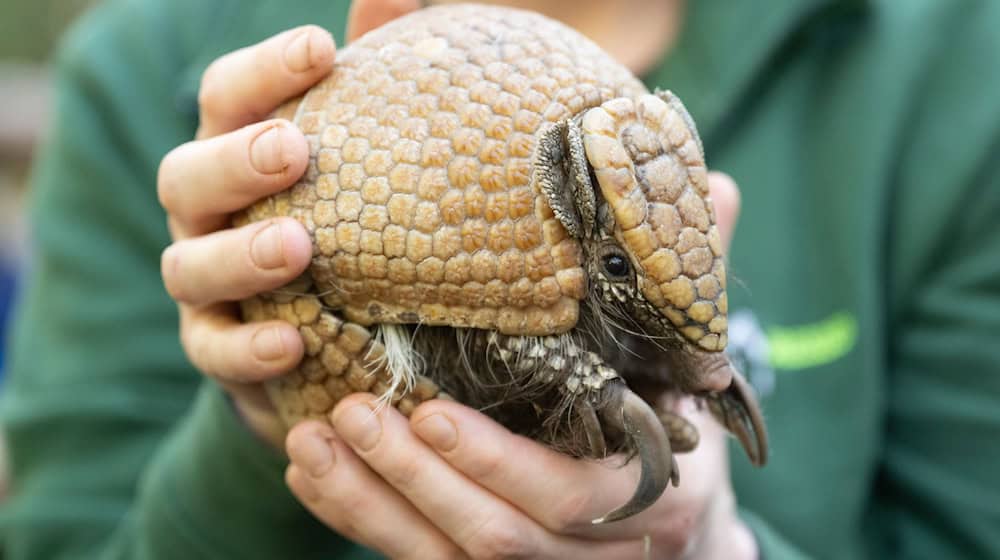
Armadillo offspring "Brosche" was born at the beginning of October / Photo: Sebastian Kahnert/dpa
From: DieSachsen News
Cute offspring at Dresden Zoo! Baby armadillo Brosche was born in October and is now preparing to move to Karlsruhe.

A new baby armadillo has been born at Dresden Zoo. The cub Brosche was born on October 1, according to Thomas Brockmann, Head of Species Conservation and Environmental Education at Dresden Zoo. Male armadillo Gurt and female Bu are already experienced parents. "We regularly have offspring," said Brockmann. This works very, very well.

The southern armadillos, whose population is considered potentially endangered, live in the wild in the grasslands of northern Argentina and southern Brazil, as Hoffmann explains. "They need it to be tropically warm." The Saxon winter would be too cold for the animals, which is why they are housed in a warm house in Dresden.


More from this category

Offspring are the size of a table tennis ball at birth

The species is solitary, but males Gurt and females Bu are put together for mating, as Brockmann explains. Before birth, the male is separated to protect the young - because when it is born, it is the size of a ping-pong ball and its bony shell is still soft. "The father would probably nibble on the cub," says Brockmann.

When the cubs have reached a weight of just over one kilo at around six months old, they leave Dresden. At almost four and a half months old, Brosche currently weighs around 900 grams and will soon be moving to Karlsruhe. There, the young female will support the breeding program herself.

Zoo animal of the year 2025

The armadillo is the zoo animal of the year 2025. According to the zoo, the 23 species of the animal group are native to South and Central America and live underground in caves. Armadillos are therefore the only mammals with real bony armor. This is covered by a layer of horn and serves as protection against predators as well as soil and substrate when digging.

Their habitat is increasingly disappearing due to agricultural use and the extraction of raw materials such as rare earths, minerals or metals, as Brockmann explains. There is hardly any contiguous habitat left, with roads cutting through it. Like hedgehogs, armadillos are often susceptible to being run over in traffic, said Brockmann. This is increasingly threatening the population. In case of danger, they curl up into a ball.

Copyright 2025, dpa (www.dpa.de). All rights reserved

The translations are automated with the help of AI. We look forward to your feedback and your help in improving our multilingual service. Write to us at: language@diesachsen.com.

Topics :

Sachsen News
Article from

Sachsen News

Sachsen News is responsible for the content itself. The platform's code of conduct applies. The platform checks and treats content in accordance with the legal requirements, in particular the NetzDG.

Social Media