

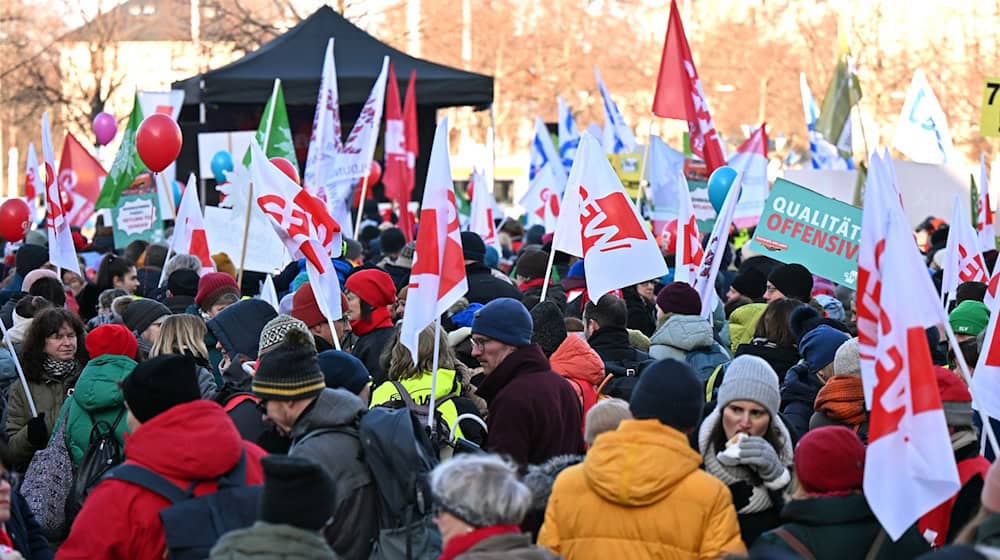
Around 1,000 demonstrators have gathered in Leipzig to strike for more pay in the wage dispute for the public sector in the federal states. This was announced by the police. The education union GEW, the Saxon teachers' association and the civil servants' association have called for the warning strike. The GEW expected around 1,200 participants. In addition to the teachers, the police union and the industrial union for construction, agriculture and the environment also gathered. They are also affected by the negotiations. The GEW hopes that the warning strikes will build up more pressure for the round of negotiations in mid-February, explained Burkhard Naumann, state chairman of the education union GEW in Saxony. "On Friday, the strike wave will roll on to Dresden, and at the beginning of next week to south-west Saxony and east Saxony," said Naumann. "Overall, we can see that the workload at schools and universities is increasing all the time. The stress is incredibly high," explains Naumann. The working conditions at schools are miserable and there is a complete lack of appreciation for the work. Claudia Behrendt, a primary school teacher in Leipzig, also shares these concerns. "The conditions are getting worse and worse," explained Behrendt. Teachers have long had to do more than just teach. Children with additional support needs are demanding more and more attention. Basically, many things have deteriorated. "The colleagues are all broken," explained Behrendt. She is amazed that many of her colleagues are still "doing a great job". With the nationwide strike announcement, there is a threat of further class absences next week. "Strikes at schools naturally also mean lost lessons", said Naumann. However, emergency care will be set up in any case. Overall, no school will have to close. Civil servant teachers will continue teaching as normal. The trade unions are demanding a seven percent pay rise for the more than 920,000 state employees covered by the collective agreement - but at least 300 euros more. The collective agreement applies not only to teachers, but also to many other professions. Around 2.2 million people are affected nationwide. The agreement is to be applied to around 1.3 million civil servants. The final round of collective bargaining is scheduled for February 11 to 13. The employers have criticized the extension of the strike. The federal states have presented key points of an agreement corridor, said Andreas Dressel, chief negotiator for the Tarifgemeinschaft deutscher Länder (TdL). They were prepared to meet the unions' key demands. The corridor includes, among other things, "a possible pay increase slightly above inflation in three steps and three financial years". Copyright 2026, dpa (www.dpa.de). All rights reservedMore pressure for negotiations in February
Further class absences expected
Why are the teachers striking?
Employers ready to meet key demands


