

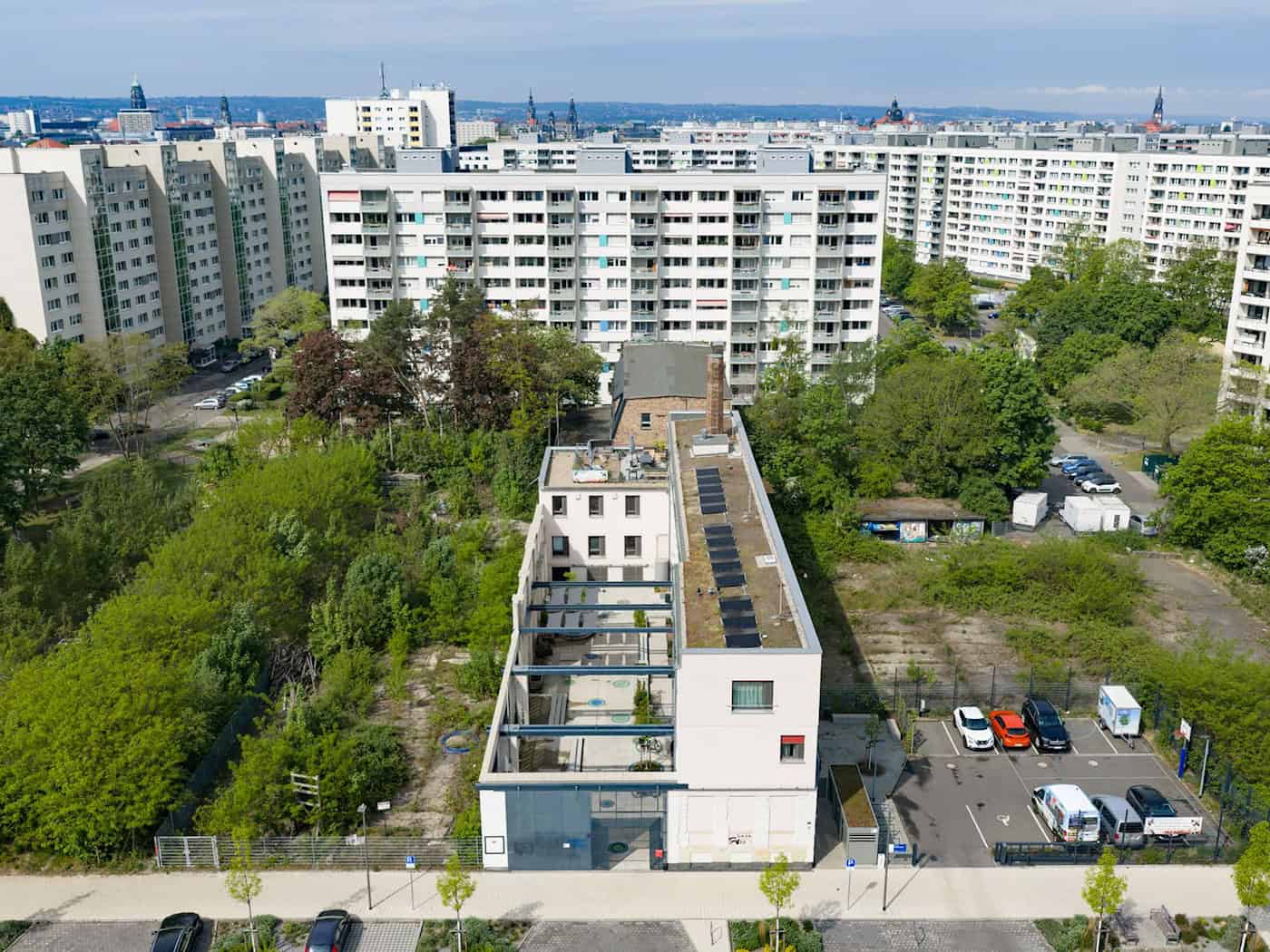
The chimney was the first thing Peter Hoffmeister saw: a ruin in Dresden's Johannstadt district, overgrown, forgotten, once a chocolate factory. It immediately became a symbol for the Chairman of the Dresden Child Protection Association. "When I saw the chimney and the walls, I thought: you could build a protective castle there, a shelter for children," says Hoffmeister today as he tours the house that was built from these ruins. It should be visible from afar and be a place for children, young people and families in the district. It has now been in existence for around two and a half years. For his vision, Hoffmeister brought Dresden architect Alexander Pötzsch on board and transformed a ruin into a utopia. This week, both were awarded the Federal Environment & Building Prize, presented by the Federal Environment Agency and Federal Environment Minister Carsten Schneider (SPD). The path there was anything but straightforward, Hoffmeister recalls. The purchase price was favorable, but what came next was anything but easy. The initial cost estimate was 3.6 million euros - which, as it turned out, was already too optimistic. The bank offered a maximum loan of three million, while the city initially offered half a million. Hoffmeister turned it down: The cover would not work that way. "I'm not doing it for the money," he told the responsible department at the city planning office at the time. Shortly afterwards, an appointment was made with the Saxon Ministry of the Interior. The result: 2.3 million euros from federal, state and municipal urban development funding. Then came the coronavirus pandemic and the costs exploded. In the end, there was a lack of money again. "It was a constant battle," says Hoffmeister. In the end, the club took on a good 1.3 million euros in debt to realize the project. A calculated risk, as the rent for the old rooms would be waived at the same time. From the outset, he was attacked for wanting to preserve the overgrown industrial ruin, which was most recently part of the Johannstadt panel factory. "We were massively attacked: How stupid are you? Why don't you tear it down?" recalls Hoffmeister. Nevertheless, the condition was clear to him: the building would remain standing. For architect Alexander Pötzsch, whose office was awarded the contract in 2019, the project was a commitment from the outset: don't tear it down, get on with it. The award in Berlin is more than just a personal success for him. "It was the only East German project to receive an award," says the architect. The factory building from the 19th century was largely preserved. A hall roof was removed to create an inner courtyard. An upper floor in timber construction with rooms for a residential group was built on top of the historic building. The building does not require any complex building services and relies on natural ventilation, explains the architect. Open brick walls in the corridors and stairwell are reminiscent of the original factory building. Historic components such as gates and windows were refurbished and reused. The floor of the inner courtyard was partially contaminated and was sealed with a concrete ceiling. This was all possible with a budget that was lower than that of a new building, explains Pötzsch with pride. "To dispel the myth that building in existing buildings is always more expensive." The Federal Environment & Building Award is explicitly aimed at such projects and sends an important signal, the architect believes. The construction sector is one of the biggest producers of CO2 emissions, waste and raw material consumption in Germany, explains Pötzsch. This is not the first award for the family center: last year, the project received the Erlwein Prize for exemplary contemporary building culture from the state capital of Dresden. Hoffmeister acknowledges the awards with satisfaction, but also sees a certain ambivalence in them. The 70-year-old works full-time as a management consultant and has been a volunteer at the Dresden Child Protection Association for 25 years, serving as its chairman for a long time. "It's not important to me personally," he says. "But the fact that we basically make child protection visible - that's important." In terms of space, it has been successful. What he misses is that this visibility is also echoed politically. "When the Dresden Child Protection Association was 20 years old, we had a great party. Nobody came from politics," he criticizes. Today, the building is much more than just an architectural project for those involved. On the first floor, mobile youth work uses its contact rooms: young people can play table football, cook, get advice or just be, says Andreas Blume, Managing Director of the Dresden Child Protection Association. The inner courtyard becomes a meeting place in the neighborhood in the afternoon. Seven young people live under the roof in a residential group. There are also counseling services, the association's office with conference rooms and the "Bibliotop", a meeting place run by volunteers with a walk-in bookcase. Around eight years later, Peter Hoffmeister sees his utopia largely fulfilled. Even if it is a plant that is still growing. "Every child who comes out here and has a perspective is worth the fact that this building was built," says Hoffmeister. Copyright 2026, dpa (www.dpa.de). All rights reservedProject on the brink due to lack of money and cost explosion
Costs for conversion lower than demolition and new construction
"Making child protection visible - that's important"


