

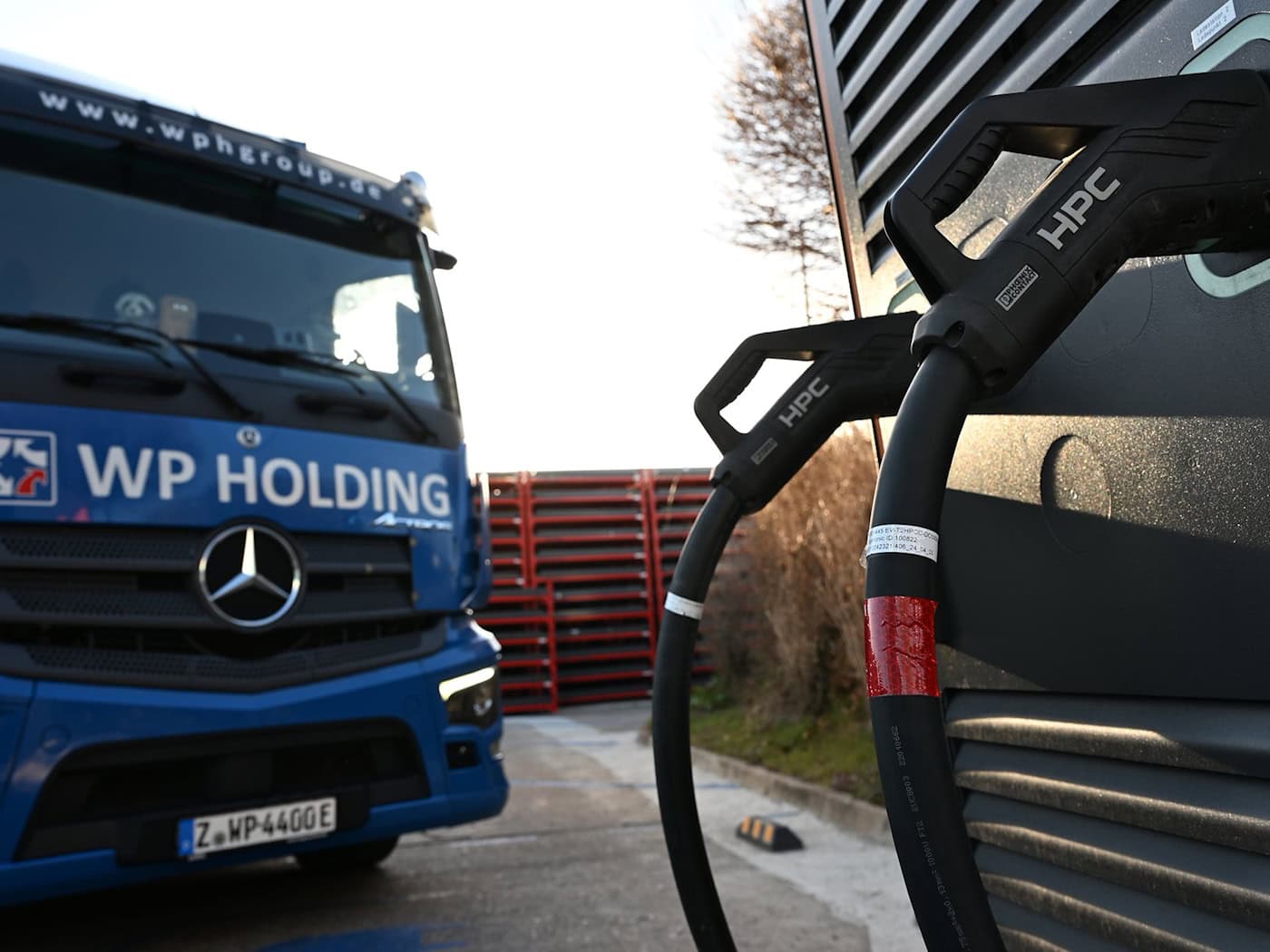
Driver Uwe Lenk has returned from his trip to Hesse and is now parking his truck on the premises of WP Spedition in Zwickau, Saxony. The drastic rise in diesel prices is of little concern to him: his truck runs on electricity. That's why he grabs the cable from the charging station at the end of the day to charge the 40-tonne truck's battery. "It's a completely different driving experience," enthuses Lenk. It's not just that there's no shifting. "It's much quieter and has much more power. You step on the gas and up to 800 hp is immediately available." The haulage company has around 350 trucks at ten locations, nine of which are purely electric. The first e-truck was put into operation at the end of 2023, says fleet manager Mike Henniger. "The positive experience with the first vehicle ensured that we ordered more." Despite the purchase price being around twice as high, the vehicles pay for themselves thanks to their own charging stations and the toll exemption, he says. A look at new registrations in Germany shows: Alternative drive systems are also on the rise for trucks. But there is still plenty of room for improvement. According to figures from the Federal Motor Transport Authority, one in eight new trucks in 2025 was not a conventional diesel, but ran on electricity, hydrogen, gas or was a hybrid. By comparison, this figure was just 5.8 percent in 2021. Vehicles that get their energy from a battery dominate. Almost 27,300 new trucks registered last year were battery-powered, around 7,300 were hybrid vehicles and just under 1,700 were gas-powered. There were just 107 new registrations of trucks with fuel cells. However, the balance is worse for articulated trucks. And a look at other vehicle types shows that Freight transport is lagging far behind in the mobility transition. For passenger cars, for example, alternative drive systems already account for 59 percent of new registrations, while the figure for buses and coaches is a good 42 percent. And a look at the roads shows: While more and more e-cars can be seen, electric trucks are rare. The proportion of heavy trucks is well below one percent, explains Dirk Engelhardt. He heads up the German Road Haulage, Logistics and Disposal Association and knows the industry inside out. It is currently groaning under high diesel prices as a result of the war in the Middle East. Is this now giving e-trucks a boost on German roads? "The potential is basically there," explains the expert. It is greatest in regional transport. In national and international long-distance transport, on the other hand, the use is difficult. This is due to the shorter range of the vehicles and the lack of charging options. To make the switch, more charging points in the megawatt range are needed across the board. In addition, electricity in the public charging network is expensive. "If I charge on the go and the providers charge 50 to 80 cents per kilowatt hour, then it doesn't pay off." The aim of the German government is to promote e-mobility in heavy goods transport on the road - also for reasons of climate protection. This is because freight transport accounts for around a third of CO2 emissions in the transport sector. To this end, a fast-charging network for trucks is to be set up on long-distance routes. According to the National Charging Infrastructure Control Center, 350 locations are planned along the freeways with around 1,800 particularly fast MCS charging points and 2,400 CCS charging points. However, according to an overview, there are currently only 69 publicly accessible locations with 270 charging points nationwide. When it comes to charging stations, Germany and the EU are lagging miles behind their own targets, complains Engelhardt. And his association estimates the demand to be much higher. A full electrification of road freight transport would require a rough estimate of 40,000 to 50,000 charging points in the megawatt range. This is the only way to ensure smooth and fast charging operations at all times. After all, e-trucks are currently exempt from tolls. That is an incentive, says Engelhardt. So are e-trucks even worthwhile for hauliers? They are significantly cheaper to run - especially now that the price of diesel has gone through the roof, explains WP fleet manager Henniger. He does the math: Even before the war in Iran, the fuel costs of his diesel fleet would have averaged around 37 euros per 100 kilometers. With the electric trucks, it is a good 25 euros. Added to this are the savings on tolls. This is offset by the fact that the vehicle is 2 to 2.5 times more expensive to purchase than a diesel. "If the e-trucks cover a lot of distance, they are at least as economical as a diesel," he concludes. At WP, they are therefore used in two shifts. They also have a significantly better carbon footprint thanks to the CO2 savings. "If the tours and the required charging infrastructure allow it, we will largely rely on e-mobility in the future due to the efficient drive concept." To achieve this, however, politicians must ensure that long-term planning is possible through reliable framework conditions - especially with regard to sufficient charging points for trucks. Other companies are having similar experiences. The freight forwarder Nanno Janssen in East Frisia, for example, has already converted well over half of its fleet to electric: 58 out of 90 trucks. The first one was purchased in 2024 with federal funding, explains junior boss Nanno Jannsen. The longest distance his company has ever driven with an electric truck is from Turkey to Portugal. "Electric trucks are the most sustainable way of transporting goods by road," Janssen is convinced. "We can see that: This is the right way forward in the long term." The Iran war and its consequences show that e-mobility is less dependent on the global energy markets. He also expects the gap in the purchase of electric and diesel trucks to narrow over the next few years. But what does it all look like in practice? How far can an electric truck travel on a single charge? Uwe Lenk and his colleague Michael Grimm from WP are on the road with electric trucks every day. They say that 400 to 500 kilometers is no problem. Depending on the power of the charging station, charging takes one to two and a half hours when the battery is empty. Ideally at their own depot or at the same time as loading and unloading at the customer's premises. If this is not possible, then the public grid is used. The current gaps in the charging network for trucks are bypassed if necessary and switched to charging stations for cars. After all, these could also be used by trucks without any technical problems. The drawback is that it is often a tight squeeze and they have to uncouple trailers or semi-trailers beforehand. However, they are met with both curiosity and reservations from colleagues. "I've already had to hear from others: I'll never drive a streetcar like that in my life," says Lenk. "Anyone who tries it out will certainly think differently." Copyright 2026, dpa (www.dpa.de). All rights reservedDiesel trucks dominate new registrations
Association calls for more speed in expanding the charging network
Will high diesel prices bring about a turnaround?
How do truck drivers make do in everyday life


