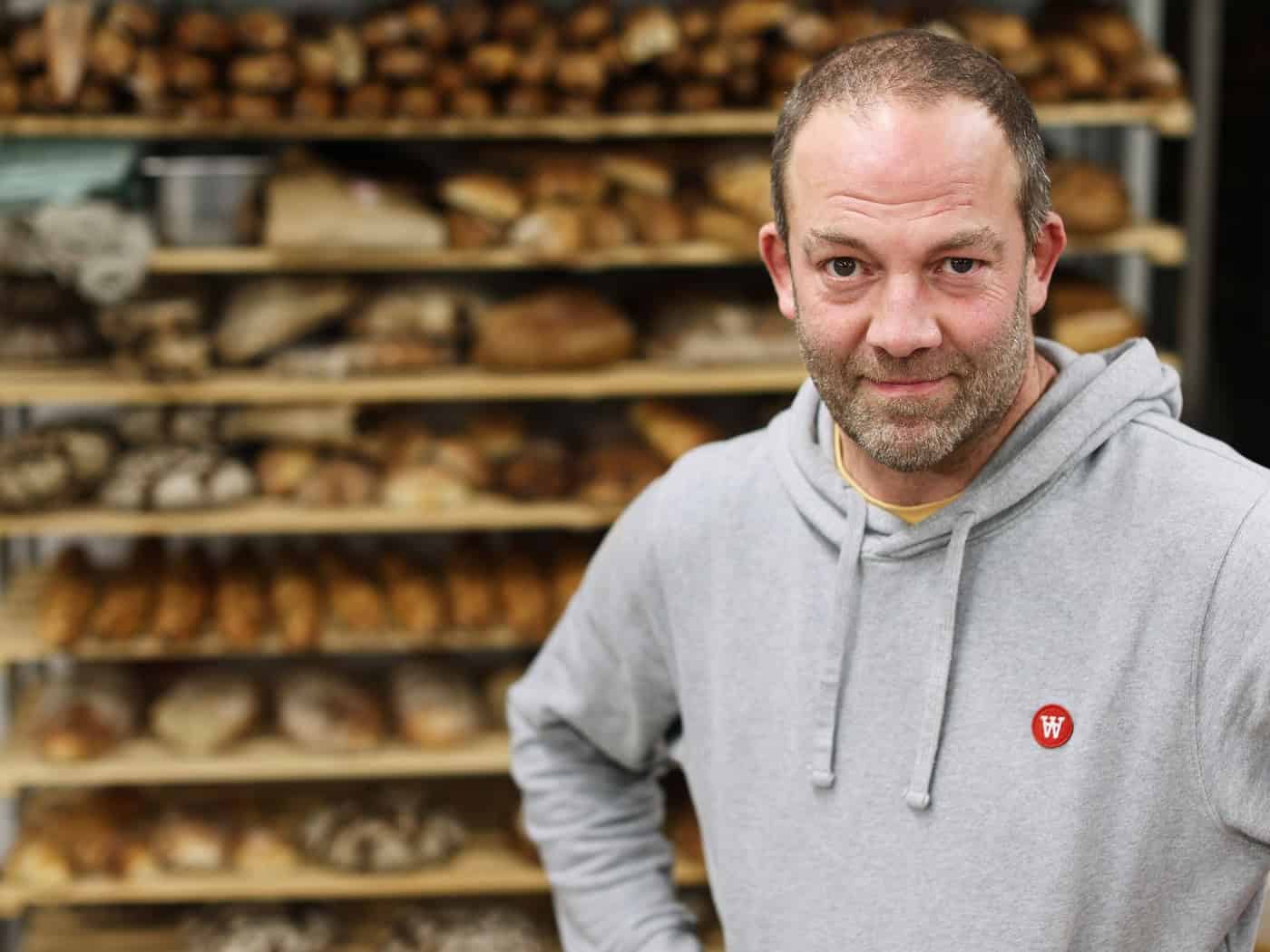
Pascal Rubertus stands in front of a bakery display case and points out the bread that came out of the stone oven today: Baguettes are stacked at the very top, followed by ciabatta with and without olives, and then large one-kilogram loaves with names like “Backstein,” “Kampagne,” and “Monte Rosa.” Flour, water, and salt—that’s all that goes into his sourdough breads: “It’s this simplicity—using just three ingredients to create something that’s so versatile,” says the 52-year-old. And apparently, this goes over well with customers: In 2018, Rubertus founded “Backstein, the Bakery for Contemporary Bread” in Leipzig—in a thirty-square-meter space in the garden of the Gallery for Contemporary Art. People often stand in long lines here to buy bread, as well as pastries like croissants or cinnamon rolls. Success as a “Hipster Baker” “I could imagine that I might have a reputation as a hipster baker,” the baker says of himself. “But I’d say that I bake in a way that’s more traditional than many others do.” In May 2025, Rubertus opened a second bakery, Backstein West, in Leipzig-Plagwitz. Here he has 300 square meters of space in an industrial-chic style: for baking, as a café, and for evening events. With this, he has fulfilled a childhood dream. Rubertus now has about fifty employees across both bakeries; slightly less than half of them are bakers, including five apprentices. While Rubertus has succeeded in opening a second location, the total number of bakeries in Saxony is steadily declining: “Over the past ten years that I’ve been observing this, we’ve consistently seen an annual decline of four to five percent,” says Manuela Lohse. She is the executive director of the Central German Bakers’ Guild Association. At the beginning of the year, there were still 821 bakeries in Saxony. A bakery can range from a small, traditional bakery with a retail store to a large chain with multiple locations. Bakeries Struggle with Bureaucracy and Rising Costs Lohse says that when a bakery goes out of business, there are often several reasons: a lack of succession, for example. But ever-rising operating costs are also an issue. “In addition to the political framework conditions, which have become significantly more stringent in recent years—with record-keeping requirements, inspection obligations, and platforms where bakers must register, for example, regarding packaging.” More and more requirements have been added, and not every business can keep up, says Lohse. Price pressure from bakery sections in discount stores is also frequently cited when it comes to the closure of traditional artisan bakeries. Lohse comments: “The relationship with discounters is, on the one hand, an emotional one and, on the other, a purely practical one. Emotionally speaking, there are certainly some bakers who see them as fierce competition, especially in the price war.” From a practical standpoint, however, no good artisan baker needs to engage in a price war with a discounter. Quality Is the Be-All and End-All Baker Pascal Rubertus agrees: “As long as you don’t try to bake like the industrial sector, there’s no competition.” He is convinced that quality must be right. In Rubertus’ bakeries, the classic wheat sourdough loaf “Backstein” costs 7.50 euros. Rubertus considers the price reasonable, since it’s a full kilo of bread. “I don’t want to sell the bread as a luxury product,” he says. But he, too, has to cover his costs. Rubertus is proud of the fact that he has never haggled over the price per kilo of flour with his predominantly local suppliers. It’s important to him that everyone along the supply chain for his baked goods gets their fair share. He’s convinced that the high quality of his baked goods has been key to his success. Specializing in sourdough breads also works in his favor: sourdough is considered easier to digest: During the long fermentation process, simple sugars are broken down, and natural toxins in the grain are eliminated through fermentation. Lohse from the Central German Bakers’ Guild also mentions a social media trend centered on sourdough. Thanks to this trend, people are talking about high-quality artisan baking. Social media marketing is important Despite the shrinking baking industry in Saxony, there are still successful new businesses and succession stories emerging. Young master bakers have innovative concepts in mind: “They’re no longer running a bakery with the full, traditional range of products, but instead have clear priorities and their own distinct profile.” Those who also market their craft well on social media channels have a good chance of successfully establishing themselves in the market: “Storytelling is important,” says Lohse. This is a trend that the Central Association of the German Baking Trade is also observing nationwide: Although the number of businesses fell by 2.8 percent to 8,659 in 2025, On average, 650 to 700 businesses closed each year, while around 400 new ones were established. Last year, 448 new businesses were added. “There are many young people with cool concepts, especially in Saxony and Thuringia,” says association spokesperson Susan Hasse. “It’s not a dying trade!” Copyright 2026, dpa (www.dpa.de). All rights reserved