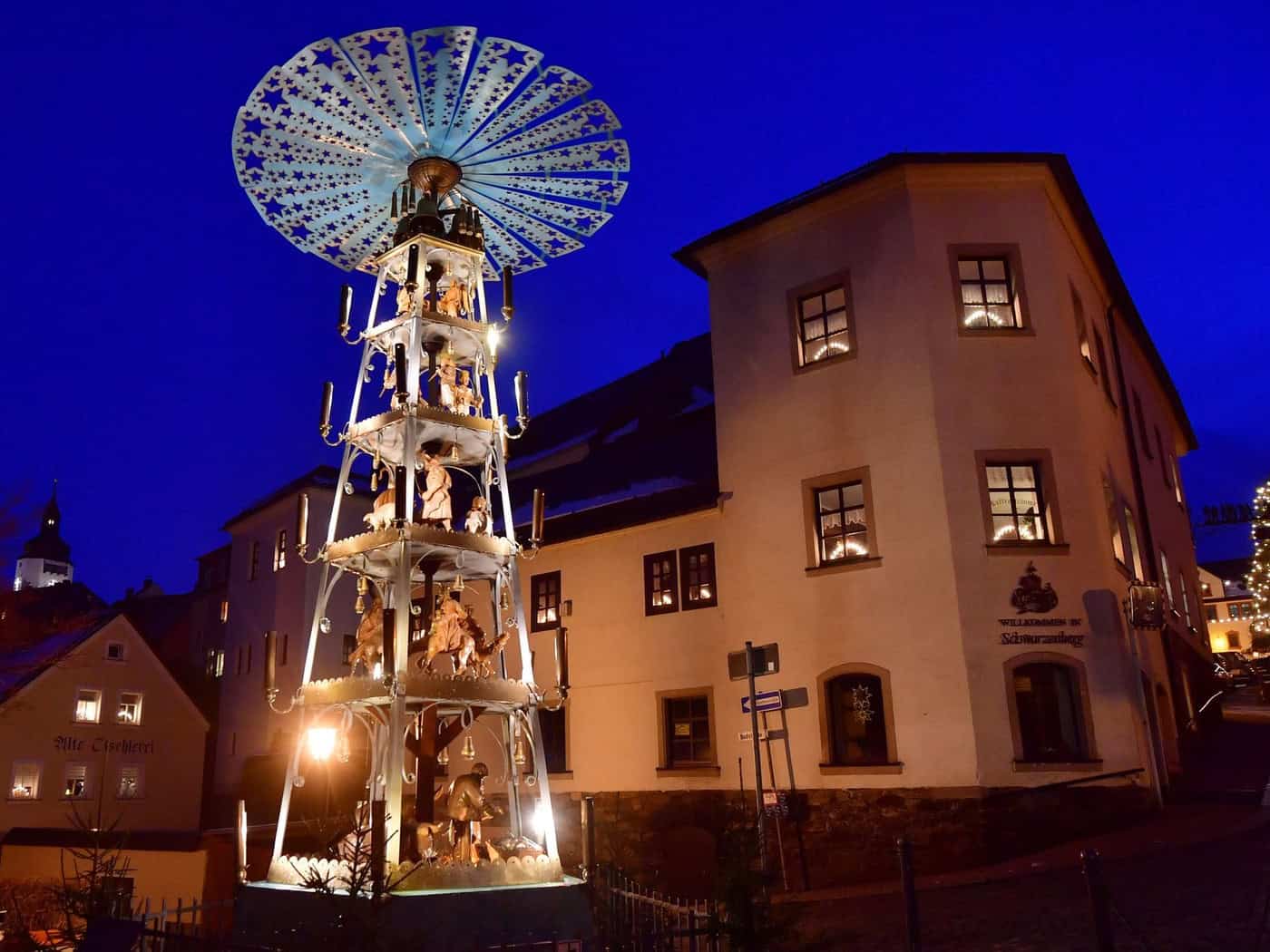
Multi-story, illuminated Christmas pyramids are a staple of the cityscape in many Saxon towns during Advent. They’re also eye-catchers at large Christmas markets, such as those in Dresden or Leipzig. Although they’re electrically powered, the tradition of “pyramid pushing” is still celebrated in many places, especially in the Ore Mountains. Here’s what that’s all about—and where the pyramid starts spinning even without the custom. Whether in Breitenbrunn, Altenberg, or Ehrenfriedersdorf—especially in the Ore Mountains—people are invited to participate in pyramid-pushing. Many towns there have their own local pyramids, some of which remain on display year-round. Most events take place on the Friday and Saturday before the first Sunday of Advent. Johanngeorgenstadt is home to the world’s tallest Christmas pyramid, standing at 25.52 meters. There, the Woodcarving Association invites everyone to the pyramid-pushing event on November 26. There will be mulled wine, bratwurst, and a bonfire; trombone players will perform, and miners in traditional attire will surround the pyramid, reports Lucas Bergauer from the Woodcarving Section. “This marks the start of the Christmas season.” The pyramid-pushing ceremony is a fixed event on Johanngeorgenstadt’s Christmas calendar. It always takes place on the Thursday before the first Sunday of Advent. The custom has nothing to do with the Christmas market, which doesn’t open until the third Sunday of Advent. The number of visitors depends on the weather, says Bergauer. “I’d say there are at least 100 people there. If the winter weather is nice and there’s snow, there can be even more.” Pyramid pushing is still a relatively new tradition that only developed after the fall of the Berlin Wall, explains Annett Fläming, spokesperson for the Ore Mountains town of Annaberg-Buchholz. There, the large market pyramid has been set in motion since 1993 with three shouts of “Hau ruck!”—a cry that also marks the opening of the Christmas market. “According to oral tradition, the origins of this symbolic pushing actually go back even further: as early as 1988–1989, the first pyramid-pushing event is said to have taken place in what is now the Frohnau district. The occasion was a visit by guests from the former Soviet Union shortly before the first Sunday of Advent. The organizers wanted to offer them a special pre-Christmas highlight,” explains Fläming. The pyramid-pushing ceremony has since become an event of extraordinary significance for Annaberg-Buchholz. An estimated 800 to 1,000 visitors attend the market each year. “It’s far more than just setting a Christmas pyramid in motion: for many people, it marks the emotional beginning of the Advent season,” says the city spokesperson. In the state capital of Dresden, the pyramid-setting ceremony is part of the opening program for the Striezelmarkt, which is Germany’s oldest Christmas market. An Erzgebirge-style stepped pyramid has stood there since 1997. Since then, it has also been symbolically set in motion, according to the city administration. “The symbolism of setting the pyramid in motion stems from the tradition of the Erzgebirge.” This year, the 14.61-meter-tall pyramid will be set in motion for the first time on November 25. To mark the occasion, the Saxonia Freiberg Miners’ Orchestra will play the “Steigermarsch,” the pyramid’s lights will come on, and it will begin to rotate. “There are no specific people who actually push it,” the city states. The tradition originated in the Ore Mountains. According to local historians, small wooden pyramids—used as home decorations, in which air warmed by candles drives a propeller—became widespread around 1800. The tradition of community pyramids, on the other hand, is much more recent—it dates back to the 1930s. The first outdoor Christmas pyramid was erected in Frohnau in 1933. A member of the local woodcarving club had the idea for a “pyramid for everyone,” reported the Frohnauer Hammer Museum on the occasion of an anniversary exhibition. The first pyramid stood in Frohnau for two years, after which it was dismantled due to political differences within the woodcarving club. Since then, the pieces have been considered lost; only old photos remain. The idea of the local pyramid, however, lived on and spread. At the Leipzig Christmas market, the nine-meter-high pyramid must stand without being pushed. “The so-called ‘pyramid pushing’ comes from the Ore Mountains and has never been practiced in Leipzig—which is why it isn’t a tradition here,” the market office explains. But even in Saxony’s largest city, the opening of the Christmas market isn’t complete without rituals: “The Christmas tree’s approximately 3,000 LEDs are lit in a synchronized illumination in five to six stages, and the approximately two-meter-tall Herrnhut Star on the Christmas tree also shines then.” In addition, the mayor presses a buzzer, and visitors count down to the opening. Copyright 2026, dpa (www.dpa.de). All rights reservedWhere can you find pyramid-pushing events?
A Relatively New Tradition
The pyramid is also set in motion at the Striezelmarkt
Why do these large outdoor pyramids exist at all?
Other Cities, Other Traditions