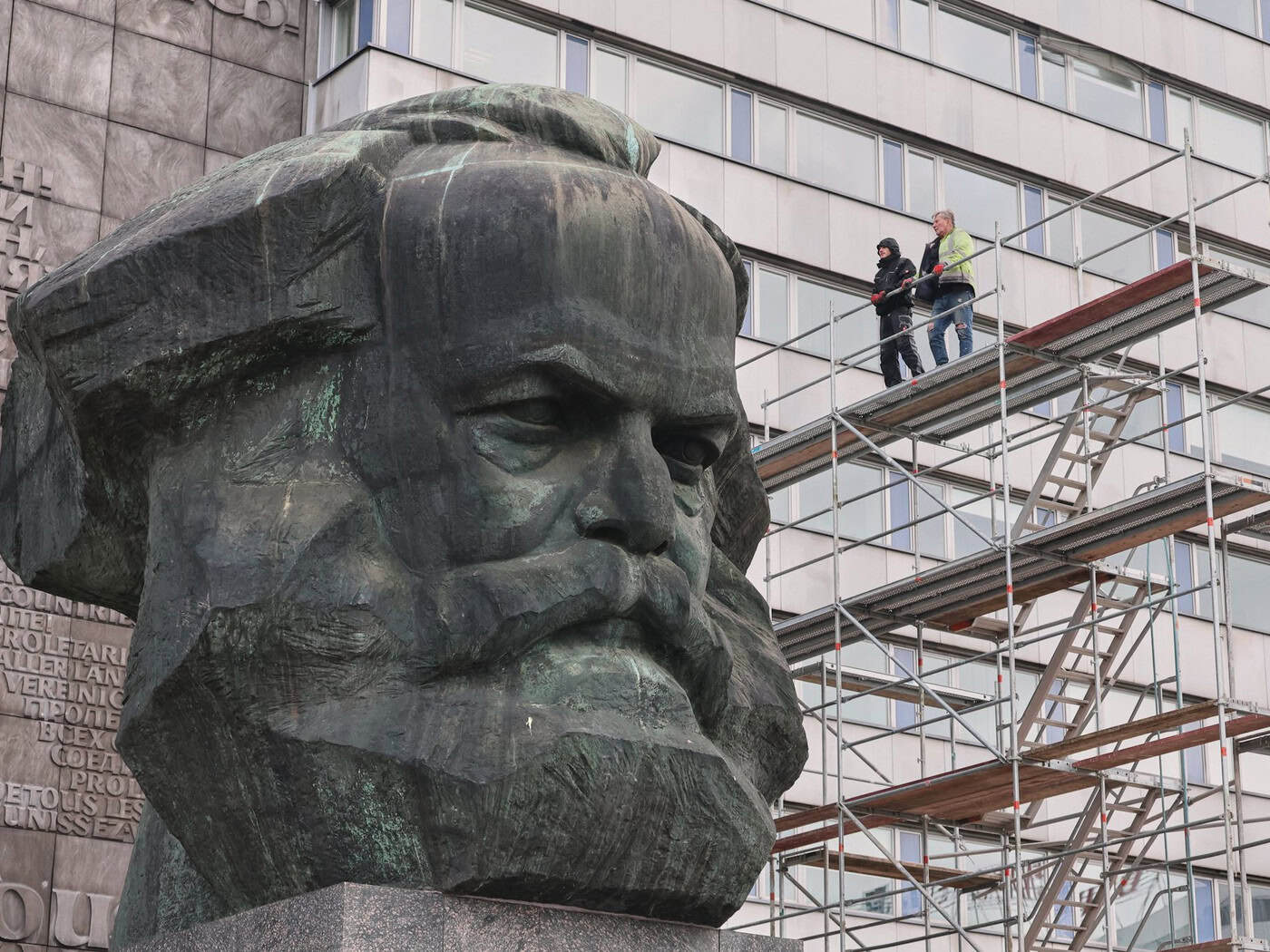
The city of Chemnitz is concerned about its most famous landmark: the giant bronze head of philosopher Karl Marx, popularly known as “Nischel.” After standing there for 55 years, it is in need of restoration, explained Ferenc Csák, head of the cultural affairs office. However, the condition of the interior of the world’s second-largest portrait bust remains unclear. For this reason, an expert will climb inside the head this week to assess the situation. The monumental statue was unveiled in October 1971. It was created by the Russian sculptor Lev Kerbel (1917–2003). The 40-metric-ton bust was originally cast in a foundry in what was then Leningrad—now St. Petersburg—and then dismantled into 95 pieces for transport. In Chemnitz, which was then called Karl-Marx-Stadt, the pieces were welded back together. The bottom plate is now to be sawed out. An expert is expected to climb inside through this opening on Wednesday. He will assess the structure of the corrosion protection, examine the bolted joints, and determine to what extent the steel structure’s anchoring in the base is still sound, according to the city. Afterward, the monument will be sealed shut again for the time being. The inspection is intended to determine the next steps, Csák explained. The actual restoration is scheduled to begin in the summer of 2027 and is expected to last into 2028. The city has initially budgeted 50,000 euros for this project next year, and additional funding of 25,000 euros has been requested, officials said. The bust also features a relief in the background bearing the inscription “Workers of the world, unite!” in several languages. This part of the ensemble has already been restored. The monument was once erected as a demonstration of power by the SED, but it survived the collapse of the GDR. Today, it is not only Chemnitz’s most famous landmark but also a popular photo spot and venue for gatherings and art events. For example, it served as the venue for the grand opening gala of Chemnitz as the European Capital of Culture 2025. Copyright 2026, dpa (www.dpa.de). All rights reservedHere’s the plan moving forward