

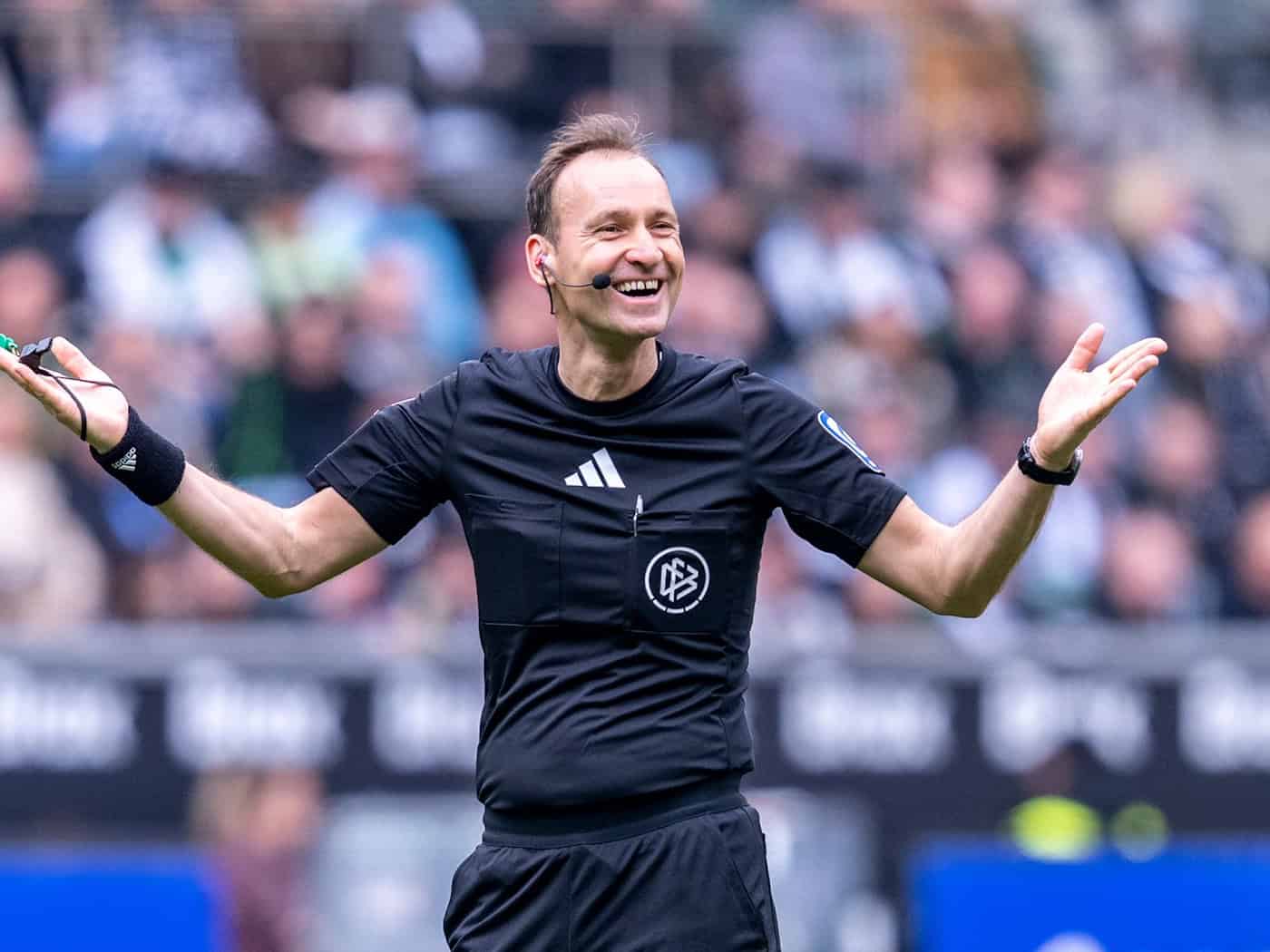
In 1970, Rudi Glöckner from Markranstädt refereed the World Cup final between Brazil and Italy (4–1). It took 56 years before another German referee was assigned to a World Cup final. Bastian Dankert of Rostock served as the “Video Assistant Referee” (VAR) last Sunday during Spain’s World Cup victory over Argentina (1–0 in extra time). The 46-year-old spoke with the German Press Agency about this sporting honor and his experiences at the World Cup. “I haven’t really processed it all yet. My bags are still in the hallway. My wife welcomed me home with a surprise party. And even though I was very tired, my adrenaline suddenly shot up again. So I celebrated my World Cup medal with my family, many friends, and my fellow teammates. And when I look at this medal and see “Spain vs. Argentina in the World Cup Final” engraved on it, I start to reflect: What have I really accomplished over the past few days? I flew to the U.S. right after the Champions League final in Budapest and was there for a total of 50 days, from June 1 to July 21. That’s just crazy. I’ll try to make sense of it all over the next few days.” “On the Thursday before the final, we had a video conference together: the referees in Miami and us video assistants in Dallas. So, of course, we were also there when the final referee was announced. And after Slavko Vincic and his team were named, it was our turn as video referees. It’s a wonderful feeling. Everything just surges through you in that moment, and you think: ‘That was just your name. And you’re going to be part of the World Cup final!’ My first thought was: This is what you’ve been working toward for so long! Maybe not necessarily since I started out as an amateur. But at the latest since I experienced my first World Cup in 2018 and was immediately assigned to the third-place match. And when I was assigned as a backup for the 2022 final. At some point, you want to be in that position yourself. And the fact that it worked out this time is also a kind of reward for everything you’ve truly sacrificed along the way. It confirms that the path I’ve taken over the last few years was the right one.” “We were based in Irving, near Dallas. And the referees were stationed in Miami. They always returned there after every game they officiated. The group stage flew by incredibly fast because there were just so many games. So we had a game every two or, at the latest, three days. And even when we weren’t officiating a game ourselves, we had to analyze all the other matches. That’s why we had a meeting every morning at 10:00 or 10:30 a.m. We also trained. We had a very large facility with our own training court, tennis courts, and an air-conditioned gym. At times, it was 40 to 45 degrees hot in Dallas. But we were able to get plenty of exercise every day. Once the knockout stage begins and the number of matches decreases, things can get a little tough. But we had a great community that did a lot together—playing tennis, playing pickleball, and holding table tennis tournaments. We were in very good hands there. Our advantage was that the Club World Cup had already taken place last year. And 80 to 85 percent of the officiating team consisted of people who already knew each other well from 2025.” “Even for referees, there are match analysts who provide us with extensive data before and during a World Cup. This covers tactical nuances, key players, and playing systems. What happens if someone is sent off? How do players behave during corner kicks or free kicks? All of this is discussed, which is why you feel very well prepared for a final like this. The challenge is really not to think about it every morning, every hour, and every minute after being assigned the match: This is a World Cup final! Messi is playing against Rodri. And 200 million people worldwide are watching it on TV. Our boss simply told us: It’s a red team playing against a blue-and-white one. And that makes a lot of things easier. You can better manage your own emotions and tension. And I think that also helped us execute well in this final. There were a lot of so-called “silent checks,” where we reviewed scenes in the background without interrupting the game. Tackles that we double-checked for possible fouls. Or Spain’s goal, which was rightly disallowed. For example, this allowed us to support the referee in confirming that he was correct and that he should continue to be so bold and consistent. Because as an outsider, you can’t even imagine the pressure a referee is under during a game like this. After all, the World Cup title is at stake—this isn’t some village tournament.” Copyright 2026, dpa (www.dpa.de). All rights reservedReturning from America:
The nomination for the World Cup final:
A day in the life of World Cup referees:
Preparing for a World Cup final:


