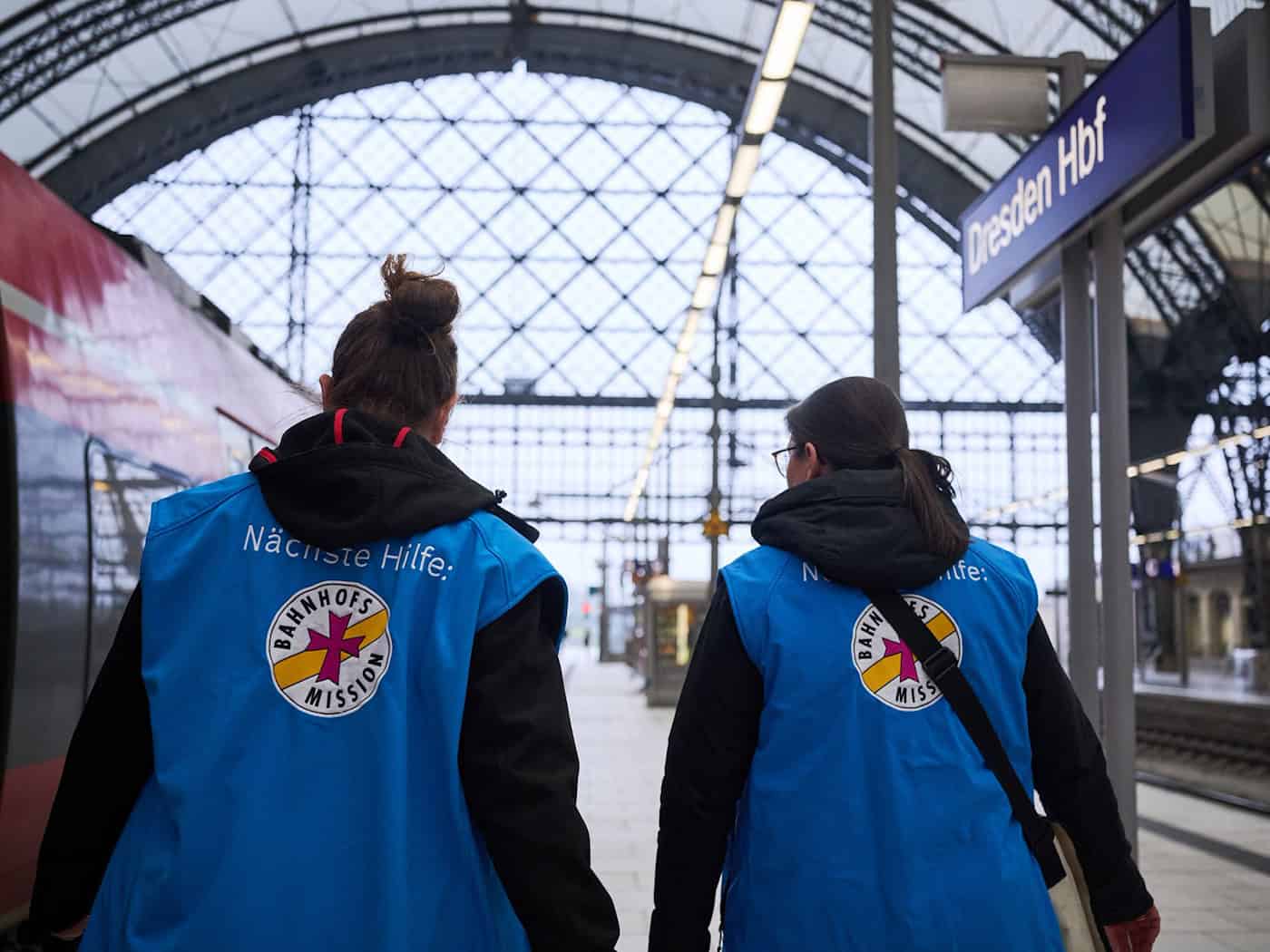
At a pharmacy near the Dresden-Neustadt train station, the staff don’t know what to do anymore. A homeless man is hanging around there and refuses to leave the pharmacy. So the staff ask the train station mission for help. Cornelia Heinrich and Ulrike Schaller head over. The man is known to the two volunteers. He regularly seeks help from the train station mission. Just in case, they have water, band-aids, tissues, and a thermal blanket in their bag. They approach him and offer assistance. But this time, he doesn’t want to go with them. “We could have helped him, but for whatever reason, he doesn’t want that,” Schaller says afterward. For her, accepting rejection is part of the job. “If we offer help repeatedly and he says no, then I can handle that. For me, that’s okay.” Cornelia Heinrich continues to think about the encounter. She would have liked a different outcome. “What else could we have done? Or what could still have been influenced?” she asks herself. Heinrich has been coming to the train station mission twice a week for about a year and a half; Schaller has been volunteering there for just under a year. In their work, both encounter stories that continue to weigh on their minds even after their shifts end. At first, Heinrich had to learn how to cope with the emotional strain. Some guests have a strong need to share their stories, while others recount experiences that are difficult to bear. Sharing experiences within the team helps them process what they’ve been through. At the same time, she’s learned that not everyone has to accept help. “Everyone has a right to neglect,” says Heinrich. That might sound harsh at first, but it’s an important insight for the job. “We can offer help to everyone, but we certainly aren’t in a position to save everyone,” adds Schaller. At the same time, the work gives her a lot in return. These encounters have changed her perspective on her own life. “You actually come to appreciate what you have even more,” she says. The railway station mission at Dresden Central Station is a point of contact for people in a wide variety of life situations. Homeless people find support here, as do travelers stranded in Dresden or people who need help transferring trains. “In principle, anyone can come here if they need assistance at the station or while traveling,” says Patrick Büttner, director of the Dresden Station Mission. Their work isn’t limited to the facilities at the main station. Staff members are also on the move at the Dresden-Neustadt station. Some travelers have lost their luggage or been robbed. In such cases, the staff try to contact relatives or organize further assistance. They also help people with limited mobility when transferring between tracks. The station mission’s services include beverages as well as clothing and hygiene items as needed. Underwear, gloves, hats, scarves, and handkerchiefs are in particularly high demand. While food is not part of the regular offerings, something to eat is provided in special situations. The facility also keeps sleeping bags, sleeping pads, and blankets on hand for emergencies around the station. One of the regular visitors is Viola. She is originally from Burgstädt, is homeless, and, according to her, has a bed in a shelter. Nevertheless, she enjoys coming to the train station mission. “The atmosphere. They’re very friendly and nice. The coffee tastes good,” she says. You can chat, warm up, and have something to eat. On this particular day, however, Viola has a specific problem. Büttner reports that her personal belongings had been put away at her emergency shelter. She was very upset about this. From the train station mission, she called the shelter. Together with Büttner, she was able to resolve the matter. According to Büttner, the train station mission is run by the Diakonie. The facility is funded primarily by the state capital, Dresden. The churches and Deutsche Bahn also support the ecumenical project. Among other things, Deutsche Bahn provides the premises free of charge. The facility itself does not offer comprehensive social counseling. If major problems arise, Büttner meets with those affected in the office and refers them to appropriate agencies. The train station mission sees itself as a complementary service within the city’s support system. There, the city administration and independent organizations work closely together to prevent gaps in care, as reported by the City of Dresden. The city is currently observing a rising number of homeless people and increasingly complex social problems. The train station mission serves as a low-threshold point of contact in this context. “By serving as a bridge between immediate aid and professional social support, the train station mission complements the existing support system in Dresden.” The train station mission is also networked beyond the city limits, explains Büttner. At regular meetings with railway station missions from Saxony and other parts of central Germany, experiences are shared and travel assistance is coordinated. Copyright 2026, dpa (www.dpa.de). All rights reservedBetween Compassion and Personal Boundaries
Help Not Only for People in Need
A Place to Warm Up and Talk
Part of Dresden’s Support Network