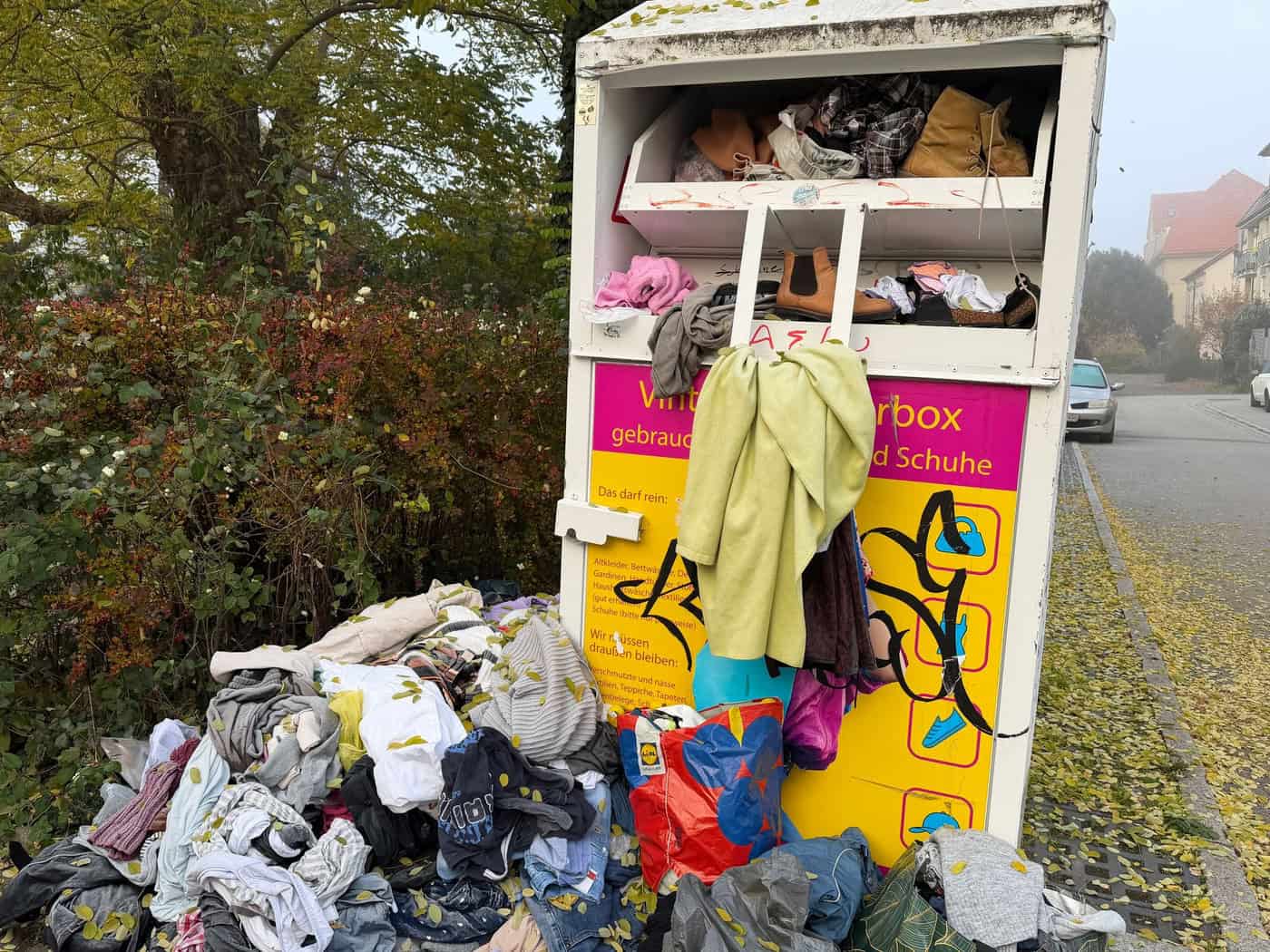
The number of used clothing collection bins has declined significantly this year in Saxony. What was once a viable model has increasingly turned into a social burden, said Kai Kranich of the German Red Cross (DRK) in Saxony. “The remaining collection points are becoming increasingly littered and turning into eyesores.” According to the DRK, the reason for the removal of the containers is the drastic change in operating conditions. For example, the drastic drop in prices on the global textile market leaves little room for revenue, and the quality of donated clothing has declined, making it harder to reuse. In addition, the amount of unusable clothing is increasing, resulting in high disposal costs. According to the report, a particularly major problem is the increasing disposal of all kinds of trash in or next to the containers. “Disposing of every kilogram of trash from the clothing containers incurs higher costs than the revenue generated by reselling used textiles per kilogram,” explained Kranich. As a result, more and more thrift stores and clothing banks are closing because they can no longer cover the disposal costs for the trash. For many years, the used-clothing collection organized by the German Red Cross (DRK) and other charitable organizations was a well-functioning system dedicated to the common good. It not only served to recycle used clothing but also helped alleviate the burden on the waste management system, supported social projects, provided people in difficult life situations with access to well-preserved clothing—and used the proceeds to fund a wide range of local DRK services. “This model was largely self-sustaining in the past,” Kranich emphasized. Clothing donations were collected, sorted, reused, or recycled. The revenue from recycling helped refinance the collection efforts and enabled investments in social work. For many DRK branches, the used clothing collection was thus an essential component of local welfare work and, at the same time, helped relieve the burden on municipal waste management systems. The DRK is calling for clothing manufacturers to be required to contribute to the costs of recycling unusable textiles for material or energy recovery. This applies above all in cases where quality or design preclude reuse. At the same time, manufacturers who produce high-quality textiles with a long service life should be rewarded. In addition to economic considerations, however, social arguments and the enhancement of a municipality’s resilience to crises must also be taken into account, the statement continued. Municipalities should therefore not only legally tolerate the work of nonprofit organizations but also actively support it. Spaces for collection containers should be made available to nonprofit organizations free of charge in public areas. “This is especially true when the organization also operates a local clothing bank or uses the proceeds to fund other civic engagement initiatives in the municipality.” The German Red Cross (DRK) also calls for the disposal costs to be shared or covered. “Given the rising proportion of non-recyclable used textiles, nonprofit collectors and municipalities must engage in dialogue on how the disposal of unusable clothing or waste could be financially managed in order to distribute the disposal burdens more evenly.” Copyright 2026, dpa (www.dpa.de). All rights reservedWaste disposal costs exceed revenue from usable used clothing
Used-clothing collection has many positive effects
These are the DRK’s demands—it’s now up to the municipalities