

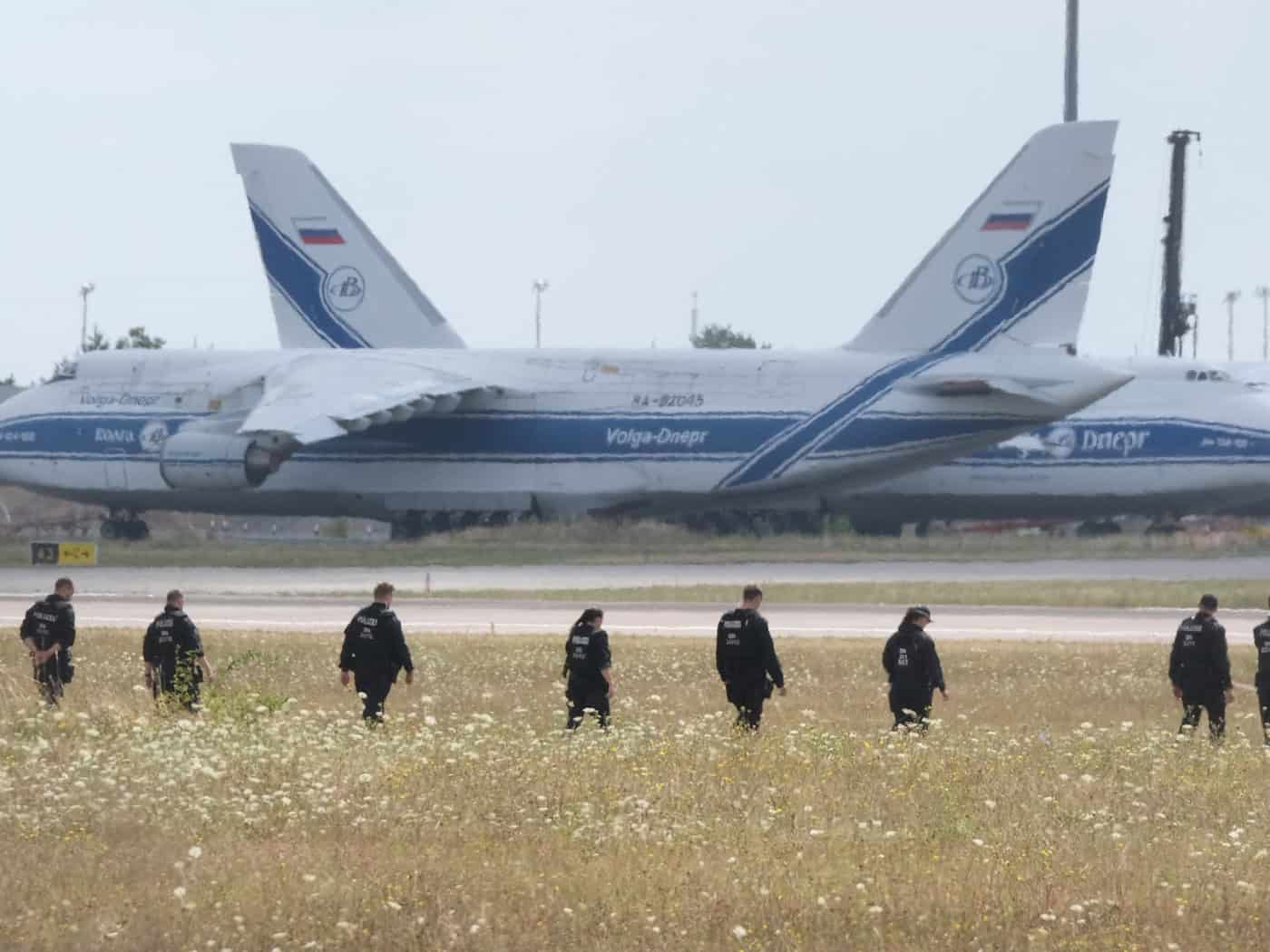
Following the discovery of a drone carrying explosives—but without an intact detonator—at the Halle/Leipzig Airport, many experts are once again quickly pointing to Russia as the suspect. Federal Interior Minister Alexander Dobrindt (CSU) is more cautious in his assessment, referring to a “hybrid” attack by “foreign powers.” Just last year, when drones were spotted at airports, Chancellor Friedrich Merz (CDU) claimed that Kremlin leader Vladimir Putin was trying to test Germany. Here are some questions and answers regarding the evidence for and against Russian involvement: The Federal Public Prosecutor’s Office is investigating on suspicion of attempted detonation of an explosive device and dangerous interference with air traffic, the Karlsruhe-based agency announced. At Leipzig/Halle Airport, a drone equipped with explosives and a detonator was discovered near Ukrainian transport aircraft and brought down by an employee. Shortly afterward, an aircraft taking off following the airspace closure collided with an unknown smaller flying object, possibly a second drone. One argument in favor of Moscow’s involvement is that Russia possesses advanced drone technology and has more or less openly threatened to respond to Western arms deliveries to Ukraine. For example, the Russian Ministry of Defense published the addresses of German and other European defense contractors. Russia’s former President Dmitry Medvedev, who continues to wield influence as deputy head of the National Security Council, described the listed companies as a “list of potential targets for the Russian armed forces.” “At first glance, there are indications that Russian intelligence services may be involved,” says Russia and military expert Matthias Uhl. The Russian military intelligence service, the GRU, is held responsible for a wide range of operations in the West. However, it would be difficult for Russia to carry out such an operation at present because its agents in the West are under close surveillance. The list is long. Uhl recalls explosions at an ammunition depot in the Czech Republic in 2014, for which the government in Prague blamed the GRU in 2021. The current case also brings back memories: In 2024, an air cargo package caught fire at the DHL logistics center in Leipzig. Security officials believe the package was planted on behalf of Russia. As a result, five suspected perpetrators are currently on trial in Lithuania, accused of terrorist acts. They are alleged to have mailed packages containing homemade explosive devices. The operations are said to have been organized by individuals with ties to the GRU. The suspects are citizens of Russia, Ukraine, and Lithuania. Kremlin leader Vladimir Putin has repeatedly and categorically dismissed allegations that Russia intends to attack a NATO member state as “nonsense.” Even after the drone sightings at airports last year, he said that the accusations against Russia were likely intended to further inflame the situation and pressure Europe to increase its defense spending while diverting attention from other problems. Former Kremlin leader Medvedev cited various explanations for the origin of the drones. As examples, he cited provocations by Ukrainians seeking to drag Europe into a war. He conceded, however, that these could be the activities of a pro-Russian underground movement in those countries aimed at destabilizing life in the EU. Last but not least, he suggested these could be pranks by hooligans seeking to annoy their authorities. And he mused: “The most important thing is that the short-sighted Europeans experience firsthand what the danger of war means.” The Russian Embassy in Berlin describes it as a “provocation” by Kyiv directed against Moscow, intended to stoke anti-Russian hysteria in Germany. It stated that the goal of Ukraine and European militarists is to prepare society for a war against Russia. The Telegram channel “Maester,” popular among many Russians for its analyses, referred to it as a cheap staging of an act of sabotage. “Whether this is the work of the Ukrainians or the German (European) hawks is of no real consequence. The only thing that is clear is the trend toward escalation of the conflict on the part of Kyiv and the EU.” Even when drones were spotted at German airports last year, the Kremlin in Moscow rejected the accusations. Kremlin spokesman Dmitry Peskov was responding to remarks by Chancellor Merz regarding the drones, who had said: “In any case, a significant portion of them is likely being controlled from Russia.” He claimed that Kremlin leader Vladimir Putin wanted to test Germany. Moscow’s foreign intelligence service, the SWR, has warned on several occasions that Ukrainian intelligence agencies were planning anti-Russian provocations in order to pin the blame on the Kremlin. Saboteurs allegedly sought to discredit Russia through attacks on infrastructure facilities in Europe and so-called “false-flag” operations—operations carried out under a false flag. Expert Uhl also considers a “false-flag” attack—perhaps intended to divert attention toward Russia—a possibility. “One argument in favor of this theory is that German officials have so far been explicitly reluctant to place blame on Moscow,” he says. Copyright 2026, dpa (www.dpa.de). All rights reservedWhat is the status of the investigation?
Some experts promptly accused Russia—are they right?
What allegations of hybrid attacks have been leveled against Russia?
What evidence is there against Russia’s involvement?
What are Moscow’s reactions to the current incident?
What other “foreign powers” could be involved?


