

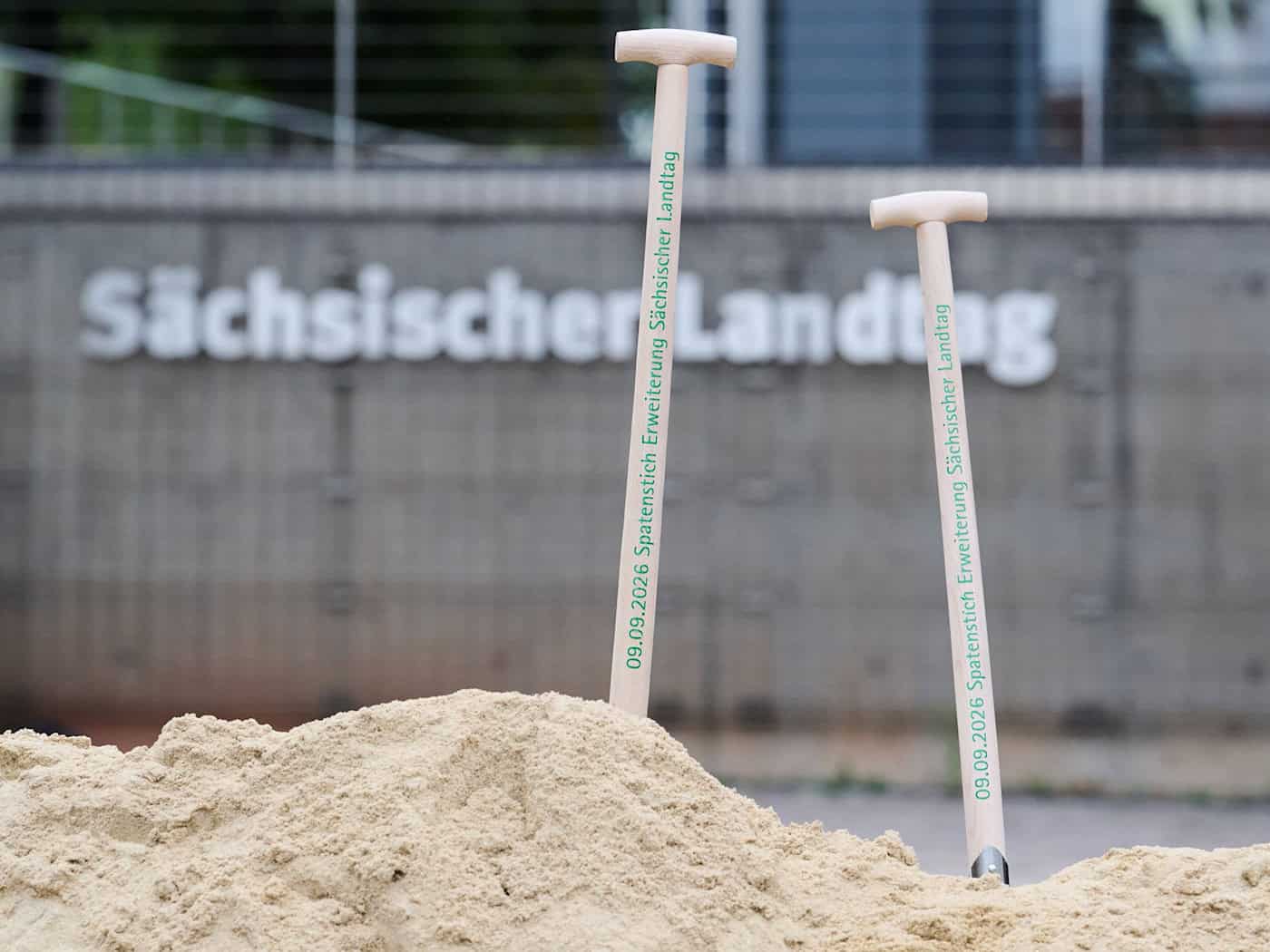
The first step has been taken: The renovation and expansion of the Saxon State Parliament has begun with a symbolic groundbreaking ceremony. State Parliament President Alexander Dierks and Finance Minister Christian Piwarz (both CDU) picked up shovels themselves on Wednesday afternoon to break ground. The new building on the open space between the State Parliament and the convention center is a prerequisite for the subsequent renovation of the old building. The new building will house additional office space and a modern technical center. The total construction costs for the project are currently estimated at 317.2 million euros. Of this amount, 73.6 million euros are allocated to the expansion, 38.6 million euros to a new building in the inner courtyard, and 202.2 million euros to the renovation of the existing building sections, according to the State Parliament. An additional 2.8 million euros is earmarked for work to be carried out in advance. Furthermore, a risk reserve of 132.9 million euros has been budgeted to account for construction cost trends throughout the entire construction period. “The Saxon State Parliament is the heart of our democracy. To ensure that our parliament can reliably fulfill its duties, it needs state-of-the-art technology and sufficient space for legislators, staff, and the many visitors. This has not been the case for quite some time,” said Dierks. After more than 30 years, the renovation and modernization are long overdue. Piwarz spoke of a challenging construction project at a special location. “We are laying the groundwork for a fundamental renovation of the Saxon State Parliament. In doing so, we are ensuring that the parliament remains operational during the construction period.” The renovation is necessary and cannot be postponed. At the same time, a solution has been chosen that avoids the parliament having to move entirely into a temporary building. “This is the right approach, both functionally and economically.” The Taxpayers’ Association spoke of “gigantism on the banks of the Elbe.” The estimated base costs are out of all proportion to the economic reality faced by Saxony’s citizens and businesses. This is impossible to justify to taxpayers. “No one disputes that a parliamentary building over 30 years old needs to be renovated and technically modernized. But why must renovation necessarily go hand in hand with a costly new replacement building and massive expansions?” The parliament building on the banks of the Elbe in Dresden has been in operation for more than 30 years. Many technical and structural systems date back to that time and no longer meet today’s requirements, officials said. This includes, among other things, the IT cabling network, electrical and media systems, fire safety, and accessibility. Added to this are heating and sewage pipes in need of renovation, as well as damage to the building’s structure. Technical systems in the plenary hall are also prone to malfunctions and would disrupt parliamentary operations. “To ensure that the Saxon State Parliament remains operational during the multi-year construction period, the two extension buildings will be constructed first,” the administration announced. Another new building is planned for the State Parliament’s inner courtyard. The so-called “Cube” will house, among other things, a publicly accessible hearing room and spaces for visitor groups. This measure is intended to accommodate the significant increase in visitor numbers, which now exceed 35,000 people. The new spaces can also be used as temporary facilities during the subsequent renovation of the old building. Completion of the two new buildings is scheduled for 2030. After that, the comprehensive renovation of the existing state parliament building will begin. The project is expected to be completed in 2037. Copyright 2026, dpa (www.dpa.de). All rights reservedCosts are currently estimated at around 317 million euros
“Heart of Democracy” Needs Comprehensive Renovation
Finance Minister: Renovation Cannot Be Postponed
Criticism from the Taxpayers’ Association
Three Decades of Operation Have Left Their Mark
First two new buildings, then renovation of the old building


