

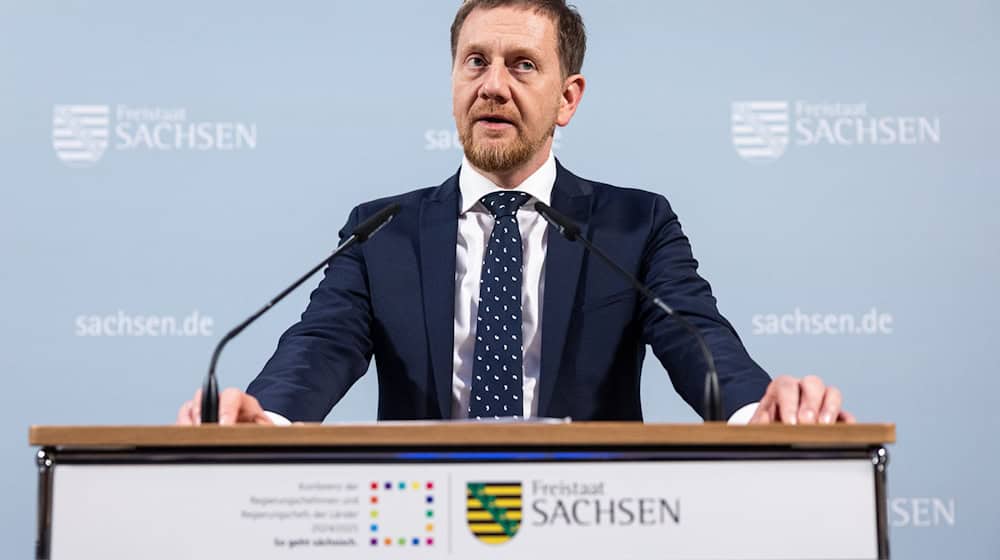
A good three and a half months after the state elections, a new prime minister is to be elected in Saxony today. The current head of government Michael Kretschmer (CDU) wants to govern with a minority government of CDU and SPD, as he does not have a majority of his own. The AfD party and parliamentary group leader Jörg Urban and Matthias Berger (Free Voters), who is not a member of the parliamentary group, want to run against him in the election. How this will work and how the minority government will function: Kretschmer wants to be elected Minister President of Saxony for the third time. He took over the office from his predecessor Stanislaw Tillich (CDU) in 2017. The Görlitz native previously sat in the Bundestag for 15 years. The coalition of CDU, SPD and Greens, which Kretschmer had led since 2019, no longer achieved a majority in the state elections. After negotiations on a Brombeer coalition with the BSW failed, Kretschmer is now relying on the SPD as a coalition partner. He is ten votes short of being elected in the first round of voting. Urban made his candidacy official on Tuesday. The AfD leader left open whether he would run in the first round of voting. Urban emphasized that he would not disclose his candidacy strategy. His parliamentary group had previously offered its support for a sole CDU government. Born in Meissen, Urban has been a member of the Saxon state parliament for the AfD since 2014 and was elected party leader in 2018. Berger, a non-attached member of parliament for the Free Voters, is also running for Minister President. He wants to form a government of experts and involve all parties in the process. Berger won a direct mandate in the election on September 1 and is the only representative of the Free Voters in the state parliament. He was Lord Mayor of his home town of Grimma from 2008 to 2024. In a secret ballot. An absolute majority is required in the first round of voting - with 120 MPs, this corresponds to 61 votes. Kretschmer is not expected to achieve this majority, as the CDU and SPD are ten votes short. The CDU has 41 MPs, the AfD 30, the BSW is represented by 15 women and men and the SPD by ten. The Greens and the Left have seven and six seats respectively, while the Free Voters have one. In the second and all subsequent ballots, a simple majority of the votes cast is sufficient. In this case, whoever receives more votes than the remaining candidates combined is elected. Abstentions do not count. In future, the CDU and SPD want to secure majorities in parliament with a consultation mechanism that involves other parliamentary groups in legislative proposals at an early stage. According to the coalition agreement, there should be an opportunity in the state parliament to articulate positions on the government's key projects. The different views in the state parliament are then to be incorporated into the legislative process. In Germany, minority governments are a rarity, unlike in Scandinavia, Spain or Canada, for example. According to a study by the Bundestag's Scientific Service, they have generally been transitional solutions in Germany. Two SPD-led minority governments in Saxony-Anhalt (1994 to 2002) managed full legislative periods. In Thuringia, Bodo Ramelow (Left Party) led a red-red-green minority government until last week. He was four votes short of an absolute majority. The governing parties concluded a "stability pact" with the CDU with selective cooperation on specific issues, which lasted for around a year. Last Thursday, Mario Voigt (CDU) took over as head of government in Thuringia. His so-called Brombeer coalition of CDU, BSW and SPD has 44 of the 88 seats - which means a stalemate with the two opposition parties AfD and Linke. Although the Left Party is not planning to tolerate the government, it has agreed on a discussion format with the coalition parties in order to "achieve democratic majorities". The Saxon constitution stipulates that the Prime Minister must be elected within four months of the new state parliament being constituted. The constituent session of the new state parliament took place on October 1, meaning that the deadline expires at the beginning of February 2025. If the necessary majority is not achieved today, further rounds of voting may take place before then. If a head of government cannot be elected, the state parliament will be dissolved and new elections will be held. Copyright 2024, dpa (www.dpa.de). All rights reservedWho will run?
How is the Prime Minister elected?
How does a minority government work?
What happens if the election fails?


