

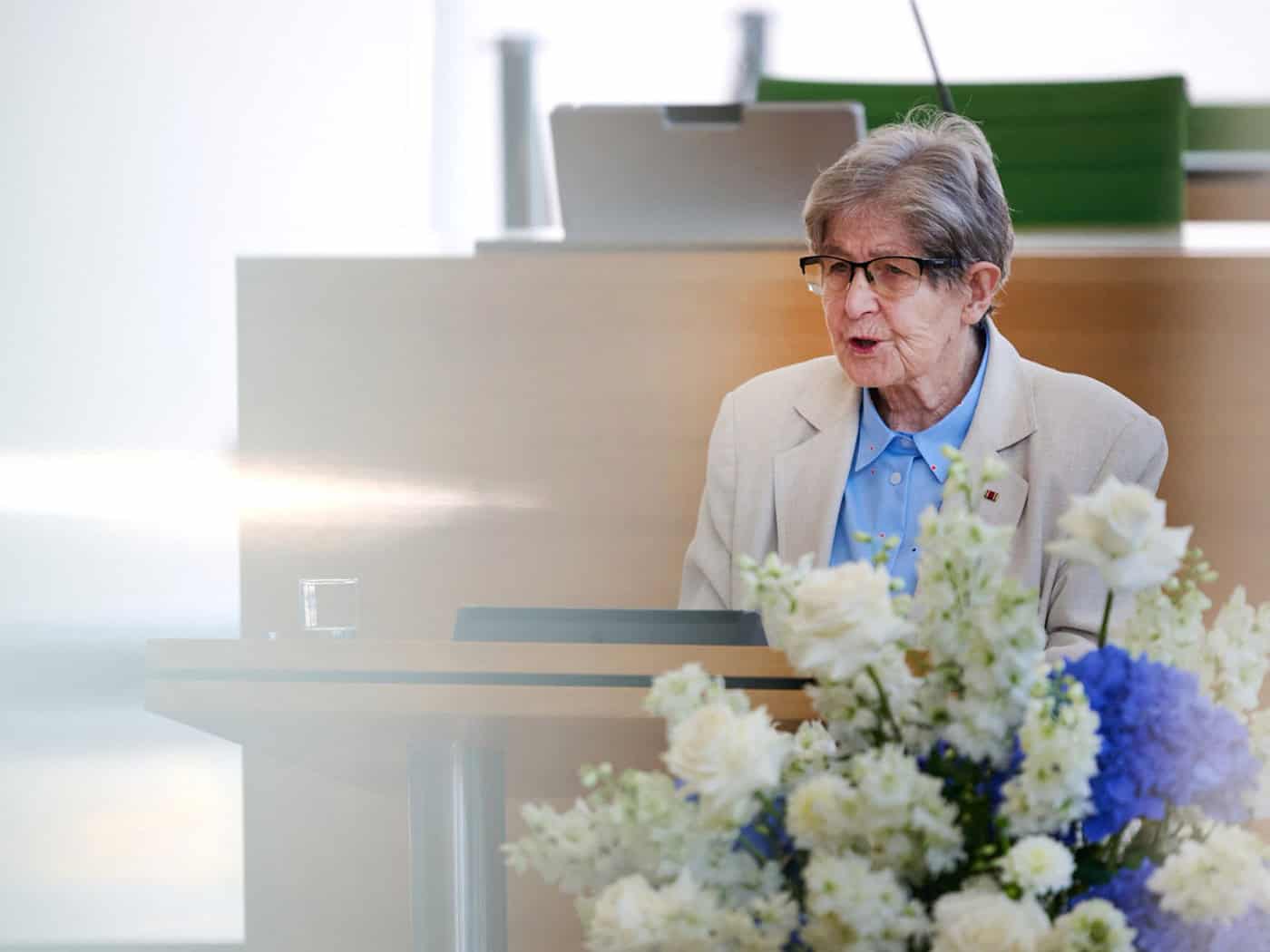
On the occasion of the 100th anniversary of their regional association, the Jewish communities in Saxony have expressed concern about rising anti-Semitism. At a commemorative ceremony in the state parliament, many somber remarks were made. State Parliament President Alexander Dierks was the first to speak. “The scourge of anti-Semitism remains, and it manifests itself in both old and new forms in our state, in Europe, and around the world.” The synagogue in Dresden has had to be renovated in recent years, in part due to increasing security requirements. “We must not limit ourselves solely to discussing the magnitude of our responsibility in light of our terrible past and the fate of Jewish people; rather, we must make Jewish life in the Free State a natural part of our shared reality,” emphasized the CDU politician, concluding: “We should remain vigilant against antisemitism and against all threats to which our open society is otherwise exposed, both internally and externally. And we should not forget to be full of joie de vivre and to celebrate life.” Ekaterina Kulakova, chairwoman of the State Association of Jewish Communities, expressed relief that there had not yet been a single anti-Semitic incident during the current Year of Jewish Culture in Saxony, which features more than 1,000 events— “even though anti-Semitism has risen sharply not only in Saxony or in Germany, but also throughout the world.” Afterward, 91-year-old Holocaust survivor Renate Aris, a native of Dresden, stepped up to the microphone and delivered a moving speech filled with many personal anecdotes. She recalled, for example, that Jews were later forbidden from keeping pets during the Nazi era. “My brother and I had each been given a little rabbit as a gift. Two men came, asked to see the animals, picked them up right in front of us, and with a single blow killed those rabbits. That is what our childish souls had to endure.” “No child should ever have to go through something like that again. No one should ever have to go through something like that again,” said Aris. On February 13, 1945—the day Dresden was destroyed—her father had to go pick up the orders for deportation to the Theresienstadt concentration camp. “We were part of the last transport on February 16, 1945. But that transport could no longer take place.” In fact, the Allied air raids on Dresden had saved the lives of numerous Jews because they were able to go into hiding amid the chaos following the attacks. Aris quoted from a poem by the writer Erich Kästner, who was also born in Dresden. “We hoped. But that hope was presumptuous. As a representative of the younger generation, Katrin Ikhilman addressed the guests at the ceremony. “For many young Jewish men and women today, antisemitism is part of our everyday lives. We encounter it in schools, at universities, in the workplace, and on the street,” said the woman, who is originally from Ukraine. Many in her generation grew up hearing their parents’ and grandparents’ stories about exclusion in the countries of the former Soviet Union. “For a long time, these stories seemed very far removed from our lives. That makes it all the more painful for me when I suddenly experience situations that remind me of those stories of exclusion.” Copyright 2026, dpa (www.dpa.de). All rights reservedDierks: Making Jewish life a natural part of daily life
Holocaust survivor Renate Aris delivers a moving speech
Jews were able to escape deportation after the air raids on Dresden
And reason remained as distant as a star. Those who came after us had quickly forgotten. Those who came after us had learned nothing.” The Jews had hoped back then that the great Erich Kästner was wrong. “Today we know: He was not wrong. We Jews had to experience that painfully after Hamas’s attack on Israel.”Young Jewish Woman Reports on Everyday Exclusion


