

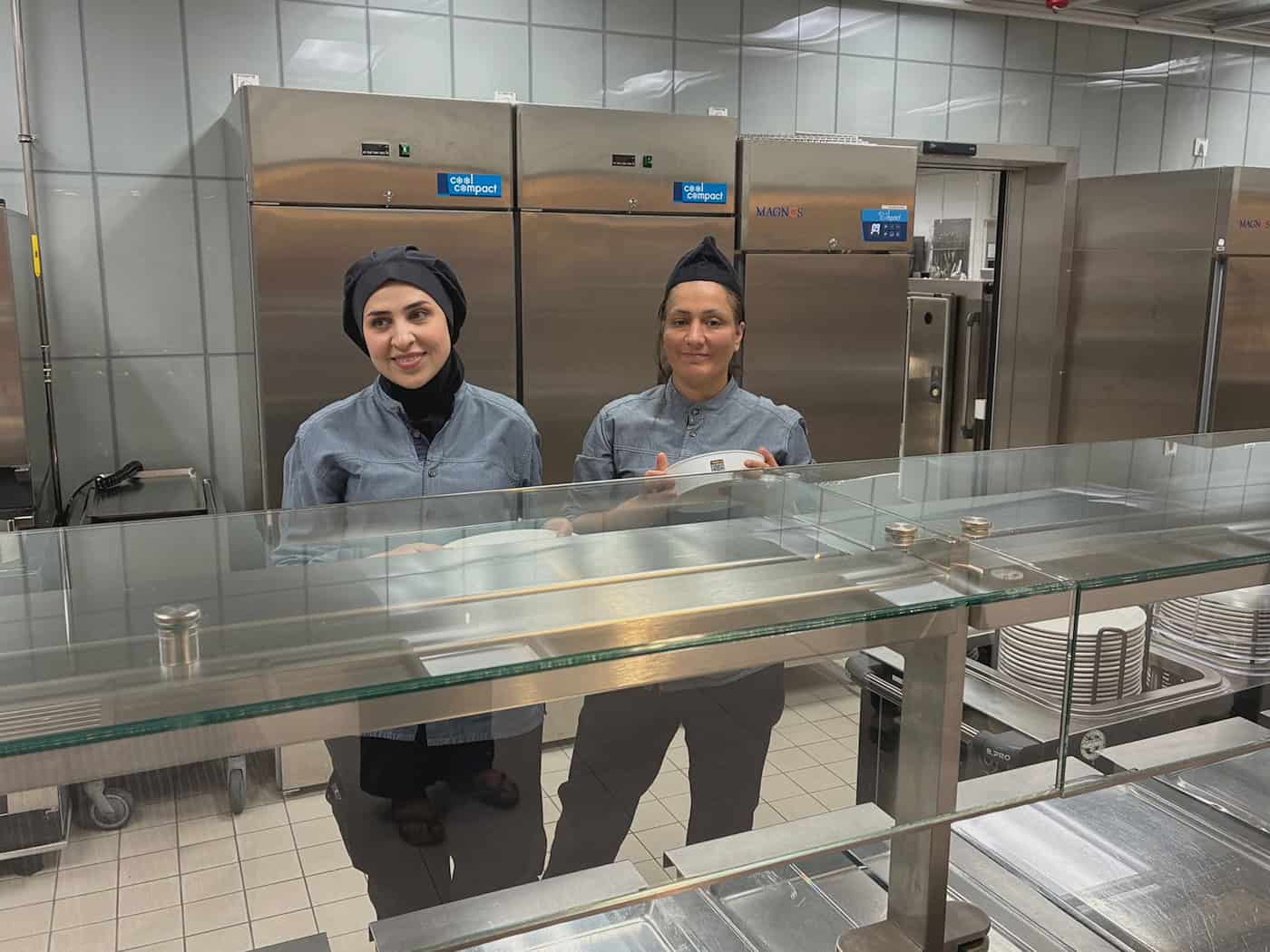
“When I get up early, I’m glad to have a job,” says Zahra Sarwari, beaming from ear to ear. Then she knows she has something to do today. For the past few months, the 39-year-old woman from Afghanistan has been working in the cafeteria at Dresden University of Technology—sometimes serving food, sometimes loading the dishwasher. She currently works four hours a day, but that’s set to increase to six or even eight hours later on. Then she might be able to work in the cafeteria or even as a cook. “I’ve been looking for a job for a long time,” says the mother of three. In her former homeland, women weren’t allowed to work at all. Now she’s part of a team. The German coworkers are “really nice.” “I don’t even feel like I’m a foreigner. I’m a German here, too.” Of course, there are sometimes problems—after all, she’s new. It’s a great feeling to no longer have to rely on benefits from the job center. “I go to my kids and say, ‘This is the money I earned from my job. This is my money.” Together with 13 other women of foreign descent, Zahra Sarwari landed the job through a program run by the Dresden Foreigners’ Council and the Saxon Refugee Council. The program is funded, among others, by the EU and the Federal Ministry of Labor. Eleven women are still participating. “That was a special situation. The Student Services Organization was looking for a lot of new employees all at once,” says Christian Schäfer-Hock, executive director of the Foreigners’ Council. According to Schäfer-Hock, the Foreigners’ Council has been working for years to help women with refugee backgrounds find employment. “That’s hard enough.” But the project with the Studentenwerk gives him hope. “If the employer really wants to, a lot can be achieved.” He often hears excuses. The executive director is convinced that if an organization like the Studentenwerk can pull it off, then others can too. And he makes one more thing clear: “This isn’t a handout; the Studentenwerk expects performance.” Michael Rollberg, managing director of the Studentenwerk, sees it the same way. With 200 employees in campus food services, there’s plenty of room for integration. He recommends—just like Schäfer-Hock and Saxony’s Minister of Social Affairs Petra Köpping (SPD), who is responsible for integration—that the project be replicated. “We need to get to a point where this is seen as something completely normal,” emphasizes Christian Schäfer-Hock. Köpping would like to see more flexibility. On the one hand, it’s important to break down bureaucratic barriers to migrants entering the workforce—and, on the employers’ side, to overcome prejudices as well. Some people think that if migrants don’t have a complete command of the German language, it won’t work out. “We’ve seen today that the best way to learn the language is on the job, when you’re working alongside German employees and are integrated here. That’s when things work out the fastest.” Working in the cafeteria has, not least, broadened the culinary horizons of Zahra Sarwari and her colleagues. Sometimes she doesn’t know the names of the dishes yet and has to ask her German coworkers first, says Rodina Jamaah, who is from Damascus. “I find German food very interesting,” says the young woman, putting it diplomatically. No doubt, one or two of these dishes will find their way onto the dinner table at home in the future. Copyright 2026, dpa (www.dpa.de). All rights reserved“I don’t even realize that I’m a foreigner.”
Finding a job for refugee women is difficult
Call for More Flexibility and Less Bureaucracy


