

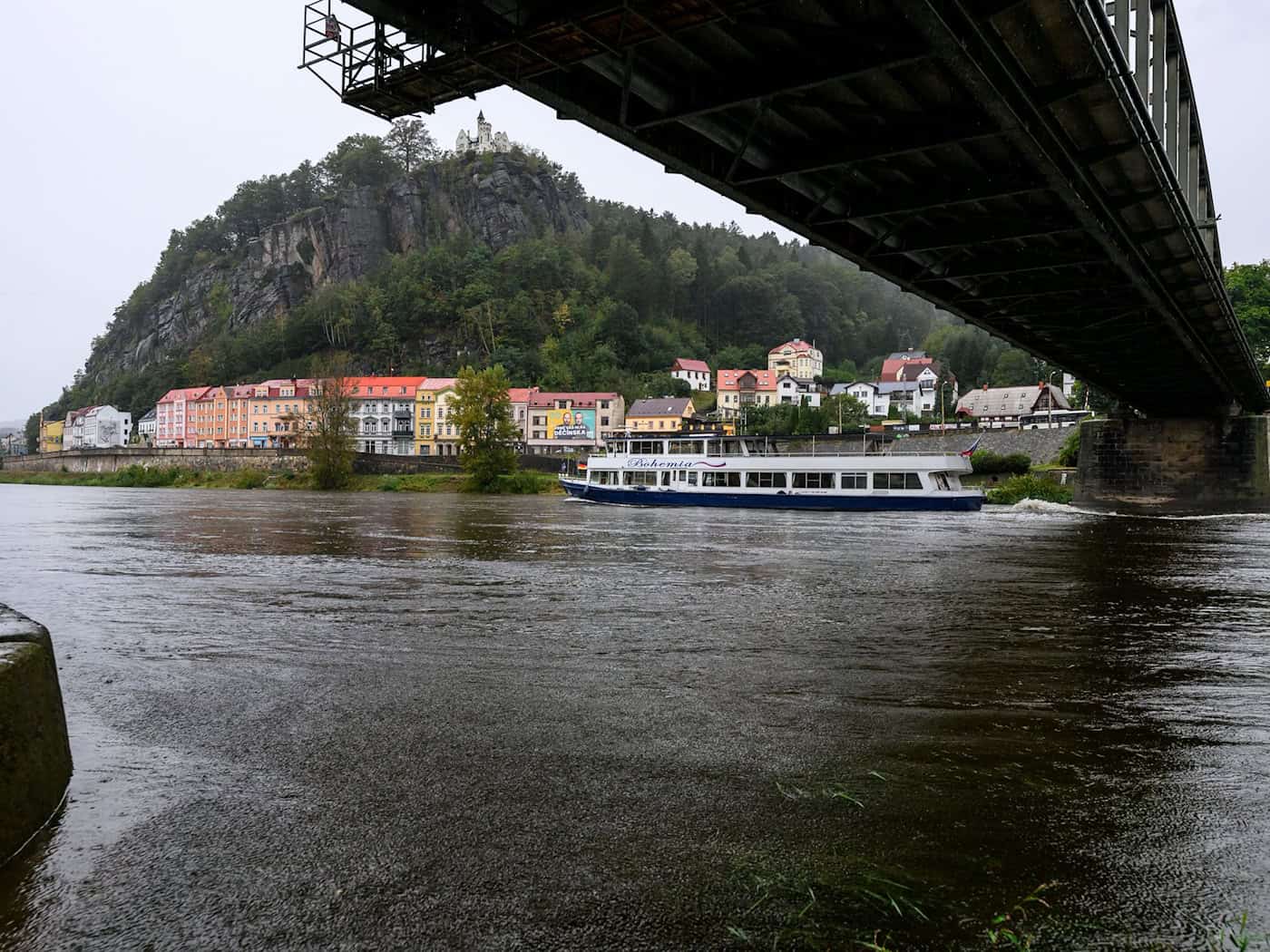
The Saxon government is backing away from its strict opposition to a barrage on the Elbe River near Decin. During a visit by Saxony’s Environment Minister Georg-Ludwig von Breitenbuch (CDU) to the Czech Republic, both sides agreed to “closely monitor the project in the future and reassess its ecological, water management, and transportation impacts based on the updated Czech plans,” the Saxon Ministry of the Environment in Dresden announced. “The planned barrage can improve shipping toward Prague without noticeably impairing conditions for inland waterway shipping on the Saxon side,” State Secretary for the Environment Sören Trillenberg was quoted as saying. Saxony had previously viewed such a barrage very critically. In addition to potential environmental damage, doubts were also raised about its economic benefits. The barrage is intended to increase the navigability of the Elbe. According to the Czech side’s current plans, a depth of 140 centimeters in the navigation channel is to be guaranteed on more than 345 days, and on more than 180 days, the depth is even expected to reach 220 centimeters. The project’s costs were previously estimated at the equivalent of around 175 million euros. Criticism came immediately from the Saxon Greens. What had been a clear “no” had turned into a vague “we’ll look into it,” complained former Environment Minister Wolfram Günther: “This marks a departure from Saxony’s decades-long cross-party and cross-government position. The environmental arguments against the barrage have not changed in the past 20 years.” Günther pointed out that the Elbe is one of Europe’s last free-flowing major rivers, and its sandbars and floodplains are strictly protected Natura 2000 sites. That is precisely why the EU halted a previous attempt in 2018—the damage simply could not be mitigated. Günther’s fellow party member Katja Meier spoke of a “breakthrough.” The barrage was not the only topic discussed at the meeting between Saxony’s Environment Minister and his Czech counterpart Igor Cerveny, as well as Transportation Minister Ivan Bednarik and Agriculture Minister Martin Sebestyan, in Litomerice and Decin. In the Saxon Switzerland and Bohemian Switzerland National Parks, there are plans to deepen cooperation on issues such as visitor management, hiking trails, and species monitoring. In the Ore Mountains, the focus is on stabilizing the black grouse population. “Saxony and the Czech Republic are united by the desire to preserve and sustainably develop the Elbe River basin as a key factor for water supply, nature and species conservation, transportation, and river tourism. We must work together with all stakeholders to wisely balance these respective interests,” emphasized von Breitenbuch. Copyright 2026, dpa (www.dpa.de). All rights reservedRisks to nature, economic benefits controversial
Greens Speak of a “Breach”
Minister: Carefully Balancing Interests


